

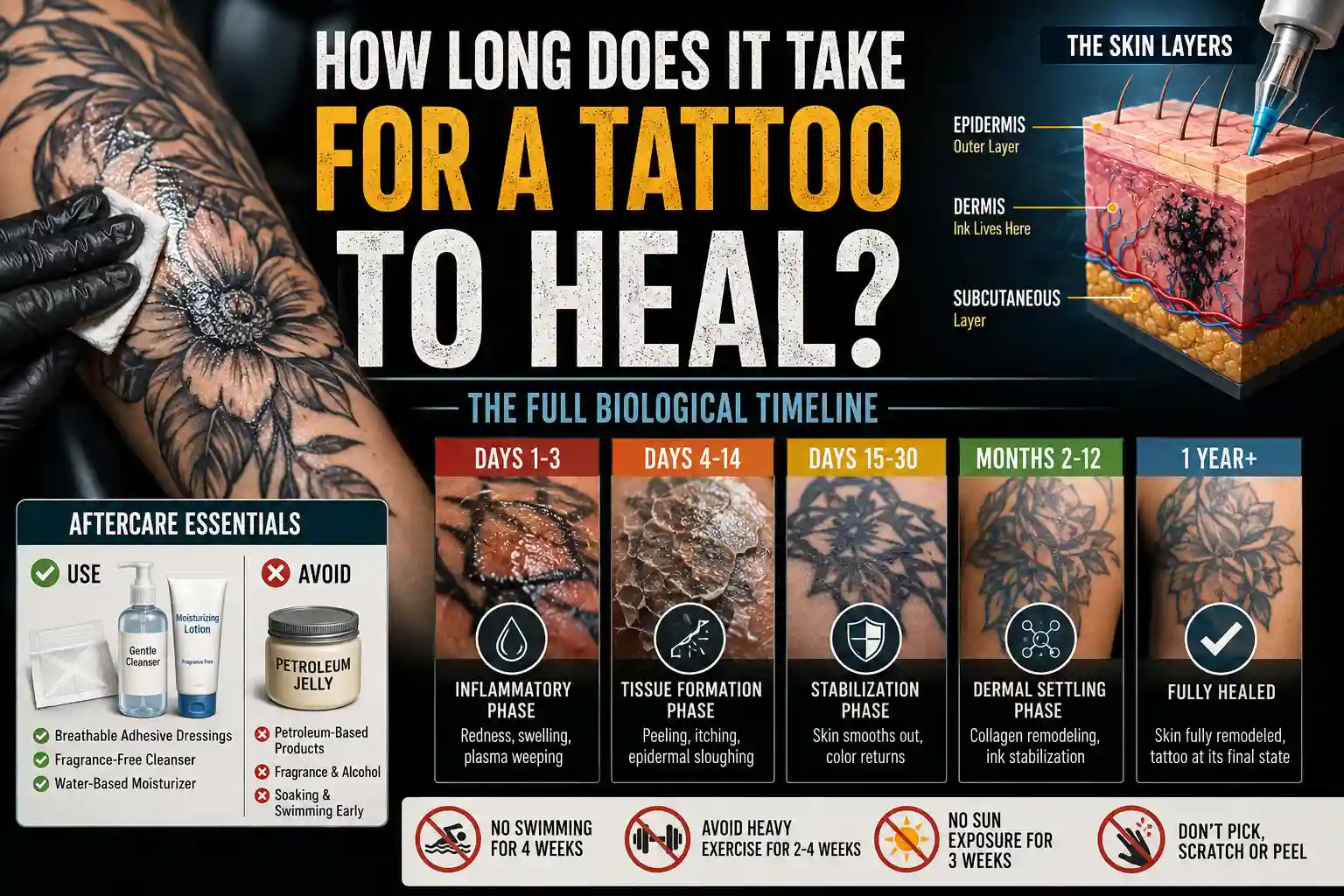
Right now, asking how long does it take for a tattoo to heal, you are not looking for a vague “a few weeks.” You want the real answer the one most tattoo blogs skip entirely.
Here it is: tattooing creates an acute puncture wound across the entire decorated surface area. A professional machine drives a needle bundle 1 to 2 millimeters into the dermis at speeds between 50 and 3,000 punctures per second, depositing pigment beneath the epidermal layer where the immune system will spend months encapsulating it. The wound is real. The healing is also real and it operates on two completely separate biological timelines that most people never learn about.
Understanding this dual-phase reality is the only way to make sense of why your tattoo looks healed at four weeks but your artist is still telling you to stay out of the ocean at eight.
What a Tattoo Actually Does to Your Skin: The Wound Biology Driving Every Healing Phase
A fresh tattoo is a controlled puncture wound. Thousands of micro-injuries in the epidermis and upper dermis trigger an immediate inflammatory cascade: blood vessels dilate, white blood cells flood the area, and the body begins active tissue repair within minutes of the needle leaving the skin. This process takes 2 to 4 weeks at the surface, and 3 to 12 months at the sub-dermal level two timelines that operate simultaneously but at completely different biological depths.
The Epidermis vs. the Dermis: Why Ink Lives in the Second Layer
The skin has two primary structural layers relevant to tattooing. The epidermis the outermost barrier is approximately 0.5 mm thick and sheds continuously. Ink deposited here would disappear within weeks as cells turn over. This is why tattoo needles target the dermis, the layer beneath, which is denser, more stable, and does not slough off.
The dermis is where ink becomes permanent. Pigment particles, too large to be expelled by the body, are surrounded and stabilized by collagen-producing fibroblasts. The American Academy of Dermatology classifies tattooing as a wound that breaches the epidermal barrier and deposits foreign material into dermal tissue a classification with direct implications for aftercare standards and infection risk.
Plasma Weeping, Redness, and Swelling: Your Immune System at Work
In the first 24 to 72 hours, a new tattoo weeps a clear-to-yellowish fluid. This is plasma the liquid component of blood, containing proteins, clotting factors, and immune cells and its presence alarms every first-time recipient who mistakes it for “ink leaking out.” It is not. Plasma weeping is the opening phase of the inflammatory response.
Alongside the plasma, redness, warmth, and mild swelling are universal. These are the four classical signs of acute inflammation rubor, calor, tumor, and dolor all operating exactly as they should. The skin is not infected; it is building.
How Macrophages and Fibroblasts Make Tattoos Permanent
Two cell types determine whether a tattoo stays sharp or fades prematurely. Fibroblasts synthesize collagen around ink particles, creating a fibrous net that immobilizes pigment in the dermis. Macrophages part of the innate immune system continually ingest ink particles over a person’s lifetime, but when they die, daughter macrophages absorb the released pigment and re-deposit it nearby.
This is the mechanism behind gradual fading: slow, net pigment loss at cellular turnover boundaries across decades, not washing away in the shower. Research published in the Journal of Cutaneous Medicine and Surgery confirms that macrophage activity is the primary driver of long-term tattoo clarity, which is why sun protection and skin hydration after healing matter far beyond the initial aftercare window.
From Vaseline to Second Skin: How Tattoo Aftercare Science Evolved Over 40 Years
Before approximately 2010, petroleum-based products were the near-universal aftercare standard in North American tattoo studios. Artists routinely sent clients home with instructions to apply raw Vaseline or petroleum jelly multiple times daily. This protocol was not evidence-based it was a folk convention that persisted for decades despite causing measurable harm.
Breathable adhesive dressings Saniderm, Tegaderm, and Dermalize Pro entered widespread studio use between 2012 and 2016. Their adoption changed the biological outcome of the first 72 hours of healing in ways that older petroleum-based approaches never could.
Why the Petroleum Jelly Standard Was Scientifically Flawed
Petroleum-based products create an anaerobic (oxygen-deprived), heat-retaining seal over the wound surface. This environment impedes fibroblast activity fibroblasts require oxygen for collagen synthesis and creates conditions favorable to bacterial overgrowth, including Staphylococcus aureus (MRSA). Vaseline is also comedogenic, meaning it blocks pores, trapping bacteria and cellular debris against an open wound.
The practical consequences: extended plasma weeping, higher rates of early scabbing, and in compromised cases, localized infection. For a wound that needs breathable moisture retention, not occlusive heat, petroleum jelly is precisely the wrong tool.
Saniderm, Tegaderm, and Dermalize Pro: What Breathable Adhesives Actually Do
These three products are all variants of polyurethane breathable medical film the same class of dressing used in post-surgical wound management. Applied within a few hours of completing the tattoo, they:
- Retain moisture at the wound surface, reducing plasma weeping from 48–72 hours to as little as 12–18 hours.
- Prevent external contamination, eliminating bacteria from clothing, bedding, and environmental contact.
- Allow gas exchange, so the epidermis can breathe while remaining protected.
- Reduce scabbing by maintaining a moist healing environment that prevents the dehydration that causes thick scab formation.
Standard application protocol: wear the initial dressing for 24–72 hours, remove carefully in the shower with warm water, apply a second piece for an additional 3–5 days if desired, then transition to a water-based moisturizer.
Water-Based vs. Petroleum-Based Moisturizers: The Ingredient Checklist
Once the dressing phase ends, moisturization is the primary aftercare variable. The CDC wound care guidelines for open wound management specify moisture-retentive, non-occluding products a category that excludes petroleum jelly and aligns with water-based formulations.
Products that meet dermatological criteria for tattoo aftercare:
| Product | Non-Comedogenic | Fragrance-Free | Water-Based | Alcohol-Free |
| Cetaphil Moisturizing Lotion | Yes | Yes | Yes | Yes |
| Eucerin Original Healing | Yes | Yes | Yes | Yes |
| Dove Sensitive Skin Unscented | Yes | Yes | Yes | Yes |
| Hustle Butter Deluxe | Yes | Yes | No (shea-based) | Yes |
| Raw Vaseline | No | Yes | No | Yes |
Hustle Butter, despite being shea-butter-based rather than strictly water-based, has a lighter molecular structure than petroleum jelly and does not occlude in the same way but standard water-based lotions remain the most consistently recommended option by dermatologists for the tissue formation and stabilization phases.
Avoid: anything with fragrance, alcohol, lactic acid (a keratolytic agent that accelerates skin shedding actively counterproductive during healing), glycolic acid, or retinols.
How Long Does It Take for a Tattoo to Heal: A Precise Day-by-Day and Month-by-Month Roadmap
How long does it take for a tattoo to heal depends on which layer of the skin you are measuring. The complete tattoo healing timeline runs from the moment the needle leaves the skin through a full year of sub-dermal activity. Here is the chronological breakdown by phase.
Days 1–3: The Inflammatory Phase
What is happening: The wound is open. Plasma weeps continuously. The surface appears shiny, slightly raised, and inflamed. Redness and warmth radiate 1–2 centimeters beyond the tattooed border. Ink may appear to bleed slightly into surrounding tissue this is normal localized migration and not a sign of blowout.
What to do: Keep the area clean with fragrance-free, non-antibacterial soap. Do not submerge. If using a breathable adhesive dressing, leave it intact. Do not touch the tattoo with unwashed hands under any circumstances.
What is not normal: Green or yellow pus (not plasma), red streaking extending beyond the tattoo border, fever above 38°C (100.4°F), or significant swelling of the surrounding limb. These indicate bacterial infection requiring medical evaluation.
Days 4–14: The Tissue Formation Phase (Peeling and Itching)
What is happening: The epidermis begins epidermal sloughing the tattooed outer skin cells die and flake away in a process nearly identical to a sunburn peel. The tattoo will appear cloudy, dull, or faded during this period. This cloudiness is not pigment loss; it is the opaque layer of dead skin cells sitting above the ink.
The itching during this phase is intense and nearly universal. Scratching ruptures the healing skin and can pull ink-saturated scab tissue away from the dermis, creating permanent light patches in the finished tattoo. Do not scratch. Press with a clean palm if the urge is unbearable.
What to expect: Small flakes of skin with visible color in them this is normal epidermal sloughing of superficial pigment, not the dermal ink being lost. The tattoo will regain clarity once the dead layer clears.
Days 15–30: The Stabilization Phase
What is happening: The skin surface smooths out. Peeling stops. The tattoo regains color saturation and sharpness. A healthy healed surface in this phase looks matte-smooth with no raised texture, no visible flaking, and consistent color across the design.
Some people see a “milky” or slightly hazy quality in weeks 3–4. This is sub-dermal lymphatic and cellular activity the body processing the inflammatory debris below the surface and resolves completely. It is not a sign of fading or poor ink retention.
Common mistake: Concluding the tattoo is “healed” and resuming all normal activities. The surface is healed. The dermis is not.
Months 2–12: Sub-Surface Dermal Settling
This is the phase no mainstream tattoo content covers. For three to twelve months after the surface appears fully healed, the dermis continues active collagen remodeling around ink deposits. Fibroblasts reorganize the collagen matrix; the tissue settles from an acutely wounded state into stable, chronic foreign-body encapsulation of the pigment.
During this period:
- The tattoo may continue to sharpen as the tissue swelling fully resolves.
- Colors particularly whites, light greys, and yellows may shift slightly in tone as the optical properties of the overlying skin stabilize.
- Trauma to the area (sunburn, abrasion, or retattooing) during this window causes disproportionate damage compared to fully remodeled skin.
This is the biological reason professional artists typically recommend waiting a full year before scheduling a touch-up on a detailed piece.
Read More: How to Wash Wool Sweater
Six Factors That Make Every Tattoo’s Healing Timeline Different
The standard roadmap describes average healing, but how long does it take for a tattoo to heal. Can vary dramatically depending on tattoo style, placement, age, immune function, and aftercare habits. Individual timelines vary by up to 100% depending on the following variables which is why two people with comparable tattoos in the same studio can have completely different healing experiences.
Tattoo Style and Ink Density: Fine Line vs. Heavy Blackwork
Fine-line tattoos single-needle work, delicate linework, minimal shading cause substantially less dermal trauma than heavy blackwork, solid color fills, or Japanese traditional work. Fewer needle passes mean less tissue disruption, shallower ink saturation depth, and a reduced inflammatory response.
| Style | Needle Passes | Dermal Trauma Level | Epidermal Healing |
| Fine line / Single needle | Low | Minimal | 10–14 days |
| Black and grey realism | Medium | Moderate | 2–3 weeks |
| Traditional color / Neo-trad | Medium-High | Moderate-High | 3–4 weeks |
| Heavy blackwork / Solid fill | High | Significant | 4–6 weeks |
| Large color realism | Very High | Severe | 5–7 weeks |
A heavily color-packed sleeve covering large muscle groups takes weeks longer at every phase than a minimalist fine-line piece on the same client.
Placement Friction: High-Movement and High-Friction Zones
Tattoos on joints and friction zones take longer because the mechanical forces of daily movement disrupt the healing tissue continuously. The highest-friction placements:
- Hands and fingers: Constant movement, washing, and contact. Peeling is prolonged; ink retention is lower long-term.
- Inner elbows and backs of knees: Flexion repeatedly stretches and compresses the healing wound.
- Feet and ankles: Enclosed in footwear for most of the day; moisture and friction compound.
- Ribcage: Respiratory movement cycles continuously across the healing surface.
Flat placements on the outer forearm, upper arm, thigh, and back consistently show the fastest, most consistent healing profiles.
Age, Immune Function, and Skin Type as Healing Determinants
The skin’s cell turnover rate slows with age. A 20-year-old’s epidermis renews in approximately 28 days; at 50, the same cycle takes closer to 45–50 days. This directly extends every phase of the tattoo healing timeline. Conditions that compromise immune function autoimmune diseases, diabetes, or immunosuppressant medications extend healing further and increase infection risk.
Skin type also matters. Dry skin is slower to rebuild the epidermal barrier and requires more active moisturization. Oily skin has higher baseline sebum production, which can occlude the wound during early healing if heavy creams are applied.
How Long Does It Take for a Tattoo to Heal Enough to Swim, Train, and Sunbathe?
How long does it take for a tattoo to heal to a level where the epidermal barrier is fully intact and safe for re-exposure to environmental stressors? The minimum thresholds below are conservative for good reason: each activity carries a distinct risk mechanism against a wound that looks finished but is not.
Swimming and Ocean Exposure: The 4-Week Minimum
Minimum wait time: 4 weeks.
When people ask how long does it take for a tattoo to heal before swimming, the safest evidence-based answer is a minimum of four weeks for complete epidermal barrier recovery. Fresh water, ocean water, and pool water all carry bacterial loads that penetrate an incompletely healed epidermal barrier. Chlorine in pools is not a sufficient antiseptic it is a sanitizer calibrated for full-barrier skin, not open wound tissue. Ocean water introduces Vibrio bacteria, which have caused serious skin infections in immunocompetent individuals with minor epidermal disruptions.
The reason the minimum is 4 weeks rather than 2: even if the surface appears healed by week 2–3, microscopic channels in the epidermis remain until the barrier fully closes, typically between days 28 and 35 in healthy adults.
Exercise and Sweat: Two Distinct Risk Vectors
Minimum wait time: 2–3 weeks for light exercise; 4 weeks for contact sports or heavy barbell training.
Exercise introduces two separate problems. The first is sweat: sodium-rich sweat is irritating to healing tissue and alters the pH of the wound surface, slowing keratinocyte migration. The second is mechanical: weightlifting and contact sports produce skin stretching, friction, and impact over the tattooed area all of which disrupt the stabilization phase and can cause ink migration or pigment loss.
Light walking and low-impact cardio carry minimal risk after 2 weeks if the tattoo is not in a friction zone. Bench pressing with a healing chest tattoo is a different matter entirely.
Sun Exposure: UV Penetration Reaches the Dermis
Minimum wait time: 3 weeks before any sun exposure; SPF 50+ for life after that.
UV-A radiation penetrates to the dermal layer. During active healing, UV exposure degrades the collagen matrix being rebuilt around ink deposits directly undermining the biological process that makes a tattoo permanent. After healing completes, UV-A drives photo-oxidation of organic pigment compounds, which is the primary mechanism of long-term tattoo color degradation.
Infection Red Flags vs. Normal Healing: A Diagnostic Reference
| Symptom | Normal Healing | Medical Emergency |
| Redness | Fades within 72 hours | Persists or spreads after day 5 |
| Warmth | Localized to tattoo area | Radiating, with red streaking |
| Discharge | Clear/light yellow plasma | Green, thick, or foul-smelling pus |
| Swelling | Mild, at wound site only | Spreading to surrounding limb |
| Fever | None | Above 38°C (100.4°F) |
| Odor | None or faintly metallic | Strong, unpleasant |
Red streaking extending from the tattoo called lymphangitis is a medical emergency. It means bacteria have entered the lymphatic system. Go directly to an emergency room; do not call your tattoo artist first.
Conclusion
Understanding how long does it take for a tattoo to heal in full—not just at the surface but at the dermal level—changes every aftercare decision you make. The surface healing in 2 to 4 weeks and the sub-surface cellular remodeling running through month 12 are not sequential phases; they overlap, each requiring a different standard of care.
The six non-negotiable rules for the healing period:
- Keep the wound clean with fragrance-free soap twice daily.
- Moisturize with a non-comedogenic, water-based lotion 2–3 times daily.
- Never apply petroleum-based products to a healing tattoo.
- No submersion in any water source for a minimum of 4 weeks.
- No direct sun exposure for 3 weeks; SPF 50+ protection indefinitely after that.
- Do not pick, scratch, or peel the skin under any circumstances.
Beyond the healing window, the dermal processes that make your tattoo permanent continue for the rest of your life. The macrophages working continuously to stabilize your ink respond, for better or worse, to every sunburn, every dry-skin winter, every unprotected summer. Learning how long does it take for a tattoo to heal is the beginning of understanding what your skin is actually doing and why taking care of it is not a short-term obligation but a permanent one.
