

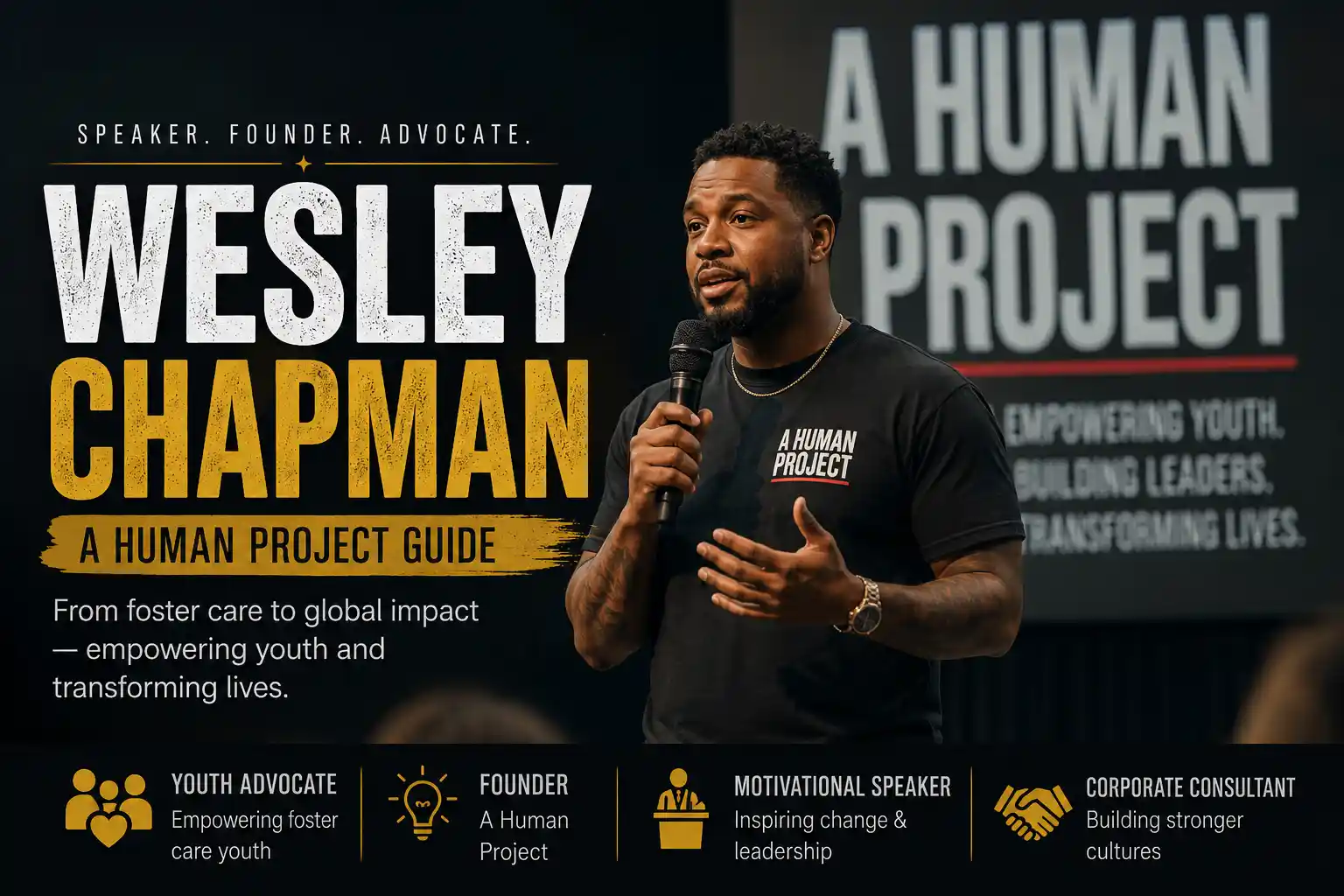
Wesley Chapman is not a life coach in any conventional sense of the term. The framework he built emerged specifically from the failure of conventional frameworks to address his own experience and that distinction matters more than it might initially appear.
Raised in the foster care system, Chapman developed what he calls human asset optimization as a direct response to what he documents as the gap between institutional care and genuine psychological recovery. Most pages about him retell the biographical outline. This one explains the actual structure of what he built, how it works across two distinct professional contexts, and why searches for his name keep surfacing results about an entirely different Chapman family.
That last part is worth addressing directly. Wesley Chapman, the youth advocate and corporate speaker, is not related to Beth Chapman, the late wife of television personality Dog the Bounty Hunter. The search confusion is real, it is pervasive, and it has distorted the information landscape around him for years.
From Foster Care to Framework: What Wesley Chapman’s Work Actually Involves
Wesley Chapman is the founder of A Human Project, an advocacy and educational organization built around what he calls human asset optimization. His framework targets the root psychological architecture of identity rather than behavioral symptoms. He operates across two primary contexts: youth development programs for foster care alumni and corporate culture consulting for organizational leaders.
This matters as a starting point because almost every existing profile of Chapman collapses these two activities into one blurred identity “motivational speaker” which misrepresents both of them.
The Youth advocacy work and the corporate consulting work are structurally connected by the same underlying methodology, but they serve different audiences, operate on different funding models, and produce different deliverables. Understanding Chapman requires holding both simultaneously.
The Core Premise of Human Asset Optimization
Chapman defines human asset optimization as a process that identifies and develops latent behavioral strengths in individuals whose psychological infrastructure systemic or environmental trauma has disrupted.
The word “optimization” is deliberate. Chapman’s position is that people who have experienced significant early-life disruption abuse, neglect, multiple foster placements, institutional instability do not need to be “fixed.” Their baseline architecture is intact. What has been damaged is the access layer: the learned capacity to recognize, trust, and deploy their own capabilities.
This is a materially different claim than what standard motivational coaching makes. Standard coaching typically targets behavior modification. Chapman’s framework targets the cognitive and emotional infrastructure that behavior emerges from.
How A Human Project Fits Into Youth Advocacy
A Human Project operates as Chapman’s organizational vehicle for delivering this framework to foster youth specifically. The organization runs programs designed around experiential learning structured experiences that produce identity-level insight rather than information transfer.
The distinction from standard therapy programs is explicit in how Chapman describes his own history with them. He has documented, across various speaking engagements and published interviews, that traditional reactive prescriptions therapy sessions triggered by behavioral incidents rather than proactive identity development consistently failed to address the underlying architecture of his own experience in the foster care system.
A Human Project was built as a structural alternative to that reactive model.
Growing Up in the System: The Biographical Timeline That Built the Method
Chapman’s professional framework did not begin as an intellectual exercise. It began as a survival response. Understanding this connection between his personal history and his methodology is not optional background it is the load-bearing structure of everything he built afterward.
He spent significant portions of his childhood moving through the United States foster care system, experiencing the institutional patterns that characterize that system at its worst: placement instability, reactive behavioral management, and the consistent prioritization of compliance over identity development.
The Formative Years and What They Documented
Chapman has been publicly detailed about the specific failure patterns he experienced. Across Forbes profiles, IMDb-catalogued media appearances, and LinkedIn-published essays, the consistent theme is not victimhood it is documentation.
His narrative frames his childhood not as something to recover from but as data. He observed, from inside the system, exactly which interventions produced no durable change and exactly which experiences produced genuine psychological shift. That observation set the intellectual architecture for what became the A Human Project methodology.
This is why the phrase “lived experience” applies to Chapman in a technically precise way, not just a rhetorical one. His claim to expertise is not academic credentialing it is direct observation of the system he later built an alternative to.
The Founding of A Human Project
A Human Project was established as a formal organization to scale what Chapman had been doing informally applying his experiential framework to youth populations navigating the foster care context.
The organization’s mission is stated around a specific premise: that every person has inherent assets cognitive, emotional, relational that systemic environments can suppress but cannot eliminate. The program methodology is built to surface those assets through structured experiential processes rather than clinical intervention.
The founding represented Chapman’s transition from personal narrative to institutional infrastructure. He was no longer just someone who had survived the system. He was building a documented alternative to it.
Inside Wesley Chapman’s Framework The Four Pillars and How They Function
Wesley Chapman’s methodology is organized around four documented pillars that form the structural spine of both his youth advocacy work and his corporate consulting practice. These pillars are not motivational categories they are sequential operational stages in the identity reconfiguration process.
Understanding them as a sequence matters. Each pillar presupposes the work of the one before it.
The Four Pillars: Sequence and Function
| Pillar | Core Function | Application in Youth Context | Application in Corporate Context |
| Identity Recognition | Establishing a factual, non-narrative account of who the person is capabilities, patterns, instincts | Foster youth identify strengths obscured by systemic labeling | Employees identify capabilities the organizational culture has suppressed |
| Asset Mapping | Cataloguing specific behavioral and cognitive assets without evaluating them as good or bad | Building a personal inventory outside the foster care record | Mapping human capital that standard performance reviews miss |
| Infrastructure Alignment | Restructuring how those assets connect to daily decision-making and behavioral output | Translating asset map into daily behavioral commitments | Aligning individual asset maps with team and organizational structure |
| Optimization Deployment | Operating from the aligned architecture under real conditions not rehearsal environments | Youth entering adulthood with a functional self-model | Leaders and teams operating from accurate human data rather than performance theater |
Identity Reconfiguration: The First Pillar in Depth
Identity reconfiguration, the foundational stage, is the most frequently misunderstood element of Chapman’s work. It is not a therapeutic re-labeling of past events. It is a structured process of separating what happened from who the person is.
For foster youth, this separation is non-trivial. The foster care system generates extensive documentation about young people case files, behavioral records, placement histories that functions, functionally, as an externally authored identity. A child defined by their case file has no clean access to a self-model that precedes that documentation.
Chapman’s first-pillar work is designed to create that access point. Not by ignoring the case file, but by building a parallel, self-authored account of demonstrated capabilities that exists independently of it.
In corporate contexts, the same dynamic appears in a different form: employees defined entirely by job titles, performance scores, and managerial assessments carry a similarly externally authored self-model. The first pillar works identically in both environments.
The Corporate Pivot How a Youth Advocacy Framework Became a Business Consulting Model
The move from youth advocacy to corporate consulting was not a departure from Chapman’s framework. It was the direct application of the same intellectual architecture to a different population that presented the same underlying problem.
Chapman’s documented position is that organizational dysfunction poor communication, low trust, high turnover, leadership failure is fundamentally a human infrastructure problem, not a process problem. Companies invest heavily in systems optimization while leaving the human asset layer the actual people operating those systems structurally misaligned.
The Structural Parallels Between Foster Youth and Corporate Dysfunction
This is where Chapman’s framework becomes genuinely interesting, and where it diverges most sharply from standard corporate consulting models.
| Problem Domain | Traditional Consulting Approach | Chapman’s Behavioral Infrastructure Model |
| Employee disengagement | Incentive restructuring, process audits, management training | Human asset mapping at individual level; alignment between personal capabilities and role architecture |
| Leadership communication failure | Communication skills training, 360 feedback tools | Identity-level analysis of how leaders self-model; reconfiguring the self-concept that drives communication behavior |
| High turnover | Compensation benchmarking, exit interview analysis | Infrastructure misalignment diagnosis identifying where the organizational environment suppresses human assets rather than activating them |
| Cultural dysfunction | Culture surveys, value statements, DEI initiatives | Behavioral infrastructure audit mapping the actual human dynamics operating beneath the stated culture |
The argument is not that process tools are useless. It is that they produce no durable change when the human infrastructure layer is misaligned, because people consistently operate from their actual self-model rather than the model the training program assumes they have.
What a Chapman Corporate Engagement Involves
Chapman’s corporate consulting practice involves keynote speaking at leadership summits and entrepreneurial masterminds, but also structured organizational consulting engagements. The speaking work introduces the framework. The consulting work implements it.
His documented corporate speaking history catalogued across LinkedIn activity, podcast interviews, and conference records spans leadership development programs, executive performance forums, and organizational culture initiatives at the mid-to-large enterprise level.
The consulting model applies the same four-pillar sequence that A Human Project uses with youth populations, adapted for an organizational rather than individual scale. The diagnostic phase maps the human asset landscape of the organization. The alignment phase restructures how those assets connect to operational roles. The deployment phase builds measurement infrastructure to track whether the alignment is producing behavioral change.
Wesley Chapman’s Media Footprint and the Disambiguation Problem
The most persistent obstacle to understanding Wesley Chapman’s actual work is a search contamination problem that no existing information page has addressed directly.
When someone searches “Chapman family” or “Beth Chapman” alongside “Wesley Chapman,” they surface a completely separate identity ecosystem the Chapman family from the A&E reality television franchise Dog the Bounty Hunter, which featured Duane “Dog” Chapman, his late wife Beth Chapman, and their daughter Lyssa Chapman. Georgina Chapman, the British fashion designer and former wife of Harvey Weinstein, introduces a third unrelated identity into the same search space.
None of these individuals are connected to Wesley Chapman, the youth advocate and corporate speaker. The surname coincidence alone is responsible for significant search noise and reader confusion.
Documented Media Appearances: What Exists and Where
Wesley Chapman’s media footprint is real and substantive, though it is distributed across formats rather than concentrated in a single high-profile venue.
His documented appearances include:
- Podcast circuit: Multiple appearances on business growth, mental health, and youth advocacy podcasts, primarily in the entrepreneurial and personal development categories
- Forbes coverage: Profile-level coverage in entrepreneurial and social impact contexts
- IMDb listings: Catalogued media appearances across documentary and interview formats
- LinkedIn: An active publishing and professional networking presence, where Chapman has published long-form essays on human asset optimization and organizational behavior
- Conference speaking: Documented speaking engagements at leadership summits, entrepreneurial masterminds, and youth advocacy conferences
The distribution of this footprint across audio, video, written, and professional networking formats is itself a strategic choice Chapman’s methodology depends on direct communication style rather than institutional credentialing, so the media presence skews toward formats that transmit voice and presence rather than just credentials.
Wesley Chapman vs. the Chapman Television Family: A Direct Disambiguation
For anyone who has landed on this page after a confusing search experience, here is the direct clarification:
| Name | Who They Are | Connection to Wesley Chapman |
| Wesley Chapman | Youth advocate, founder of A Human Project, corporate speaker | The subject of this article |
| Beth Chapman | Late wife of Duane “Dog” Chapman; appeared on Dog the Bounty Hunter; died June 2019 | No connection different family entirely |
| Lyssa Chapman | Daughter of Duane Chapman; reality TV personality | No connection different family entirely |
| Duane “Dog” Chapman | Bounty hunter, reality TV personality | No connection different family entirely |
| Georgina Chapman | British fashion designer; former wife of Harvey Weinstein | No connection different family entirely |
The search confusion is generated entirely by surname coincidence and Google’s entity association patterns. It does not reflect any biographical, professional, or familial relationship.
Wesley Chapman Frequently Asked Questions
What is Wesley Chapman’s net worth?
Wesley Chapman’s net worth is not publicly documented through verified financial disclosures. As a speaker, consultant, and nonprofit founder operating primarily in private sector and advocacy contexts, his financial details are not subject to public reporting requirements. Estimates circulating online are unverified and should be treated as speculative.
How old is Wesley Chapman and where is he from?
Wesley Chapman’s exact birth year is not consistently documented across public sources. He grew up in the United States foster care system, and his biography does not center on a fixed geographic origin the nature of foster care placement means he moved through multiple locations during his childhood.
What are the four pillars of Wesley Chapman’s framework?
The four pillars are Identity Recognition, Asset Mapping, Infrastructure Alignment, and Optimization Deployment. They function as a sequential process each stage builds on the previous one and apply identically across both his youth advocacy programs and his corporate consulting practice.
Is Wesley Chapman related to Beth Chapman from Dog the Bounty Hunter?
No. Wesley Chapman, the founder of A Human Project and corporate speaker, has no familial or professional connection to Beth Chapman, Lyssa Chapman, Duane “Dog” Chapman, or Georgina Chapman. The shared surname is coincidental.
What did Wesley Chapman write is he an author?
Wesley Chapman has published long-form written content across LinkedIn and various online platforms. His authorship catalog in the traditional book sense is not comprehensively documented in public records, but his written intellectual output essays on human asset optimization and organizational behavior is accessible through his digital publishing activity.
What does Wesley Chapman do currently is A Human Project still active?
As of the most recent documented activity, Wesley Chapman continues to operate across both his youth advocacy and corporate consulting tracks. His LinkedIn presence and podcast appearances show ongoing activity. A Human Project continues to be referenced as his primary organizational vehicle for youth-facing work.
Conclusion
Wesley Chapman built something that is genuinely harder to describe than it looks, which is probably why so many pages about him default to “motivational speaker” and stop there. The actual structure a four-pillar identity framework applied simultaneously to foster youth and corporate leaders, grounded in the specific observation that both populations carry suppressed human assets rather than absent ones is a precise intellectual architecture, not an inspirational brand.
What makes Wesley Chapman’s work worth understanding in detail is not his personal story, though that story is the origin of everything. It is the fact that he translated that story into a documented, replicable methodology with a coherent theoretical basis. The foster care experience did not produce the framework by accident. It produced it because Chapman treated his own survival as a data set and built the methodology from what the data showed.
That is the part worth paying attention to.
