

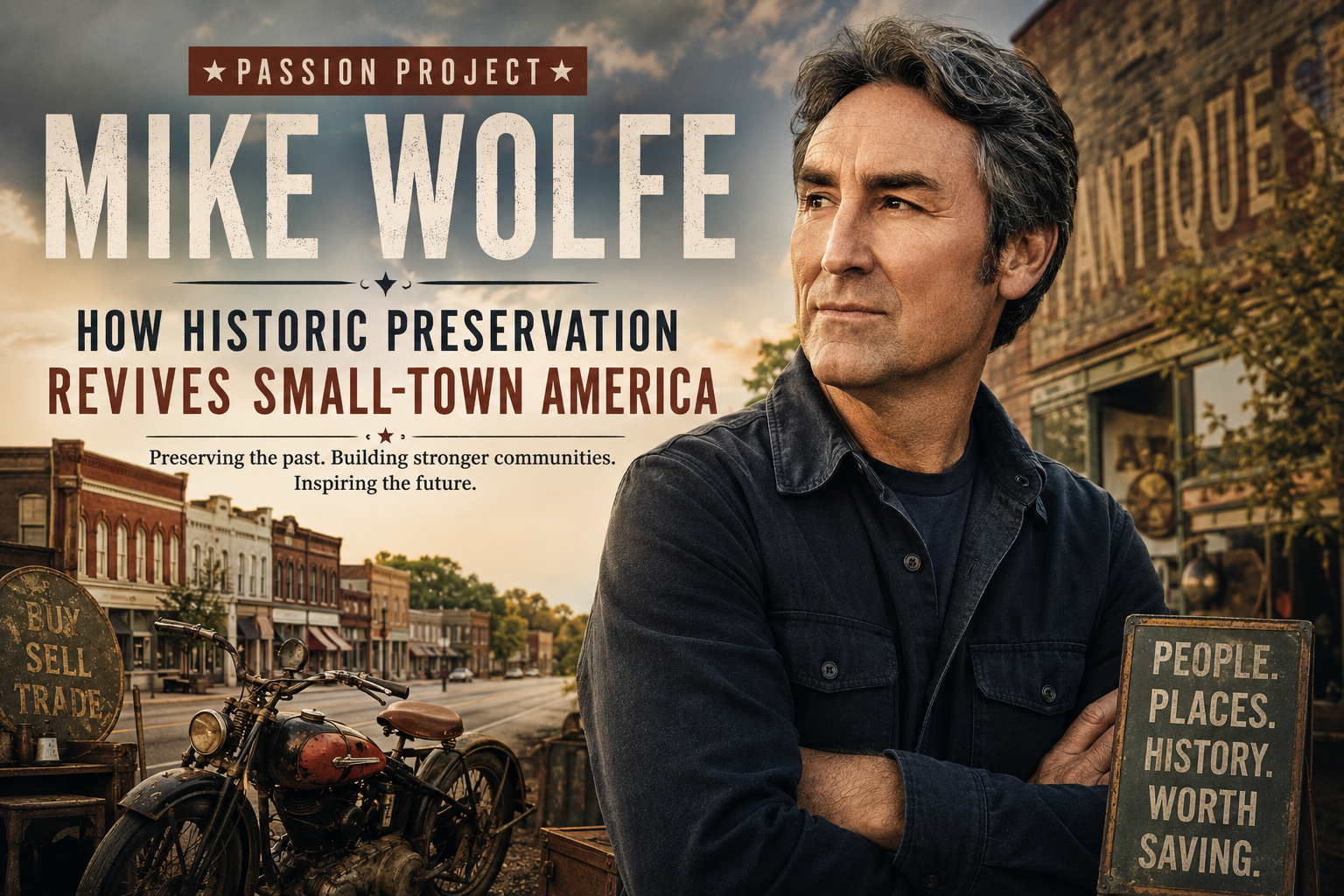
For many television viewers, Mike Wolfe is the familiar face behind the long-running History Channel series American Pickers. Yet beyond the excitement of uncovering vintage motorcycles, rusty gas pumps, and forgotten antiques lies a broader mission that has gained national attention over the last decade. The mike wolfe passion project is not simply about collecting rare items. It reflects a larger commitment to preserving American history, restoring overlooked buildings, and supporting the cultural identity of small towns across the United States.
At a time when many rural communities face declining populations, abandoned storefronts, and shrinking tourism revenue, Wolfe’s work offers a different perspective. Through restoration, storytelling, and local investment, he has shown how history can become an economic and cultural asset.
This article explores the origins of Wolfe’s preservation efforts, the real-world impact of his projects, and why his approach resonates with audiences far beyond reality television.
Who Is Mike Wolfe?
Mike Wolfe is an American television personality, antique collector, entrepreneur, and preservation advocate best known as the creator and host of American Pickers. The series premiered on the History Channel in 2010 and quickly became one of cable television’s most successful nonfiction programs.
The show follows Wolfe as he travels through rural America searching for vintage items, collectibles, and historical artifacts hidden in barns, garages, and forgotten properties. Rather than focusing solely on monetary value, the program emphasizes the stories attached to each object.
Wolfe grew up in Bettendorf, Iowa, where his fascination with discarded items began at a young age. According to multiple interviews and reports, he started collecting bicycles, old signs, and soda bottles as a child before eventually turning his passion into a business.
Today, Wolfe operates Antique Archaeology stores in LeClaire, Iowa, and Nashville, Tennessee, both of which have become popular tourist destinations connected to the success of American Pickers.
The Origins of Wolfe’s Preservation Mission
Long before television fame, Wolfe believed that forgotten objects represented pieces of American culture worth saving. His interest gradually expanded beyond antiques and into architecture, local heritage, and historical preservation.
Instead of viewing abandoned buildings as unusable spaces, Wolfe saw them as opportunities for restoration and community revitalization. This mindset became the foundation for many of his projects in Tennessee and the Midwest.
Over time, the mike wolfe passion project evolved into a broader movement focused on three main goals:
- Preserving historic Americana
- Supporting small-town economies
- Encouraging appreciation for craftsmanship and heritage
These themes consistently appear in Wolfe’s public interviews, restoration work, and social media presence.
Why Historic Preservation Matters Today
Historic preservation is no longer viewed as a niche hobby limited to collectors and historians. Across the United States, communities increasingly recognize the economic and cultural value of restoring older buildings.
According to data from the National Trust for Historic Preservation, heritage tourism generates billions of dollars annually in economic activity and supports local businesses ranging from restaurants to boutique hotels.
Travelers are increasingly interested in authentic experiences rather than generic commercial developments. Restored downtown districts, vintage architecture, and locally owned businesses often attract visitors seeking character and historical identity.
Preservation also supports environmental sustainability.
Rather than demolishing old structures and creating construction waste, restoration projects reuse existing materials and extend the lifespan of historic properties. Adaptive reuse has become a major trend in urban planning and small-town redevelopment.
Wolfe’s projects align closely with these modern preservation trends.
Columbia, Tennessee: A Real-World Example
One of the strongest examples of Wolfe’s restoration work can be found in Columbia, Tennessee.
Located roughly 45 miles south of Nashville, Columbia has experienced renewed tourism and commercial interest in recent years. Wolfe has invested in restoring several historic buildings within the downtown district, helping preserve the city’s architectural character while attracting visitors.
His restoration philosophy focuses on maintaining authenticity rather than completely modernizing properties.
Original brick walls, vintage signage, industrial textures, and historic design elements are often preserved to maintain the building’s historical identity. This approach appeals to both tourists and residents who value authenticity.
Local business owners have also benefited from increased foot traffic tied to tourism connected with American Pickers and Wolfe’s broader brand.
Restaurants, coffee shops, vintage stores, and creative businesses in Columbia have seen increased exposure as visitors travel to explore locations associated with Wolfe’s restoration efforts.
This demonstrates how preservation projects can create ripple effects throughout local economies.
The Economic Impact of Heritage Tourism
The economic impact of heritage tourism continues to grow nationwide.
Research from preservation organizations shows that travelers interested in cultural and historical experiences typically spend more money and stay longer than average tourists.
Historic districts often generate:
- Increased retail activity
- Higher restaurant revenue
- More hotel bookings
- Greater demand for local events
- Improved property values
In many small towns, restored buildings become anchors for broader redevelopment.
A renovated storefront may attract cafes, art galleries, retail shops, or community spaces that encourage additional investment nearby.
Wolfe’s projects reflect this strategy by turning forgotten structures into destinations with both cultural and commercial value.
The visibility created through television and social media further amplifies the economic benefits.
Fans frequently visit restored locations connected to Wolfe’s work, contributing to tourism activity that extends beyond antiques alone.
Storytelling as a Core Philosophy
One reason Wolfe’s work resonates with audiences is his focus on storytelling.
Every antique, motorcycle, neon sign, or building carries personal history connected to real people and communities.
Rather than treating old objects as simple collectibles, Wolfe often highlights the emotional and historical narratives behind them.
This storytelling approach reflects a larger cultural trend.
Consumers increasingly value authenticity, craftsmanship, and human connection in a world dominated by mass production and digital experiences.
Vintage objects provide tangible links to previous generations.
A restored gas station sign or handmade tool can remind viewers of family traditions, local businesses, or childhood memories that may otherwise disappear over time.
Through television, interviews, and restoration projects, Wolfe has helped bring attention to these overlooked stories.
Supporting Skilled Trades and Craftsmanship
Another important aspect of Wolfe’s preservation efforts involves promoting craftsmanship and skilled trades.
Many restoration projects require expertise in woodworking, metalwork, masonry, vintage automotive repair, and architectural restoration.
As industries increasingly shift toward automation and mass manufacturing, traditional trade skills have become less common in some regions.
Preservation projects help keep these skills alive by creating demand for specialized artisans and craftspeople.
According to labor statistics from the construction and restoration industries, demand for skilled trades remains strong across the United States, especially in renovation-focused sectors.
Historic restoration often requires more specialized labor than new construction because original materials and architectural details must be preserved carefully.
By showcasing restoration work publicly, Wolfe also helps younger audiences appreciate the value of hands-on craftsmanship.
Antique Archaeology and Brand Expansion
Wolfe’s Antique Archaeology stores play a central role in his broader preservation brand.
The stores combine retail, storytelling, tourism, and historical aesthetics into immersive experiences for visitors.
Rather than functioning like conventional antique shops, the locations are curated to reflect Americana culture and vintage design.
Visitors often travel specifically to experience the atmosphere associated with American Pickers.
The Nashville location, in particular, benefits from the city’s strong tourism industry.
This blending of entertainment, retail, and heritage preservation demonstrates how historical storytelling can become a sustainable business model.
The success of Antique Archaeology also highlights changing consumer preferences.
Modern shoppers increasingly seek products and experiences with meaning, originality, and craftsmanship rather than purely mass-produced goods.
Vintage culture, restoration content, and nostalgic design trends continue to grow across social media platforms, especially among younger audiences interested in authenticity and sustainability.
Preservation and Sustainability
Environmental sustainability has become another important dimension of historic restoration.
Preserving old buildings reduces demolition waste and lowers the environmental costs associated with new construction.
The Environmental Protection Agency has noted that construction and demolition debris accounts for hundreds of millions of tons of waste annually in the United States.
Adaptive reuse projects help reduce that impact.
Restoring existing structures also preserves embodied energy — the energy already invested in producing and transporting building materials decades earlier.
Wolfe’s restoration approach naturally aligns with this sustainability model.
By repurposing historic structures instead of replacing them entirely, preservation projects contribute to environmental conservation while maintaining community identity.
This combination of sustainability and cultural preservation appeals strongly to modern audiences who value responsible development.
The Influence of Social Media and Digital Storytelling
Social media has significantly expanded public interest in restoration culture.
Platforms such as Instagram, YouTube, TikTok, and Facebook have helped popularize content related to vintage design, home restoration, antique collecting, and DIY craftsmanship.
Wolfe effectively uses digital platforms to share restoration updates, behind-the-scenes projects, and historical narratives.
These posts often generate strong engagement because they combine visual transformation with emotional storytelling.
Audiences enjoy seeing neglected buildings or objects restored into meaningful spaces.
This digital exposure also benefits local communities connected to restoration projects.
Restaurants, stores, artists, and tourism businesses located near restored properties often gain additional visibility online.
As a result, preservation projects increasingly function as both cultural initiatives and modern marketing opportunities.
Why Audiences Connect With Preservation Stories
The popularity of restoration-focused content reflects deeper cultural and emotional factors.
Many viewers feel disconnected from local history due to rapid urban development, technological change, and the decline of traditional community spaces.
Preservation projects offer a sense of continuity.
They remind people that older generations built businesses, neighborhoods, and traditions that still shape modern life.
The emotional connection attached to antiques and historic spaces also explains the continuing success of American Pickers.
Viewers are not simply watching people buy and sell objects.
They are witnessing stories about memory, identity, family history, and craftsmanship.
This emotional dimension has helped the mike wolfe passion project stand out from ordinary reality television.
Challenges Facing Historic Preservation
Despite growing interest in restoration culture, preservation projects often face significant obstacles.
Historic renovations can be expensive and time-consuming.
Older buildings frequently require structural repairs, updated electrical systems, plumbing upgrades, and compliance with modern safety codes.
Funding can also be difficult to secure, especially in smaller communities with limited development budgets.
Some critics argue that restoration efforts may contribute to rising property prices or commercial tourism that changes the character of local neighborhoods.
Balancing economic growth with community preservation remains an ongoing challenge for many towns.
Successful projects typically require collaboration among property owners, local governments, businesses, and preservation advocates.
Wolfe’s work demonstrates how public visibility and storytelling can help generate broader support for preservation initiatives.
Lessons Entrepreneurs Can Learn From Wolfe’s Approach
Wolfe’s success offers several valuable lessons for entrepreneurs, creators, and community leaders.
1. Authenticity Builds Long-Term Trust
Audiences connect more deeply with projects rooted in genuine passion and consistent values.
2. Storytelling Creates Emotional Engagement
People remember stories far more than sales pitches or statistics.
3. Preservation Can Become Profitable
Historic restoration and heritage tourism can create sustainable business opportunities while benefiting communities.
4. Local Identity Matters
Communities with strong cultural identity often attract more tourism and customer loyalty.
5. Small Projects Can Create Large Ripple Effects
Restoring even one historic building can encourage broader neighborhood revitalization.
These principles explain why Wolfe’s projects continue attracting attention beyond the world of television.
The Future of Preservation Culture
Interest in preservation, restoration, and heritage tourism is expected to continue growing over the next decade.
Younger generations increasingly value sustainability, authenticity, vintage design, and meaningful travel experiences.
Small towns with strong historical identity may benefit significantly from these trends if they invest strategically in preservation and local culture.
Digital storytelling will likely play an even larger role moving forward.
Creators who successfully combine history, community engagement, and visual storytelling can build powerful brands around restoration culture.
Wolfe remains one of the most recognizable public figures associated with this movement.
His work demonstrates that preserving history is not simply about nostalgia.
It can also support economic development, environmental sustainability, cultural education, and community pride.
Final Thoughts
The mike wolfe passion project represents far more than antique collecting or reality television fame.
It highlights the growing importance of historic preservation in a rapidly changing world.
By restoring buildings, supporting local economies, promoting craftsmanship, and sharing overlooked stories, Wolfe has helped demonstrate how preservation can create meaningful social and economic impact.
His projects show that old structures and forgotten objects still hold value — not only financially, but culturally and emotionally.
As more communities search for ways to preserve identity while adapting to modern challenges, restoration efforts like Wolfe’s may become increasingly relevant.
In many ways, his work serves as a reminder that progress does not always require abandoning the past.
Sometimes the future begins by restoring what was nearly forgotten.
Read More Guide’s: Nsfemonster: How This Mysterious Trend Took Over the Internet Fast
FAQs
What is Mike Wolfe best known for?
Mike Wolfe is best known as the creator and host of American Pickers, a television series focused on antique collecting and historical storytelling.
What is the main goal of his preservation work?
His projects focus on preserving historic buildings, supporting small-town communities, and promoting appreciation for Americana culture and craftsmanship.
Where are some of his restoration projects located?
Many of Wolfe’s restoration efforts are connected to Columbia, Tennessee, Nashville, Tennessee, and LeClaire, Iowa.
Why is historic preservation important?
Historic preservation supports tourism, protects cultural identity, encourages sustainability, and helps communities maintain architectural heritage.
How does restoration benefit local economies?
Restoration projects can increase tourism, support local businesses, improve property values, and attract additional investment into historic districts.
