

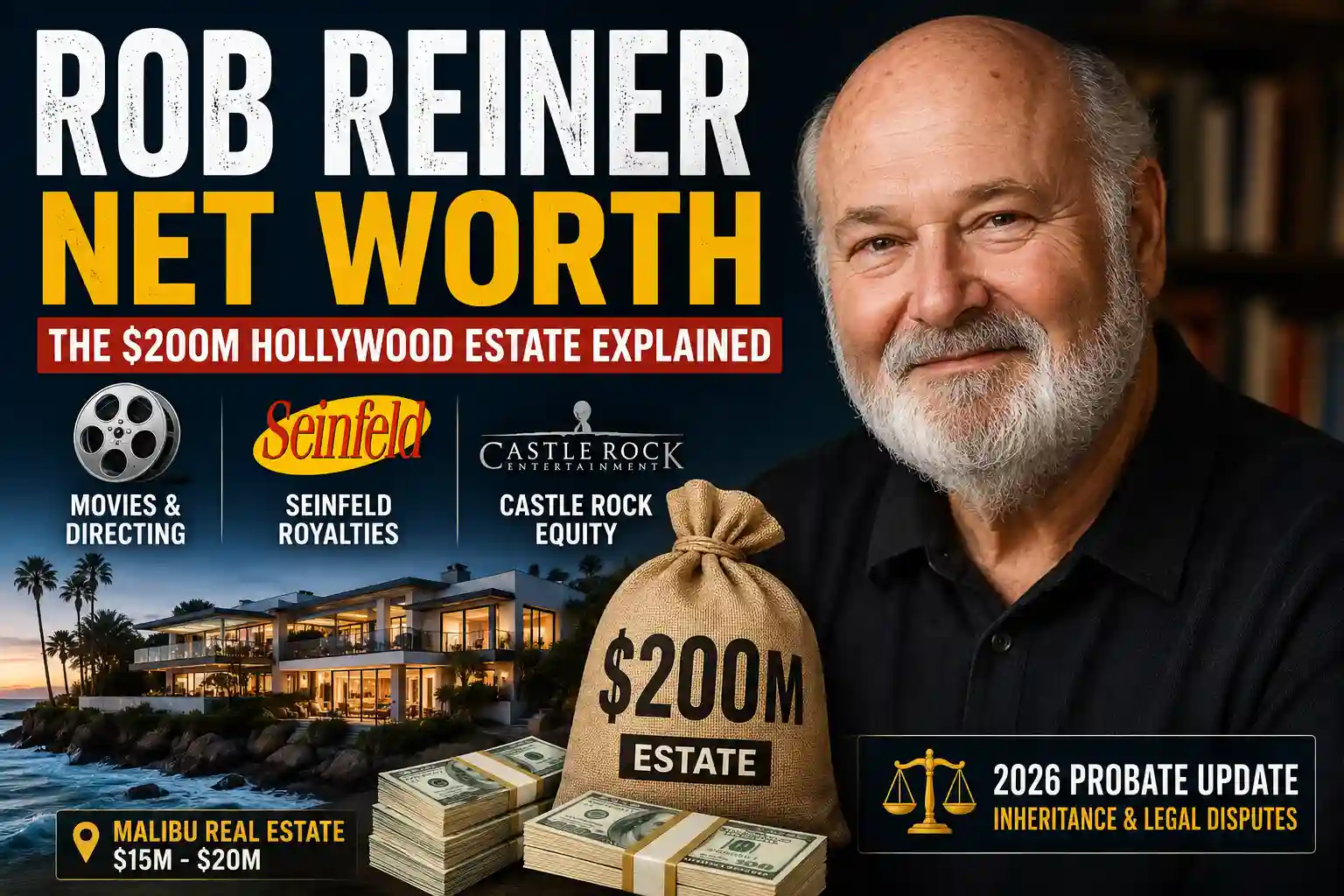
At the time of his passing in December 2025, Rob Reiner left behind an estate valued at $200 million a fortune built not from any single spectacular transaction but from four decades of compounding royalty streams, equity stakes in one of Hollywood’s most strategically positioned independent studios, and prime Southern California coastal real estate.
Contrary to what celebrity finance aggregators estimated throughout his lifetime, Rob Reiner net worth does not primarily reflect directing fees. Those, even at his commercial peak, reached $4 million per film. The true engine of his wealth was a co-production back-end stake in a television show he neither created nor performed in: Seinfeld.
This analysis disaggregates his $200 million estate into verified component streams directing royalties, Castle Rock Entertainment founder equity, Seinfeld back-end participation, Shawshank Redemption producer residuals, and Malibu Colony real estate while providing a legally precise account of the active 2026 probate administration that has become one of entertainment law’s most publicly scrutinized proceedings.
The $200 Million Benchmark What His Estate Actually Represents
Rob Reiner net worth was reflected in an estate valued at $200 million at death in December 2025, reflecting accumulated wealth from four primary streams: Castle Rock Entertainment co-founding equity and ongoing royalty participation rights, Seinfeld syndication back-end income, a career-long portfolio of directing and acting residuals, and prime California coastal real estate anchored by a Malibu Colony compound valued at $15–$20 million in 2026.
Gross Estate vs. Net Estate: Understanding the Legal Distinction
“Net worth” and “gross estate” are not interchangeable terms. The $200 million figure represents Reiner’s gross estate the fair market value of all assets at the date of death, before federal estate taxes, probate administration fees, outstanding debts, and legal costs are deducted.
Under federal law (California imposes no state estate tax), estates exceeding the applicable exemption threshold approximately $13.6 million per individual for 2025 are subject to federal estate tax at a marginal rate of up to 40%. On a $200 million gross estate, this tax obligation alone runs into the tens of millions of dollars, significantly reducing the net amount ultimately distributed to heirs.
This distinction matters because much of the public discourse around the Reiner estate conflates the gross valuation with what the family will actually receive.
Why Aggregator Sites Reported Lower Figures During His Lifetime
Multiple celebrity finance websites published estimates ranging from $80 million to $150 million for Reiner during his active years. These figures suffered from a structural analytical flaw: they counted only publicly documented directing fees and real estate sale records, both of which are visible in court filings and property databases.
They systematically ignored:
- Back-end royalty income from Seinfeld syndication, which accrues privately and compounds over decades
- Residual participation in The Shawshank Redemption, When Harry Met Sally…, and other Castle Rock productions
- Investment and trust growth on wealth accumulated from the early 1990s forward
The $200 million probate estate valuation represents the most rigorously documented figure available, established through court-supervised appraisal rather than media estimation. As a result, many previous estimates of Rob Reiner net worth likely understated the full scale of his assets.
Castle Rock Entertainment and the Architecture of Rob Reiner Net Worth
Rob Reiner’s $200 million net worth was not primarily generated by his directing career it was generated by his co-founding of Castle Rock Entertainment in 1987, a strategic equity position that continued producing income decades after the studio changed corporate ownership. Castle Rock’s co-production stake in Seinfeld entitled founding partners to back-end syndication participation, creating a royalty engine that compounded long after the show’s 1998 finale.
1987: The Five Partners Who Built Castle Rock
In 1987, Rob Reiner partnered with four entertainment industry executives to establish Castle Rock Entertainment as an independent production company:
| Co-Founder | Primary Role | Post-Castle Rock Career |
| Rob Reiner | Director / Creative Principal | Continued directing; retained royalty interests |
| Glenn Padnick | TV Division President | Oversaw Seinfeld co-production relationship |
| Martin Shafer | Feature Film Production | Senior executive at subsequent studio roles |
| Andrew Scheinman | Producer / Partner | Collaborated with Reiner on multiple films |
| Alan Horn | Studio Operations / President | Later served as Chairman of Walt Disney Studios |
The company’s founding structure gave each partner equity ownership in the studio and critically back-end participation rights in every major production the company co-produced. This meant that when Castle Rock partnered with Jerry Seinfeld and Larry David’s production to create Seinfeld for NBC, Castle Rock held not just production fees but a perpetual percentage of all future revenue generated by the show.
The Turner Broadcasting Acquisition: How the 1993 Sale Crystallized Equity
In 1993, Turner Broadcasting System acquired Castle Rock Entertainment. The acquisition was a crystallization event: founding partners received cash compensation for their equity stakes.
However, the critical detail absent from most accounts is that Reiner and his co-founders retained back-end royalty participation rights in their existing productions even after the acquisition. The sale of the studio did not terminate the co-production agreements or the royalty entitlements already embedded in Castle Rock’s deals with Seinfeld, The Shawshank Redemption, and other properties.
This is the structural reason why Reiner continued earning significant passive income through the 1990s, 2000s, 2010s, and 2020s long after he had transitioned away from active studio leadership.
Retained Back-End Points: The Mechanism That Made Seinfeld Generational
Think of a back-end participation deal the way a young professional today might think of equity vesting: the salary (upfront fee) gets you in the door, but the equity (back-end percentage) is where long-term wealth accumulates.
Castle Rock co-produced Seinfeld, which means in exchange for production resources and financial risk-sharing, it was contractually entitled to a percentage of the show’s downstream revenue every syndication license, every streaming deal, every international broadcast agreement in perpetuity.
This is how a man who never wrote a single episode of Seinfeld accumulated a meaningful portion of his $200 million estate from the show’s commercial afterlife.
The Seinfeld Syndication Engine How One Show Fueled Decades of Passive Royalty Income
Castle Rock Entertainment’s co-production position in Seinfeld entitled its founding partners to back-end participation in one of the most lucrative syndication revenue streams in television history. Seinfeld‘s cumulative licensing value exceeded $3.1 billion across domestic and international markets as of 2024 generating ongoing royalty income for Castle Rock participants long after the series concluded its original NBC run in May 1998. For many analysts, this revenue stream became one of the largest drivers of Rob Reiner net worth.
What “Back-End Participation” Means in Practice
A back-end participation deal functions as follows:
- Production Phase: The co-producer (Castle Rock) contributes production infrastructure, financing, or distribution relationships.
- Revenue Threshold: The deal specifies when back-end participation activates often after the production recoups a defined cost baseline.
- Participation Kicks In: Once the threshold is crossed, the co-producer receives a negotiated percentage of all subsequent revenue syndication fees, streaming licensing payments, international broadcast rights, DVD/digital sales, and merchandise licensing tied to the intellectual property.
- Perpetual Duration: These rights do not expire. Every new licensing cycle a new streaming platform, a new international territory generates a fresh payment to eligible back-end holders.
In Seinfeld‘s case, syndication rights sold to TBS generated hundreds of millions of dollars. Later streaming deals with Hulu and Netflix’s international platforms added further licensing revenue. Each cycle contributed income to Castle Rock’s royalty pool.
Seinfeld‘s Syndication Scale in Context
| Licensing Event | Approximate Value | Year |
| First domestic syndication package | ~$1.7 billion (180+ markets) | 1998 |
| Hulu U.S. streaming exclusive | ~$130 million/year | 2015–2021 |
| Netflix international license | Multi-year, est. $500M+ total | 2021 onward |
| Cumulative syndication value | $3.1+ billion | As of 2024 |
Castle Rock’s founding partners did not receive the full gross value of these deals their entitlement was a negotiated percentage. But even a modest fractional share of $3.1 billion in cumulative licensing value, distributed over three decades, represents a substantial contribution to an individual founder’s net worth.
The Royalty Stacking Effect: Multiple Properties, One Balance Sheet
The Seinfeld participation was not Reiner’s only simultaneous royalty stream. In a single fiscal year during the 2010s, his estate was receiving concurrent income from:
- Seinfeld streaming and international licensing
- The Shawshank Redemption persistent broadcast and streaming licensing (consistently one of the highest-rated cable films in U.S. television history)
- When Harry Met Sally… broadcast and digital licensing from the 1989 Nora Ephron–scripted romantic comedy
- A Few Good Men streaming and broadcast residuals from the 1992 Columbia Pictures release
- All in the Family SAG acting residuals from the CBS classic
- Malibu Colony rental income estimated at $100,000–$150,000 per month
This royalty stacking multiple independent income streams each compounding on their own timelines is the financial structure most celebrity net worth analyses fail to model. It explains why the estate valuation of $200 million significantly exceeds every estimate made during Reiner’s lifetime.
Read More: MERC L&T Finance
From Meathead to the Director’s Chair The Career Revenue Timeline That Built the Foundation
The growth of Rob Reiner net worth followed a clear three-phase arc: an acting era that established cultural capital and SAG royalty entitlements, a directorial peak that generated escalating upfront fees and residuals, and a passive compounding era fueled by the royalty stacking described above.
All in the Family (1971–1979): Acting Residuals and Cultural Currency
Reiner played Michael Stivic affectionately known as “Meathead” on All in the Family from 1971 to 1979. The CBS sitcom, produced by Norman Lear, was one of the highest-rated programs of the 1970s and remains in active syndication today.
His compensation during the original run was modest by modern standards standard television actor rates for the era. However, the SAG residual structure meant he continued earning royalties on every subsequent airing of the show’s 202 episodes throughout the following decades.
More importantly, eight years on one of television’s most-watched shows gave Reiner the name recognition and industry credibility to transition from actor to director a transition that dramatically expanded his financial ceiling.
The Directorial Peak (1984–1992): Eight Films, Escalating Fees
Between 1984 and 1992, Reiner directed an almost unbroken string of commercially and critically significant films. His per-film directing fees escalated in direct proportion to each film’s commercial success:
| Film | Year | Est. Box Office | Significance |
| This Is Spinal Tap | 1984 | Cult classic | Launched directorial career |
| The Sure Thing | 1985 | $18M domestic | Early commercial validation |
| Stand by Me | 1986 | $52M domestic | Major critical breakthrough |
| The Princess Bride | 1987 | $30M domestic | Enduring cultural classic |
| When Harry Met Sally… | 1989 | $93M worldwide | Castle Rock’s commercial peak |
| Misery | 1990 | $61M domestic | Oscar-winning adaptation |
| A Few Good Men | 1992 | $243M worldwide | $4M directing fee; Oscar nomination, Best Picture |
A Few Good Men represents the pinnacle of Reiner’s upfront compensation: a documented $4 million directing fee from Columbia Pictures, at the time one of the highest director salaries on record. The film earned five Academy Award nominations, including Best Picture.
Carl Reiner and the Broader Financial Dynasty
The Reiner family’s financial ecosystem extends beyond Rob. His father, Carl Reiner the comedian, actor, director, and writer behind The Dick Van Dyke Show built his own substantial estate through a parallel but separate decades-long career in entertainment. Carl Reiner’s estimated estate at his 2020 passing was approximately $70 million, reflecting Dick Van Dyke Show syndication residuals, film work, and his celebrated partnership with Mel Brooks.
Tracy Reiner Rob’s daughter from his first marriage has pursued her own entertainment career, though her financial profile is entirely independent from the Rob and Michele Reiner estate currently in probate.
The Malibu Colony Compound and the Full Asset Portfolio
A significant portion of Rob Reiner net worth was tied to his Malibu Colony compound, valued between $15 million and $20 million in 2026, anchors a broader real estate portfolio that constitutes the most immediately tangible component of his estate for general readers. Located within one of the most exclusive gated coastal communities in Southern California, the property historically generated documented rental income ranging from $100,000 to $150,000 per month producing annual gross rental yield exceeding $1 million in peak years.
Malibu Colony: Location, Premium Dynamics, and Valuation History
The Malibu Colony is a gated beachfront enclave situated along a private stretch of Pacific Coast Highway. Access is restricted; the community has historically been home to senior Hollywood figures, entertainment executives, and major studio principals.
Key real estate dynamics that support the $15–$20M valuation range:
- Absolute oceanfront positioning properties front directly onto the Pacific
- Extreme supply constraint the gated community contains a finite number of parcels; new supply is essentially impossible
- High-end comparable sales adjacent properties regularly transact above $15 million; premium compounds exceed $25 million
- Rental market depth the property type commands the $100,000–$150,000 monthly rental rate documented in connection with the Reiner estate
Beyond Real Estate: Intellectual Property and Financial Holdings
Reiner’s estate extends beyond physical property. The balance of his $200 million includes:
- Royalty contract entitlements legally documented back-end participation rights in Seinfeld, The Shawshank Redemption, When Harry Met Sally…, and other Castle Rock productions, which represent ongoing income-generating assets valued on a capitalized royalty basis
- Investment and trust assets wealth accumulated from the 1990s forward and placed in investment vehicles, the specific composition of which is subject to the confidentiality of the ongoing probate proceeding
- Additional real property beyond the Malibu Colony anchor, the estate may include additional California real estate holdings
How California Probate Values an Estate
Under California probate procedure, every asset in the estate is assessed at its fair market value as of the date of death the price a willing buyer would pay a willing seller, with neither under compulsion. For the Malibu Colony property, this means a formal appraisal anchored to comparable sales data from December 2025. For royalty contract entitlements, it means an expert valuation of the present discounted value of expected future royalty income a complex financial exercise that typically involves entertainment industry valuation specialists and can itself become a source of litigation between co-heirs who disagree on the methodology.
The 2026 Inheritance and Rob Reiner’s Estate: A Legally Precise Account
Rob Reiner’s estate entered formal California probate administration following his passing in December 2025. The proceeding also brought renewed attention to how Rob Reiner net worth was structured and distributed. The gross estate, valued at $200 million, encompasses all asset classes described above and is subject to federal estate tax, probate administration fees, and the court-supervised distribution process. In early 2026, a significant legal development emerged: Jake and Romy Reiner filed a court action to prevent the allocation of estate funds toward Nick Reiner’s criminal legal defense costs a proceeding that has drawn public attention without altering the fundamental legal structure of the estate administration.
Who Are Rob Reiner’s Heirs? The Legal Structure Explained
Rob Reiner and Michele Reiner, who predeceased or passed concurrently, are survived by four children:
- Jake Reiner Son; currently a co-plaintiff in the estate fund dispute
- Romy Reiner Daughter; currently a co-plaintiff in the estate fund dispute
- Nick Reiner Son; subject of the criminal proceeding for which estate fund access was sought
- Tracy Reiner Daughter from Reiner’s first marriage to Penny Marshall; her legal standing in the current estate depends on the specific terms of Reiner’s estate planning documents
Michele Reiner’s concurrent estate adds a layer of legal complexity. Under California community property law, assets accumulated during a marriage are presumptively owned equally by both spouses. The administration of two concurrent spousal estates both originating from the same community property pool creates an administrative and legal structure more complex than a single decedent’s probate.
The Nick Reiner Legal Defense Dispute: What the Filing Shows
In early 2026, Jake Reiner and Romy Reiner filed a formal legal action in California probate court to block the release of estate funds for Nick Reiner’s criminal defense expenses.
The legal principle at stake is straightforward: a probate estate’s assets belong to all beneficiaries collectively, not to any individual heir. An individual heir cannot unilaterally draw on estate assets for personal legal costs without the court’s approval and, typically, the consent of co-beneficiaries. When co-heirs object as Jake and Romy did the court applies the standard that estate funds may only be disbursed in accordance with the terms of the decedent’s estate planning documents and applicable probate law.
This proceeding does not speak to the merits of the underlying criminal matter. It is a routine probate administration dispute elevated to public attention by the prominence of the estate and the participants.
How Much Will Each Heir Actually Receive?
Projecting net distributions requires applying several deductions to the $200 million gross estate:
| Deduction Category | Estimated Range |
| Federal estate tax (40% marginal rate on taxable portion) | $50M–$75M (est.) |
| Probate attorney and executor fees (California statutory scale) | $1.5M–$3M |
| Appraisal, accounting, and administration costs | $500K–$2M |
| Any outstanding debts or obligations | Unknown |
| Estimated Net Distributable Estate | ~$120M–$145M |
These are structural estimates. The actual net figure depends on the precise asset composition, available deductions, the outcome of any contested valuation proceedings, and the resolution of the Nick Reiner legal defense dispute.
The Oscars 2026 Tribute: Billy Crystal, Meg Ryan, and the Cultural Legacy
The 2026 Academy Awards ceremony included a tribute to Rob Reiner hosted by Billy Crystal and Meg Ryan two actors whose careers were indelibly shaped by Reiner’s direction. Crystal’s relationship with Reiner spanned decades; Meg Ryan’s star-making performance in When Harry Met Sally… (1989) remains one of the most celebrated director-actor collaborations in American romantic comedy.
The tribute served as the cultural acknowledgment of Reiner’s creative legacy a counterpart to this financial analysis of his economic one. Both dimensions are real, both are significant, and the distinction between them matters: the Academy tribute honored the art; the probate court is administering the assets. Together, those achievements and assets explain how Rob Reiner net worth reached an estimated $200 million.
Conclusion
Rob Reiner’s financial legacy was built on far more than directing salaries alone. While his acclaimed film career provided the foundation, the real drivers of his wealth were long-term royalty streams, Castle Rock Entertainment equity, valuable intellectual property interests, and premium California real estate. Together, these assets created a diversified portfolio that continued generating income for decades.
The story behind Rob Reiner net worth is ultimately one of strategic ownership rather than short-term earnings. From Seinfeld syndication participation to enduring film residuals and high-value property holdings, his estate reflects the power of assets that appreciate and produce revenue over time. As probate proceedings continue, Rob Reiner net worth remains a notable example of how lasting entertainment industry wealth is often built behind the scenes.
