

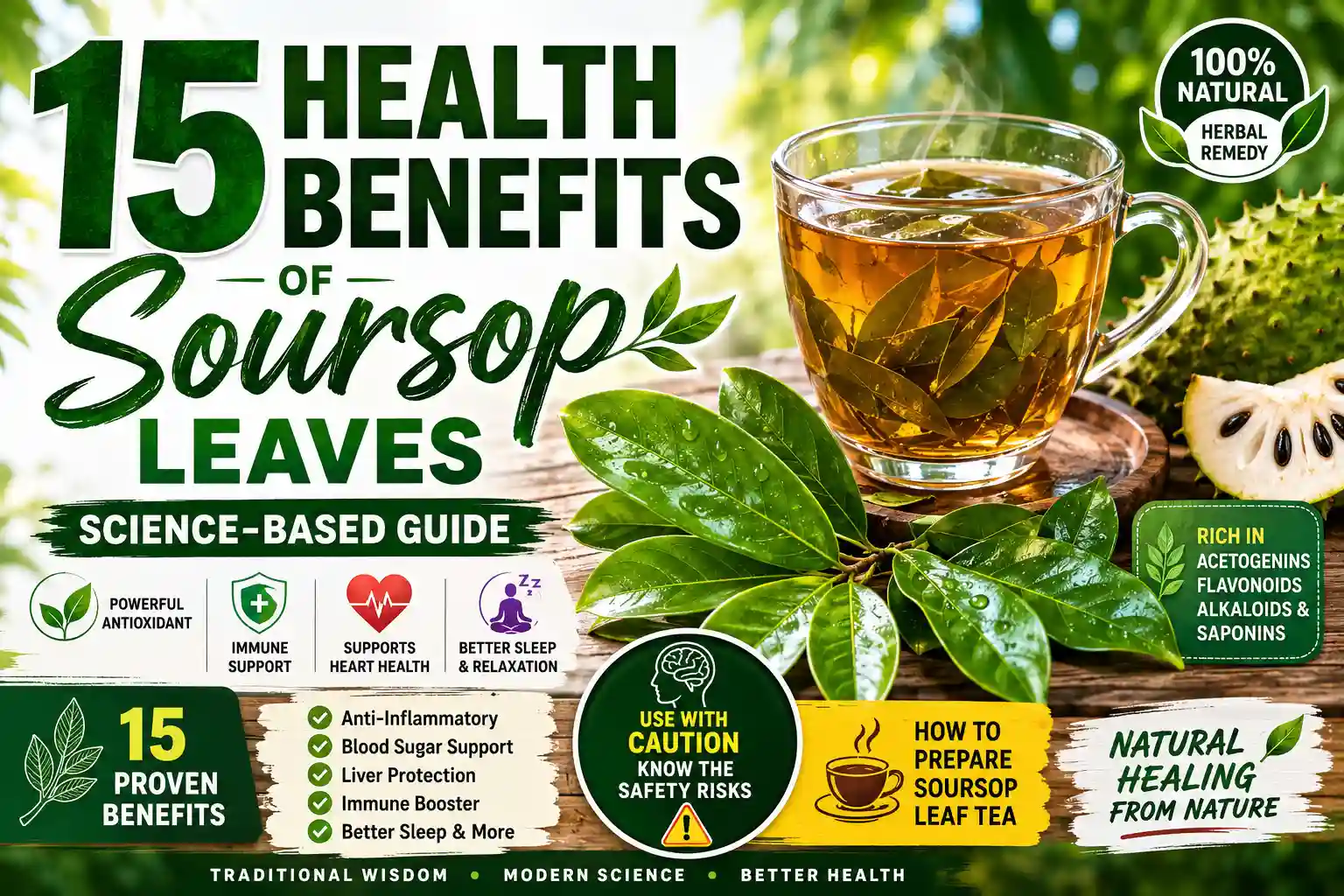
The 15 health benefits of soursop leaves documented in peer-reviewed research are produced by one of the most biochemically distinct phytochemical profiles in tropical ethnopharmacology and yet the same leaf that generates these benefits carries a safety risk that virtually no mainstream health guide mentions.
Soursop (Annona muricata), a flowering tree native to the tropical Americas and now cultivated across West Africa, Southeast Asia, and the Caribbean, has accumulated more than two centuries of traditional use and over four decades of formal scientific investigation. The leaves concentrate a molecular arsenal annonaceous acetogenins, quercetin, rutin, alkaloids, saponins, and tannins that explains both their remarkable therapeutic range and their documented toxicity profile when misused.
This article delivers a mechanism-level breakdown of all 15 health benefits of soursop leaves, grounded in biochemical data rather than folklore. It also addresses every major safety concern that the rest of the internet has quietly omitted.
What Soursop Leaves Actually Contain The Biochemical Foundation of All 15 Benefits
Annona muricata leaves produce health effects through four primary compound classes: annonaceous acetogenins unique to the Annonaceae plant family, flavonoids including quercetin and rutin, alkaloids with vasodilatory and sedative properties, and saponins with immunomodulatory activity. Soursop leaves contain 3–5× higher acetogenin concentrations than the fruit pulp, making them the pharmacologically dominant plant part.
Annonaceous Acetogenins A Compound Class Found Nowhere Else
Annonaceous acetogenins are C35 or C37 long-chain fatty acid derivatives exclusive to the Annonaceae family. In Annona muricata leaves, the dominant forms are annonacin, bullatacin, squamocin, and asimicin.
Their primary mechanism is inhibition of mitochondrial NADH-ubiquinone reductase also known as Complex I the first enzyme in the electron transport chain. By blocking Complex I, acetogenins deprive rapidly dividing cells of ATP, triggering apoptosis. This single mechanism is responsible for both the anticancer activity observed in laboratory settings and, at excessive chronic doses, the neurotoxic effects documented in epidemiological research.
Flavonoids, Alkaloids, and Saponins The Supporting Phytochemical Cast
- Quercetin Donates hydrogen atoms to DPPH (2,2-diphenyl-1-picrylhydrazyl) free radicals, neutralizing oxidative chain reactions before they damage cellular membranes; also downregulates COX-2 enzyme expression.
- Rutin A flavonoid glycoside with documented vascular protective activity, reducing capillary permeability and supporting blood pressure regulation.
- Alkaloids (reticuline, coreximine) Produce mild vasodilatory and sedative effects via smooth muscle relaxation.
- Saponins Activate macrophage proliferation, contributing to immunomodulatory activity.
- Tannins Astringent polyphenols with antimicrobial and anti-ulcer properties.
How Drying Temperature Alters Compound Yield
Drying method is a pharmacological variable, not a trivial preparation detail. Pharmacognosy research demonstrates that drying soursop leaves at 50°C for 3–6 hours preserves the highest total flavonoid content and antioxidant activity. Sun-drying at ambient temperature produces moderate retention. Temperatures above 70°C begin to denature heat-sensitive phenolic structures, reducing therapeutic potency.
From Rainforest Remedy to Research Laboratory How Soursop Leaf Medicine Evolved
Annona muricata leaf medicine has a documented trajectory across the Caribbean, West Africa, and Southeast Asia spanning at least two centuries, culminating in formal scientific investigation that both validated traditional applications and produced an urgent safety finding.
Indigenous Use Across Three Continents
In Trinidad and the wider Caribbean basin, soursop leaf tea was historically the standard sedative preparation for insomnia and anxiety, an application that maps closely to the alkaloid-mediated smooth muscle relaxation later confirmed in pharmacological studies. Among Yoruba healers, Guanabana leaf decoctions were commonly used for liver complaints and skin infections. Across the Philippines and Malaysia, leaf poultices were applied to relieve rheumatic pain. This geographically dispersed convergence multiple cultures independently targeting the same organ systems provided early evidence of genuine multi-system activity.
The Purdue University Acetogenin Research (1996) and the Cancer Narrative
In 1996, researchers at Purdue University published findings on acetogenin cytotoxicity against adriamycin-resistant human tumor cell lines. The data showed selective toxicity at low concentrations in cell culture. This finding accurate within its narrow scope was extracted, amplified, and distorted over the following decade into the claim now ubiquitous on health blogs: “soursop is 10,000 times stronger than chemotherapy.” The original research made no such comparison, tested cell cultures not living patients, and did not address human clinical outcomes.
The Guadeloupe Parkinsonism Finding When Traditional Overconsumption Became a Medical Warning
Between 2002 and 2005, epidemiologists Caparros-Lefebvre and Elbaz documented unusually high rates of atypical parkinsonism in Guadeloupe and identified chronic high soursop consumption as the primary environmental differentiator. The causative agent: annonacin. This acetogenin crosses the blood-brain barrier, accumulates in dopaminergic neurons of the substantia nigra, and through sustained Complex I inhibition triggers tau protein aggregation consistent with progressive supranuclear palsy. This was not a theoretical risk. It was a documented epidemiological outcome from real-world traditional overconsumption.
The Complete 15 Health Benefits of Soursop Leaves Mechanism-Level Breakdown
The 15 health benefits of soursop leaves span antioxidant defense, inflammation control, metabolic regulation, microbial resistance, organ protection, and laboratory-confirmed cytotoxicity. Each benefit is traceable to a specific compound class. Evidence quality varies antioxidant and anti-inflammatory data are robust; human clinical trial evidence for cancer applications remains entirely absent as of 2026.
Benefits #1–5: Antioxidant Defense, Inflammation, Metabolism, and Immunity
| # | Benefit | Active Compound | Mechanism |
| 1 | Neutralizes free radicals | Quercetin, Rutin | DPPH radical scavenging competitive IC50 with ascorbic acid in standardized assays |
| 2 | Reduces joint/muscle inflammation | Quercetin, Acetogenins | COX-2 enzyme inhibition; downregulates TNF-α and IL-6; reduces carrageenan-induced paw edema in animal models at 100–400 mg/kg |
| 3 | Stabilizes blood sugar | Alkaloids, Flavonoids | Alpha-glucosidase inhibition; GLUT4 transporter upregulation; beta-cell function enhancement. Significant fasting glucose reduction at 400 mg/kg in T2D rodent models |
| 4 | Manages hypertension | Alkaloids (Reticuline) | Calcium channel antagonism in vascular smooth muscle → reduced peripheral resistance. Clinically significant: additive effect with antihypertensive medications |
| 5 | Boosts immune response | Saponins | Macrophage proliferation and phagocytic activation the soursop immunomodulatory effect confirmed in in-vivo models |
Benefits #6–10: Antimicrobial Activity, Digestive Relief, and Cellular Maintenance
These five benefits of soursop leaves address the body’s microbial environment, digestive integrity, pain management, and cellular repair areas where traditional applications most consistently align with documented biochemistry.
| # | Benefit | Active Compound | Mechanism |
| 6 | Suppresses bacterial infections | Tannins, Alkaloids | Inhibitory activity against Staphylococcus aureus, E. coli, and Bacillus cereus in disc diffusion assays; disrupts bacterial membrane permeability |
| 7 | Alleviates digestive disorders | Tannins | Astringent mucosal protection over ulcer sites; reduces intestinal secretion; anti-bloating via antimicrobial reduction of gut fermentation |
| 8 | Relieves menstrual cramps | Alkaloids (Reticuline) | Smooth muscle relaxation via calcium antagonism same mechanism as blood pressure reduction. Note: contraindicated in pregnancy for this same reason |
| 9 | Promotes cellular repair | Vitamin C, Flavonoids | Ascorbic acid retained at optimal levels in leaves dried at 50°C; cofactor in collagen synthesis and antioxidant enzyme recycling |
| 10 | Reduces fever | Flavonoids, Alkaloids | Prostaglandin synthesis inhibition same pathway as conventional antipyretics (paracetamol); most historically consistent traditional use across all three continental traditions |
Benefits #11–15: Organ Protection, Systemic Stress Reduction, and In-Vitro Anticancer Activity
The final five benefits of soursop leaves address organ-specific protection and systemic disease prevention. Benefit #15 in-vitro anticancer activity requires the most careful evidence contextualization of all fifteen domains.
| # | Benefit | Active Compound | Mechanism |
| 11 | Protects the liver (Hepatoprotective) | Flavonoids, Acetogenins | Upregulates catalase and superoxide dismutase against CCl4-induced hepatotoxicity in rodent models; reduces ALT and AST serum levels |
| 12 | Lowers systemic oxidative stress | Quercetin, Rutin | Reduces malondialdehyde (MDA) a systemic oxidative damage marker in in-vivo studies |
| 13 | Respiratory relief | Alkaloids | Bronchial smooth muscle relaxation widens airway diameter; anti-inflammatory effects reduce mucosal irritation; antimicrobial activity addresses bacterial secondary infection |
| 14 | Enhances sleep quality | Alkaloids (Reticuline) | Acts on serotonergic and GABAergic pathways producing mild anxiolytic/sedative effects functionally analogous to chamomile at tea-level concentrations |
| 15 | Inhibits abnormal cell growth (in vitro) | Acetogenins (Bullatacin, Annonacin) | Selective mitochondrial Complex I inhibition in cancer cell lines: breast (MCF-7), colon, prostate, pancreatic. Critical qualifier: in-vitro and animal model data only no human RCT evidence as of 2026 |
The Anticancer Evidence Guardrail What Lab Data Proves and What It Does Not
The therapeutic evidence ladder runs: cell culture → animal model → Phase I trial → Phase III RCT. Soursop’s anticancer evidence sits at rungs one and two. MD Anderson Cancer Center classifies soursop as a complementary botanical of research interest not a standalone oncological treatment. The WHO does not list it as an evidence-based cancer therapy. Moving from “kills cancer cells in a Petri dish” to “treats cancer in humans” requires navigating bioavailability barriers, dose-toxicity thresholds, and immune interactions that no cell culture study can simulate.
What Soursop Research Overstates And the Safety Risks No One Is Telling You
Two failures dominate the soursop information ecosystem: overclaiming therapeutic scope and suppressing critical safety data. Both distortions affect real health decisions by real people.
Deconstructing the “10,000× Chemotherapy” Claim
The Purdue University finding (1996): specific acetogenins were selectively cytotoxic to adriamycin-resistant tumor cells in cell culture at low concentrations. This is a pharmacologically meaningful observation. The leap to “10,000 times stronger than chemo” is not found anywhere in that research it conflates in-vitro cytotoxic concentration with in-vivo clinical efficacy, ignores bioavailability, and omits the complete absence of human trial data.
Annonacin, Neural Accumulation, and Atypical Parkinsonism
The compound family responsible for soursop’s anticancer reputation is the same family responsible for its primary toxicity risk. Annonacin accumulates in dopaminergic neurons, chronically inhibits Complex I, depletes neuronal ATP, and triggers tau aggregation. The Guadeloupe epidemiological data is not theoretical it documents a measurable public health outcome from traditional overconsumption.
Complete Drug Interaction and Contraindication Registry
| Group | Risk Level | Clinical Basis |
| Pregnant women | Absolute contraindication | Uterine smooth muscle stimulation |
| Parkinson’s disease patients | Absolute contraindication | Annonacin accelerates neurodegeneration |
| On antihypertensive drugs | High physician clearance required | Additive hypotension |
| On anticoagulants (warfarin) | Moderate | Potential enzyme competition affecting anticoagulant metabolism |
| On diabetes medication | Moderate monitor blood glucose | Additive hypoglycemia risk |
| During chemotherapy | Consult oncologist | Unknown interaction potential with treatment agents |
How to Safely Prepare Soursop Leaf Tea A Phytochemistry-Informed Protocol
Optimal preparation maximizes flavonoid and alkaloid extraction while keeping acetogenin concentration within safe daily thresholds. The goal is therapeutic compound delivery, not maximum potency at all costs.
Fresh vs. Dried Leaves A Comparative Profile
| Parameter | Fresh Leaves | Dried (50°C / 3–6 hrs) | Sun-Dried |
| Flavonoid retention | High | Highest | Moderate |
| Acetogenin level | Moderate | Higher | Moderate |
| Vitamin C retention | Highest | High | Low |
| Shelf life | 2–3 days (refrigerated) | 6–12 months | 3–6 months |
Leaves dried at 50°C for 3–6 hours offer the best combined profile. Commercial dried soursop leaves are acceptable if sourced without high-heat processing. Avoid leaves dried above 70°C phenolic compound degradation becomes significant.
Step-by-Step Preparation
- Select 5–10 mature, dark green leaves avoid yellowed or very young pale leaves.
- Rinse under cold running water to remove surface contamination.
- Bring 2 litres of water to a rolling boil, then reduce to a gentle simmer.
- Add leaves and simmer 15–20 minutes for a strong preparation; 10 minutes for a milder daily version.
- Remove from heat and steep 5 additional minutes alkaloid extraction increases as temperature drops slightly.
- Strain, cool, and consume maximum 1–2 cups per day.
- Refrigerate unused tea and consume within 24 hours.
Reuse, Timing, and Cycling Protocol
Leaf reuse: The same leaves can be re-boiled up to 2–3 times. The first boiling extracts ~65% of available water-soluble compounds. The second yields ~20%. A third extraction produces negligible therapeutic concentration.
Timing: Morning use best supports antidiabetic and antihypertensive effects. Evening use leverages the sedative alkaloid profile for sleep support.
Cycling: A 5-days-on/2-days-off weekly pattern minimizes acetogenin accumulation. After 4–6 consecutive weeks, a 2-week break is advisable before resuming.
Conclusion
Soursop leaves (Annona muricata) represent one of tropical pharmacognosy’s most genuinely complex botanical subjects a plant with documented, mechanism-confirmed therapeutic activity across fifteen distinct domains, and simultaneously, a documented neurotoxic risk profile that demands informed, calibrated use rather than uncritical consumption.
The biochemical reality is this: quercetin, rutin, saponins, alkaloids, and annonaceous acetogenins collectively produce real antioxidant, anti-inflammatory, hepatoprotective, antidiabetic, and immunomodulatory effects. The evidence for these applications is substantive. The evidence for anticancer effects in living humans as opposed to isolated cell cultures does not yet exist.
When reviewing all 15 health benefits of soursop leaves against their evidence base, the honest conclusion is that soursop leaves earn their place as a legitimate, science-supported complementary herbal tool when consumed at appropriate doses, with appropriate cycling protocols, and with awareness of drug interaction risks.
The informed approach to soursop is not maximalism it is precision. The person who understands annonacin accumulation, who follows a 5-days-on cycling protocol, who seeks physician clearance before combining soursop with antihypertensive medication, is the person most likely to experience all 15 health benefits of soursop leaves while avoiding the risks that turn a complementary remedy into a clinical complication.
