

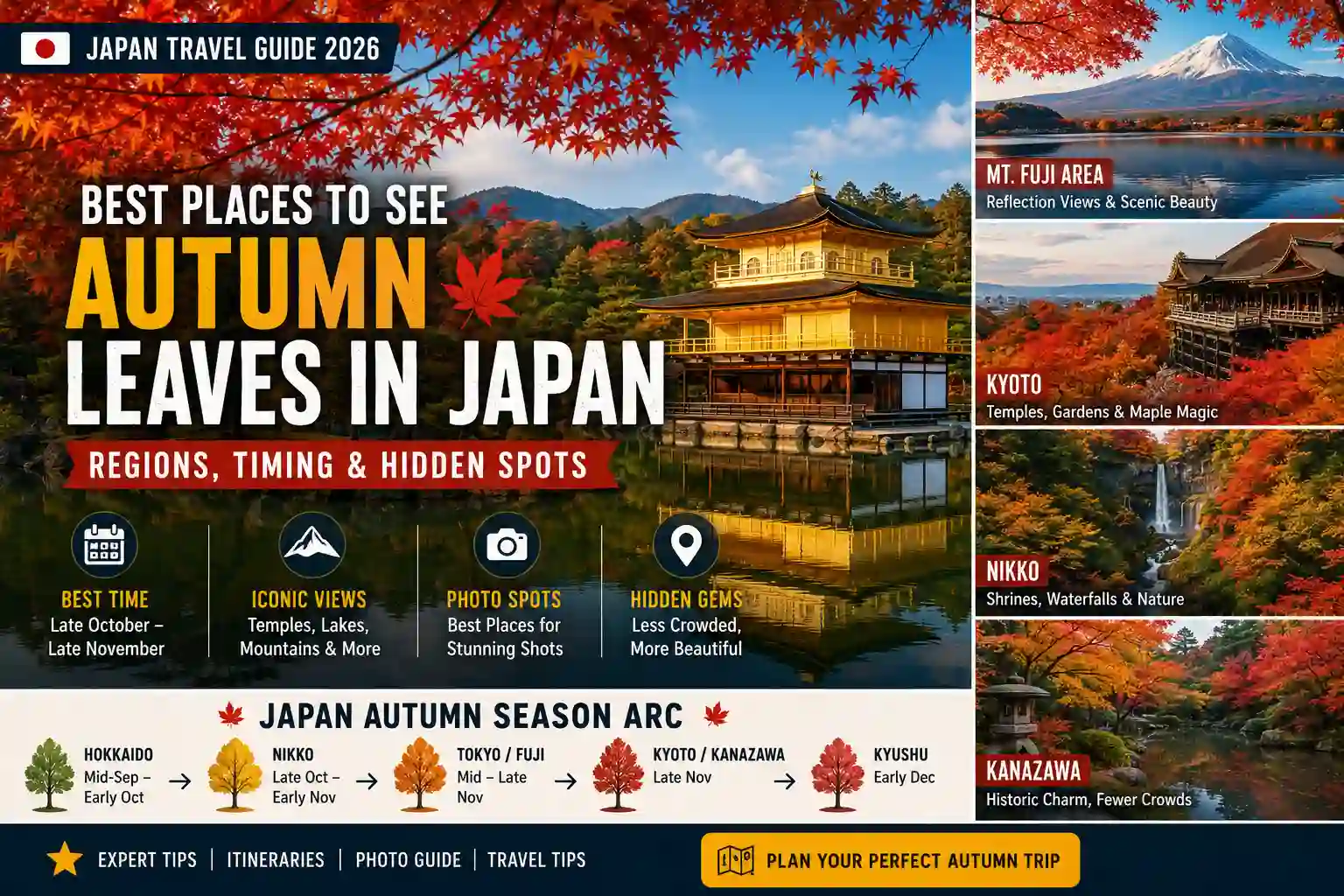
The season moves like a slow wave. It starts in Hokkaido in mid-September and doesn’t finish until Kyushu in December nearly three months of color rolling south through the country. Most travelers pick a destination first and then check dates. That’s backwards. Pick your travel window first, then choose your region.
Timing matters as much as location. Show up in Kyoto in early November and you’ll find mostly green. Arrive the final week of the month and you’ll walk into one of the most deliberately designed autumn landscapes on earth. One week is the difference.
This guide covers where to go by region, when each area peaks, how to photograph it well, and which spots almost no competing guide mentions. Use the route section to build an actual itinerary, not just a wish list.
At a Glance: Japan Autumn Leaves 2026
The koyo season runs late September through early December depending on latitude and elevation. For first-timers, the late October to late November window covers the most ground. Kyoto in late November is the iconic experience. Hokkaido in late September is the earliest and least crowded option at comparable quality.
Quick Reference: Regional Peak Windows
| Region | Peak Window | Best For |
| Hokkaido | Late Sep – mid Oct | Early color, hiking, onsen |
| Nikko | Late Oct – early Nov | Temples + waterfalls |
| Mt. Fuji area | Late Oct – mid Nov | Iconic reflection shots |
| Tokyo | Mid – late Nov | Urban gardens, day hikes |
| Kyoto | Late Nov | Classic temple + maple |
| Kanazawa | Mid – late Nov | Same quality, fewer crowds |
How Japan’s Autumn Works (Read This Before Booking)
Japan’s temperature drops from north to south as the season progresses — Hokkaido’s alpine elevations hit peak color in mid-September while Kyushu is still fully green. The total arc from first color to last spans nearly three months across the full length of the country.
Within any given region, elevation accelerates the timeline. Daisetsuzan’s summit turns before its valleys. Hakone’s hills peak before central Tokyo. A few hundred meters of altitude often means a week or more of lead time.
Year-to-year variation is real. Warmer autumns push peak later — 2025 saw Kyoto’s peak arrive in late November rather than the typical mid-month timing. If your travel dates are fixed, don’t chase a specific spot; choose the region that statistically peaks during your window, then adjust once you arrive based on what you see on the ground.
Hokkaido — Japan’s First Autumn
Hokkaido’s autumn looks nothing like the temple-and-garden aesthetic most people associate with Japan in fall. This is raw alpine color — wide valleys, volcanic peaks, river gorges. It arrives weeks before the rest of the country, and the crowds are a fraction of what you’ll find further south.
Daisetsuzan National Park
Japan’s largest national park holds the country’s earliest autumn. Color begins at altitude in mid-September and works its way down through the valley forests into early October. The Asahi-dake ropeway carries you above the treeline before the valleys have turned — a genuine rarity in a country where most autumn viewing happens at ground level.
Most articles highlight the summit panorama and stop there. The better experience is the descent: a hiking trail through subalpine forest where the color closes in on both sides at eye level. The summit view is wide; the forest walk is immersive.
Peak: Mid to late September | Crowd level: Low
Sounkyo Gorge
Towering basalt cliffs rise above a narrow canyon, with waterfalls dropping through walls of maple and birch. On a weekday morning before 8am, this place can feel genuinely empty — a word you won’t use often in Japan in autumn. The combination of vertical rock and autumn foliage exists nowhere else in the country quite like this.
Peak: Mid October | Crowd level: Low to moderate
Jozankei Onsen
Thirty minutes from central Sapporo, this hot spring town sits where the Toyohira River cuts through forested hills. The Futami Jozan no Michi trail follows the river at stream level — you’re looking across at maples reflected in moving water, not up into a canopy overhead. That lateral perspective is what most autumn walks miss.
Stay in Sapporo and day-trip both Sounkyo and Jozankei — neither spot requires an overnight.
Peak: Early to mid October
Nikko — Waterfalls, Shrines, and Mountain Color
For autumn specifically, Nikko is the most impactful day trip from Tokyo. The layering here is unusual: cedar forest, gold-lacquered shrine architecture, and red maple, all in the same frame. It’s a different visual register from anything in Kyoto.
Toshogu Shrine’s approach through ancient cedar is dramatic even without the autumn color. Add the surrounding maple canopy in late October and the contrast — dark cedar against bright red — is genuinely striking. Kegon Falls drops 97 meters into a canyon surrounded by autumn trees; in peak foliage the waterfall and the color compete for attention roughly equally, and neither loses.
Lake Chuzenji, above the falls, is the primary reflection photography spot. Arrive before 8am when the water is still. Midday wind disturbs the surface and the shot disappears.
For crowd management: mid-week in early November, just past peak, offers color that’s still 85-90% of its best while the weekend crush of late October has thinned considerably. A JR Nikko day pass covers the journey from Tokyo — no regional pass needed.
Peak: Late October to early November
Mt. Fuji Area — The Reflection Shot (And Beyond It)
Every photographer knows the image: Fuji reflected in a still lake, surrounded by autumn color. Getting beyond that one shot — and finding quieter alternatives within the same area — is worth the extra planning.
Lake Kawaguchi (Kawaguchiko)
The Maple Corridor on the lake’s north shore concentrates the densest color closest to the water. On calm mornings, the reflection photograph works. On overcast days, Fuji appears as a silhouette through mist — a different composition, but not a lesser one. Arrive 30 minutes after sunrise before the tour group coaches fill the lakeside car parks.
Peak: Late October to mid-November
Oshino Hakkai
Eight spring-fed ponds in a village of thatched farmhouses, with Fuji rising directly behind. The water here is so clear that the bottom is visible 3-4 meters down. From Oshino you’re looking at Fuji’s northern face, which catches better morning light than the view from Kawaguchi. Less photographed, more intimate, and easier to have to yourself before 9am.
Hakone
Hakone combines Fuji views, volcanic landscape, hot springs, and an open-air sculpture park in one geography. The Hakone Open-Air Museum in mid-November surrounds modern sculpture with fiery tree color — it’s an unexpected combination that earns the trip. The Romancecar from Shinjuku is the most comfortable access point, about 85 minutes direct.
Peak: Mid November
Tokyo — Autumn Between the Buildings
Tokyo’s autumn is accessible, not spectacular. Ginkgos and maples in formal gardens and park-lined avenues rather than mountain forests. The value is logistics: no overnight travel, minimal planning, and a handful of genuinely excellent spots that reward early arrival.
Meiji Jingu Gaien
Around 150 ginkgo trees line a 300-meter avenue. In mid to late November they turn gold simultaneously — not scattered, but uniform, which is what makes the corridor effect work. The annual Ginkgo Festival runs during peak with food stalls along the avenue. Good atmosphere; congested for photography. Late afternoon light hits the avenue from the southwest — the best window for photographs is around 3:30-4pm on a clear day.
Peak: Mid to late November
Rikugien Garden
An Edo-period strolling garden centered on a large pond that reflects the surrounding maple and ginkgo canopy. The evening illuminations run until 9pm on selected November dates, and the reflection shots at night — colored light on still water — are the reason to visit. Smaller and more intimate than Shinjuku Gyoen, which means the compositions are tighter and less dispersed.
Peak: Late November to early December
Mount Takao
Real forest, real hiking, one hour from Shinjuku on the Keio Line. Trail 6 follows a stream through beech, oak, and cedar — completely different in character from the main Trail 1, which is basically a wide path to a viewpoint. The stream trail is where the color surrounds you on both sides. On weekends the cable car line runs 45+ minutes; capable walkers should go on foot and use the cable car only on the descent.
Peak: Mid to late November
Tokyo’s ginkgo season extends into early December, one of the latest peak windows in the Kanto region.
Kyoto — The Iconic Season, Honestly
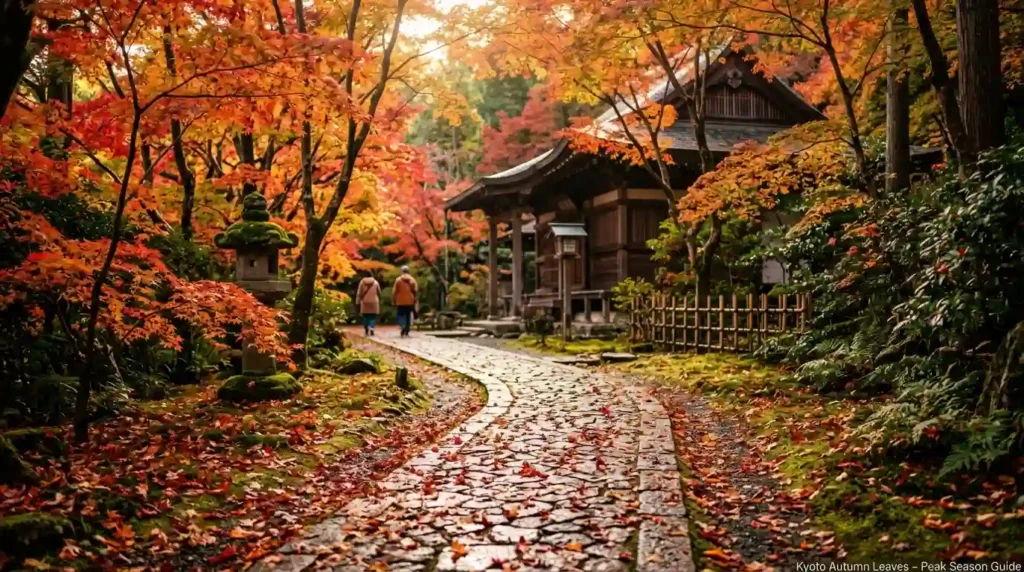
Late November in Kyoto is crowded. That’s not a guidebook exaggeration. Domestic travel peaks simultaneously with international visitors in the final two weeks of November, and the major temples fill by 9am on weekends. The crowds are real and you should plan around them rather than hoping to avoid them.
The reason to go anyway: Kyoto’s garden designers spent centuries planning for this exact moment. The maple placement isn’t accidental — it’s deliberate. You’re walking inside a composition that was built for November.
Eikando (Zenrinji Temple)
The pond reflection of the maple-covered hillside is the defining image of Kyoto in autumn. Climb to the Tahoto Pagoda for the wider view: the entire temple complex in a bowl of red and gold below you. The evening illuminations transform the pond into something different — the reflection becomes the main subject rather than the hillside, and the crowd is thinner than midday. Worth a separate evening visit.
Peak: Mid to late November
Arashiyama
Togetsukyo Bridge with forested mountains behind it is the most reproduced Kyoto autumn image. The crowds along the main path are the price of that view. The escape: Jojakko-ji temple, up the hill from the bamboo grove, with moss-covered steps, a maple canopy overhead, and a fraction of the visitors who stop at the better-known spots below. Most people don’t walk the extra ten minutes uphill. Their loss.
Peak: Late November
Nanzen-ji
The enormous Sanmon Gate with autumn forest visible through its upper arch is one of the best naturally framed views in Japan. The aqueduct behind the temple — a 19th-century brick structure half-hidden in maple trees — is almost never photographed, which is precisely why you should photograph it. Follow the path behind the main hall to find it.
Peak: Late November
Kurama Village
Thirty minutes from central Kyoto on the Eizan Electric Railway, Kurama sits in a mountain valley with ancient cedar forest, a hillside temple, and almost none of the tourist density of the main Kyoto circuit. The Kurama-dera temple complex requires a 30-minute uphill walk through forest to reach the main hall, and that walk — through mixed cedar and maple canopy — is the point. The valley floor turns vivid red in mid-November, about a week ahead of central Kyoto’s peak, which means you can combine both in a single trip.
This is the most underrated autumn spot in greater Kyoto, and it appears in almost no competing travel guides.
Peak: Mid to late November
Practical crowd strategy: Weekday mornings within the first 30-60 minutes after opening give you the best light and the lowest density. The second week of November delivers 80-90% of peak color with noticeably fewer visitors than the final week, when domestic and international tourists converge simultaneously. Evening illuminations shift the experience entirely — different light, a different crowd dynamic, and many day visitors have already left by 6pm.
Kanazawa — Kyoto-Level Beauty, Half the Crowds
The honest comparison: Kanazawa delivers the same caliber of autumn experience as Kyoto with significantly fewer international visitors. It’s one of the most overlooked decisions in Japan autumn travel.
Kenrokuen Garden — one of Japan’s three designated “great gardens” — holds stone lanterns, teahouse pavilions, and maple clusters that light up in late November. The evening illumination reflects the garden in its central pond. Higashi Chaya District, the preserved geisha quarter nearby, is best visited on a weekday morning before the tour groups arrive: narrow ochre-walled lanes that look like Kyoto’s best alleys, without the foot traffic.
Weather note: Kanazawa sits on the Sea of Japan coast and runs misty in autumn. That diffused light softens the color differently than Kyoto’s clear-sky sharpness — closer to an oil painting, less to a photograph. Some prefer it.
Peak: Mid to late November | Access: 2.5 hours from Tokyo by Shinkansen; easy to insert between Nikko and Kyoto
Hidden Spots Most Guides Skip
These four locations appear in almost no competing articles. Each is worth a detour — and two of them rival more famous spots on pure visual terms.
Korankei Gorge (Aichi Prefecture)
Nearly 4,000 maple trees packed into a narrow gorge near Toyota City in Aichi. The density of color here is more intense than most Kyoto gardens — it’s just not famous outside Japan. The gorge shape funnels the trees into a compressed, almost theatrical frame: walls of maple on both sides, closing to a narrow strip of sky overhead. Around November 18-20 is typically peak. Access is about an hour from Nagoya by bus or car.
Metasequoia Namiki Avenue (Shiga Prefecture)
A 2.4-kilometer avenue of around 500 metasequoia trees near Lake Biwa. In November the trees turn rust-red and the avenue creates a perspective corridor — two converging walls of color meeting at a vanishing point — that looks unlike anything else in Japan. Twenty minutes from Makino Station by car. This is a specific trip, not something you stumble past.
Peak: Mid to late November
Kiso Valley / Nakasendo Trail (Nagano Prefecture)
The historic post towns of Magome and Tsumago, connected by an 8-kilometer forest trail through the same mountain road that Edo-period travelers used 300 years ago. Stone paths, thatched-roof inns, autumn forest, and almost no cars. The walk takes about three hours one-way and is manageable as a day trip from Nagoya or Matsumoto. The combination of historical setting and autumn color is unlike the temple circuit further south.
Peak: Late October to mid-November
Kurobe Gorge (Toyama Prefecture)
A narrow-gauge sightseeing train runs through one of Japan’s deepest canyons. Canyon walls, seasonal suspension bridges, waterfalls, and the compressed drama of steep autumn terrain on both sides of the train windows. The train operates only until late November before winter closure — check exact dates before planning, as the final departure can be as early as the third week of November in some years.
Peak: Mid October to early November
Photography: Getting the Best Shots
Overcast mornings are underrated. Diffused light eliminates harsh shadows in dense forest and produces even color rendering across the frame — particularly useful in heavily canopied spots like Kurama or the Nakasendo trail.
Clear mornings serve a different purpose: dramatic contrast and reflection photography. For lake shots — Kawaguchi, Chuzenji, or Eikando’s pond — arrive before wind disturbs the surface. By 9am, most reflection shots are compromised.
Rain doesn’t cancel plans; it improves them. Light rain intensifies color saturation and creates reflections on stone paths and wooden decking that don’t exist on dry days. The post-rain hour, when the light returns, is often the single best window of the day.
Opening time (usually 8-8:30am) gives you the best available light and the lowest crowd density simultaneously. At 11am, both advantages are gone.
The best reflection spots in the country: Lake Kawaguchi, Eikando pond in Kyoto, Lake Towada in Aomori, and Koishikawa Korakuen in Tokyo.
One compositional note worth keeping: pure foliage photographs become visually repetitive across an album. Include one structural element in each frame — a gate, a water surface, a stone path, a bridge — to give the color context and the image somewhere to rest.
Trip Planning: Routes That Actually Work
7 Days — First-Timer Route
- Days 1-2: Tokyo (Meiji Gaien, Rikugien, Mount Takao)
- Day 3: Nikko day trip
- Days 4-5: Kyoto (Arashiyama + Eikando + Kurama)
- Day 6: Nara
- Day 7: Return or flex
Best arrival timing: into Tokyo around November 14-16 and into Kyoto by November 20-22 to catch peak color in both regions.
10 Days — Add Kanazawa
Insert two days in Kanazawa between Nikko and Kyoto. Take the Shinkansen from Tokyo to Kanazawa, then the limited express to Kyoto. Alternatively: start with three days in Hokkaido, fly to Tokyo, and run the same southern route.
14 Days — Chase the Wave
Hokkaido (3 days) → Oirase Gorge/Tohoku (2 days) → Nikko (1 day) → Tokyo (2 days) → Fuji area (1 day) → Kanazawa (2 days) → Kyoto/Nara (3 days)
This route follows the foliage front southward, keeping each region near its individual peak. It’s the most immersive way to experience the full season — and it genuinely earns the phrase “chasing autumn.”
JR Pass: Worth it for any itinerary covering Tokyo, Kyoto, and at least one additional major region.
Accommodation: Book Kyoto three to four months ahead for November. Osaka, 15 minutes from Kyoto Station by Shinkansen, works as a budget base with easy access.
Common Mistakes Travelers Make
Booking Kyoto for early-to-mid November is the most frequent error — mid-November often shows 50-60% color at best. Late November is the real peak, and the bookings that matter are the ones that land you there on a weekday.
Treating Hokkaido as a skip is the second. It offers the earliest color in the country, the lowest crowd density, and a completely different landscape character. Travelers who go wonder why they waited.
Visiting popular Kyoto temples on weekend afternoons is the single worst timing combination. The crowds compound mid-morning and don’t thin until evening. Weekday mornings or evening illumination visits are the only two good options.
Missing the 8am window changes the experience significantly. The quality difference between 8am and 11am at the same temple — in light, in crowd density, in photograph quality — is not marginal. It’s the difference between a good experience and a frustrating one.
Skipping Kanazawa or Nikko because they’re not on the standard tourist circuit is a pattern worth breaking. Both places consistently outperform traveler expectations.
Best Strategy Summary
One week: Tokyo + Nikko + Kyoto. Arrive mid-November. Be in Kyoto by late November.
Ten days: Add Kanazawa between Nikko and Kyoto. Same route, deeper.
Two weeks: Start in Hokkaido late September or early October. Follow the wave south.
If you go only once: Third week of November. Kyoto + Nara + one day in Kanazawa on the way back.
Best kept secret: Kurama Village, 30 minutes from Kyoto, overlooked by roughly 95% of visitors to the city.
Final Thoughts
Chasing autumn leaves in Japan is one of those travel experiences that rewards understanding over luck. Pick a date without knowing the wave — the way color moves from north to south, from mountains to cities, from early October to late November — and you might arrive a week too early or a week too late. Understand the pattern and you can plan around it, adjusting by a few days if the season runs early or late in a given year.
The most reliable public resource for real-time tracking is the Japan Meteorological Corporation’s koyo forecast, updated throughout the season. Weather services and Japanese tourism boards publish weekly updates once October arrives. Checking these a few weeks before you travel and adjusting your itinerary accordingly is worth doing — a few days’ difference at the right spot can be the difference between good and extraordinary.
Whatever region you’re in, the crowds are heaviest on weekends, the light is best in the morning, and the spots everyone knows are worth seeing even if they’re busy. Japan’s autumn is popular because it actually delivers. Just go with some understanding of when and where, and it will.
