

This page covers everything you need to know about the Deccan Herald logo — one of South India’s most recognised masthead identities. Deccan Herald is Karnataka’s leading English-language daily, established in 1948. Its current logo, introduced on August 5, 2019, marked the paper’s most significant visual overhaul in decades — and this guide walks through the brand history, the 2019 redesign, official colors, format options (PNG, SVG, WebP), and proper usage guidelines.
What Is the Deccan Herald Logo? (Quick Brand Overview)
Deccan Herald is an English-language daily published from Bengaluru, Karnataka. It launched on June 17, 1948, founded by K. N. Guruswamy and published by The Printers (Mysore) Private Limited — a company that still owns and operates the paper today.
The current logo has been in place since August 5, 2019. Edinburgh-based design agency Palmer Watson Words and Pictures led the rebrand, introducing an aquamarine blue masthead (approximately hex #00A8B4), a stacked DH monogram, and the paper’s first formal tagline: “The Power of Good.”
It’s a logo that signals both heritage and intent — and it’s immediately recognisable on print, digital, and mobile.
Brand Facts at a Glance
| Attribute | Detail |
| Founded | June 17, 1948 |
| Logo Since | August 5, 2019 |
| Primary Color | Aquamarine Blue (~#00A8B4) |
| Designer | Palmer Watson Words and Pictures (Edinburgh) |
| Tagline | “The Power of Good” |
| Publisher | The Printers (Mysore) Private Limited |
Deccan Herald Logo History — From 1948 to 2025
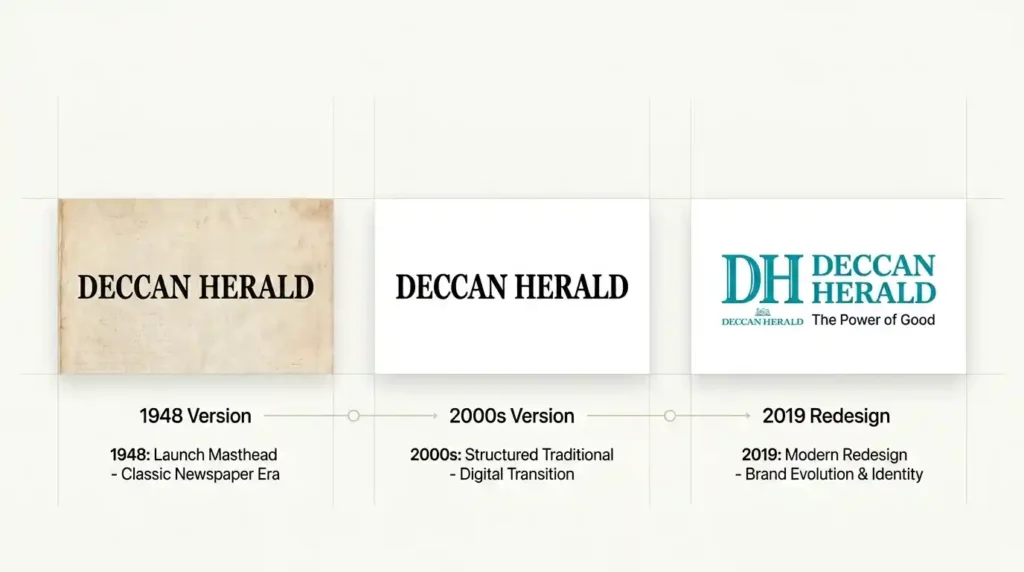
When Deccan Herald launched in June 1948 as an eight-page tabloid priced at one anna, the masthead was purely functional — a black serif wordmark with no secondary mark, no tagline, and no color. The goal was readability, not brand equity. That was the standard for press design of the era.
Through the 1960s into the 1990s, the paper grew into a full broadsheet, but the masthead evolved cautiously. The type shifted toward a more structured, conservative style. During this period, the Nandi bull — the state symbol of Karnataka — began appearing as part of the corporate identity of The Printers (Mysore) Pvt. Ltd., though not prominently on the masthead itself.
The early 2000s brought the internet. The logo migrated online without significant adaptation, a common shortcut among legacy print titles at the time.
Then August 5, 2019 changed everything. Palmer Watson redesigned the entire visual system — new color, new type hierarchy, centralized layout, a stacked DH monogram, and the “Power of Good” tagline. This wasn’t cosmetic maintenance; it was a deliberate editorial repositioning for a generation that reads news on a phone screen. The masthead finally looked like it belonged in the same decade as its digital audience.
From 2020 onward, the identity has been consistent: same aquamarine blue, same DH mark, same proportions across print editions, the website, the mobile app icon, and social media avatars.
The 2019 Redesign — What Changed and Why It Worked
New Color: Aquamarine Blue
The most visible change in 2019 was the color shift — from decades of black ink to a vivid aquamarine blue at approximately hex #00A8B4. The newspaper’s own design documentation cited the goal of projecting “richness to convey depth” while building appeal with younger readers.
It worked because aquamarine occupies an unusual position in the color spectrum for news: authoritative enough to read as serious journalism, fresh enough to avoid the institutional heaviness of navy or charcoal. On a mobile screen, it pops cleanly against white without feeling garish.
Typography and Layout Changes
The 2019 rebrand moved headline alignment to a centered model and deliberately introduced more white space across the page. The reasoning was direct: reduce visual clutter for readers who switch between print and digital throughout the day.
That same logic carries into the website and app. Cleaner column structure, fewer competing typographic weights, more breathing room between elements. The redesign treated print and digital as one continuous reading environment rather than two separate products.
The DH Monogram and Tagline
The stacked “DH” monogram was built specifically for small formats — the app icon, browser favicon, social media profile picture. At 32×32 pixels, the full wordmark becomes illegible; the DH mark holds its identity.
“The Power of Good” was the paper’s first formal masthead tagline in 75 years of publication. It communicates an editorial stance: that journalism done properly is a force for positive outcomes. Whether you read that as civic optimism or brand positioning depends on your cynicism level — but as a tagline, it’s specific enough to mean something.
Deccan Herald Logo Color — Meaning Behind Aquamarine Blue
Color Reference
| Swatch | Name | Hex |
| 🟦 | DH Aquamarine | #00A8B4 |
| ⬛ | DH Ink Black | #0D1117 |
| ⬜ | Background White | #FFFFFF |
| 🔵 | Light Tint | ~#E6F8FA |
Blue is the dominant color in global news branding for a reason: it tests consistently for trust, authority, and reliability. But most news blue is dark — navy, royal, or midnight. Deccan Herald chose teal-adjacent aquamarine, and that distinction matters.
Compare the competitive landscape: Times of India leads with red, The Hindu uses dense dark typography, Indian Express leans on black-and-white authority. Aquamarine gives Deccan Herald its own lane. There’s no color confusion at the newsstand or on a social media feed.
Demographically, teal and aquamarine track well with 18–35 audiences across brand research — it reads as modern without being trendy. Functionally, #00A8B4 renders cleanly at any screen resolution, holds contrast against both white and dark backgrounds, and scales without muddying. For a brand living across print, 4K monitors, and phone screens, that flexibility isn’t incidental — it’s essential.
The Nandi Bull — Deccan Herald’s Hidden Brand Symbol
Most coverage of the Deccan Herald brand stops at the blue masthead. Almost none mentions the Nandi.
The Nandi — Shiva’s sacred bull — is the state emblem of Karnataka. The Printers (Mysore) Pvt. Ltd. uses a refined Nandi mark as part of its corporate identity, separate from the DH masthead but connected to the same publishing house. According to design documentation from the 2019 rebrand, this symbol was “beautifully refined and adapted” for the digital platform, with animated printer’s marks derived from the Nandi appearing as site interaction cues.
The result is a dual visual identity: the aquamarine DH wordmark for all public-facing communication, and the Nandi as a heritage mark embedded in the company’s deeper institutional layer. It’s a quiet signal of Karnataka roots that most readers will never consciously notice — and that’s exactly the point.
Deccan Herald Logo PNG, SVG & WebP — Which Format to Use?
Format choice matters depending on how you plan to use the logo.
PNG is the go-to for web articles, blog posts, presentations, and social media. Always use a transparent-background PNG when placing the logo over any non-white surface.
SVG is a scalable vector format — it has no quality ceiling. Resize to any dimension and it stays sharp. Use SVG for print materials, large-format designs, or anywhere visual precision is non-negotiable.
WebP delivers the same visual quality as PNG at a smaller file size — typically 25–35% lighter. Use it for web pages where load speed matters, which is most pages.
EPS/AI files are required for professional print production environments. These are usually available only through official press kits and are not for general download.
Format Reference Table
| Format | Best For | Key Advantage |
| PNG | Web, social, presentations | Transparency support |
| SVG | Print, large-format | Resolution-independent |
| WebP | Fast-loading web pages | Smaller file size |
| EPS/AI | Professional print | Maximum precision |
Image SEO note: When using the logo in editorial content, name the file deccan-herald-logo.png or deccan-herald-logo-transparent.png. Alt text should read: Deccan Herald official logo transparent PNG — aquamarine blue 2019 redesign. This aids both accessibility and Google image indexing.
Copyright notice: The Deccan Herald logo is a registered trademark of The Printers (Mysore) Private Limited. It may be used in editorial, journalistic, academic, or press contexts. Any commercial use requires written permission from the publisher.
Official Usage Guidelines — What You Can and Cannot Do
Acceptable uses include editorial journalism that references or quotes Deccan Herald, academic and media industry research, design education citing the 2019 rebrand as a case study, and press releases identifying Deccan Herald as a media partner.
Not permitted without written permission: using the logo on commercial products, modifying the logo in any form, creating the impression that Deccan Herald endorses a product or service, or redistributing recreated or reworked versions of the logo file.
For official media kit assets and press-use materials, contact Deccan Herald directly through deccanherald.com.
Deccan Herald vs Deccan Chronicle — Are They the Same?
They share a word. That’s where the similarity ends.
Quick Comparison
| Deccan Herald | Deccan Chronicle | |
| Founded | 1948 | 1938 |
| HQ | Bengaluru, Karnataka | Hyderabad, Telangana |
| Coverage | Karnataka-focused | 5 South Indian states |
| Publisher | The Printers (Mysore) Pvt. Ltd. | Deccan Chronicle Holdings |
| Logo Color | Aquamarine blue | Distinct identity |
| Logo Designer | Palmer Watson (2019) | Separate design history |
Deccan Herald was founded in Bengaluru in 1948 and remains focused on Karnataka. Deccan Chronicle launched a decade earlier in Hyderabad and covers a broader South Indian footprint under entirely separate ownership. Despite the shared “Deccan” in the name, these are independent publications with no common ownership, no shared editorial team, and no visual identity overlap.
Frequently Asked Questions
What color is the Deccan Herald logo?
The Deccan Herald logo uses aquamarine blue (#00A8B4). It was introduced in the 2019 redesign to give the brand a modern, fresh visual identity.
When did Deccan Herald change its logo?
Deccan Herald updated its logo on August 5, 2019. The redesign modernized the masthead and introduced the current aquamarine identity and DH monogram.
Where can I find the official Deccan Herald logo PNG?
Official logo files are usually available through Deccan Herald’s media kit. Always use authorized sources to ensure correct usage and licensing compliance.
Is Deccan Herald the same as Deccan Chronicle?
No, both are different newspapers. They have separate ownership, headquarters, editorial teams, and regional coverage, despite sharing the word “Deccan” in their names.
Who designed the Deccan Herald logo?
The current logo was designed by Palmer Watson Words and Pictures, an Edinburgh-based design agency, during the 2019 rebranding process.
Can I use the Deccan Herald logo on my website?
Only editorial use is generally allowed. Commercial use, modification, or branding misuse requires written permission from the publisher.
Conclusion
The Deccan Herald logo has evolved from a simple traditional masthead into a strong and recognizable digital brand identity that reflects the modern transformation of journalism. From its classic black wordmark in 1948 to the refreshed aquamarine redesign in 2019, each stage has contributed to a clearer and more refined visual direction for the publication. The Deccan Herald logo today is not just a design update but a strategic shift toward better digital presence and audience engagement.
The 2019 rebrand gave Deccan Herald a fresh, consistent identity across print, web, and mobile platforms. The aquamarine color and DH monogram make the brand visually distinctive, while the tagline “The Power of Good” reinforces its editorial purpose. Overall, the Deccan Herald logo stands as both a branding asset and a lasting symbol of credibility and legacy in Indian journalism.
