

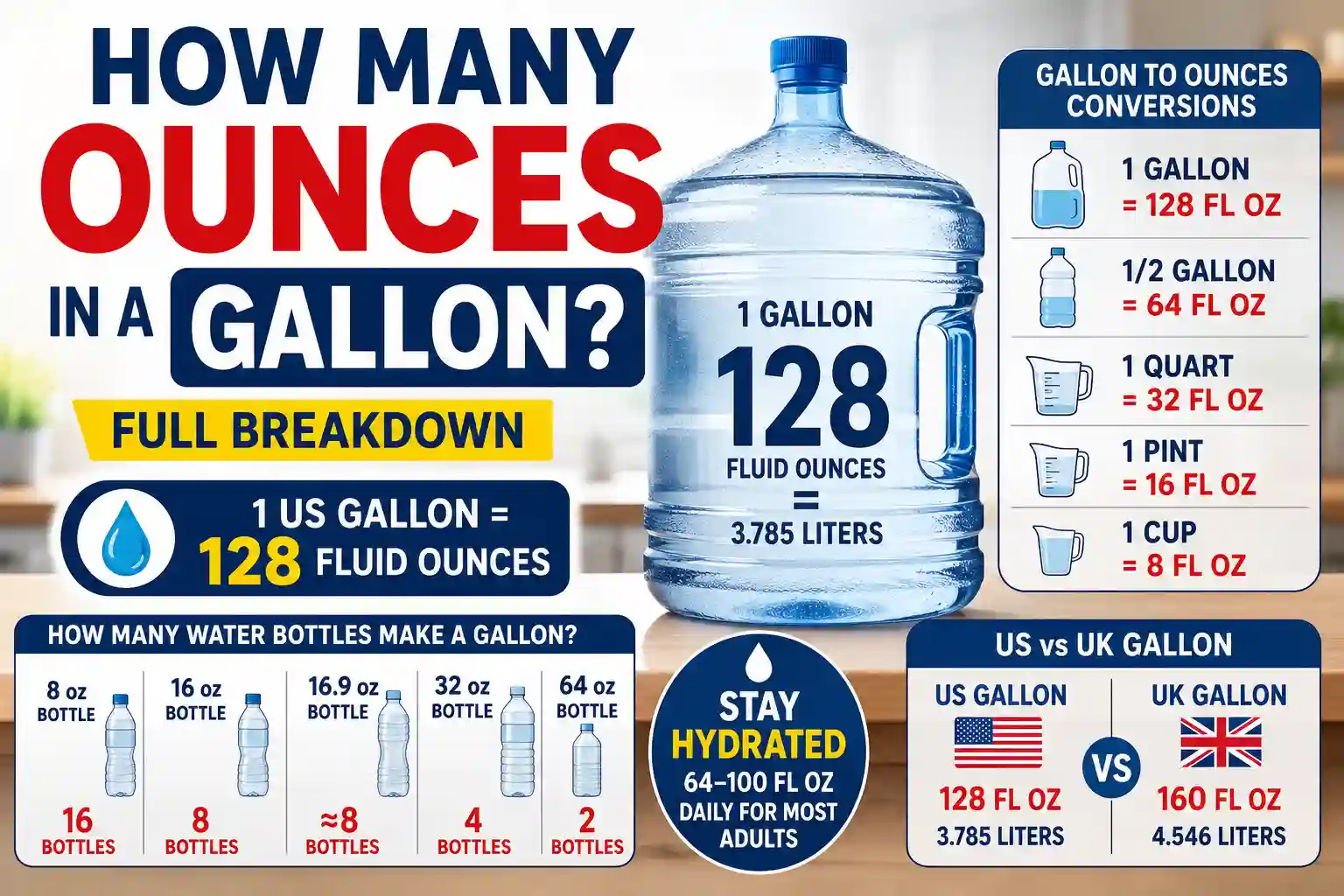
There are 128 fluid ounces in a US gallon and that’s the number most people are searching for. But how many ounces in a gallon of water you should drink daily, why your half-gallon jug says 64 oz, or why UK recipes give you different numbers that’s where it gets interesting.
This guide covers every conversion, every common confusion, and all the hydration questions you actually care about, all in one place.
The Quick Answer How Many Ounces in a Gallon
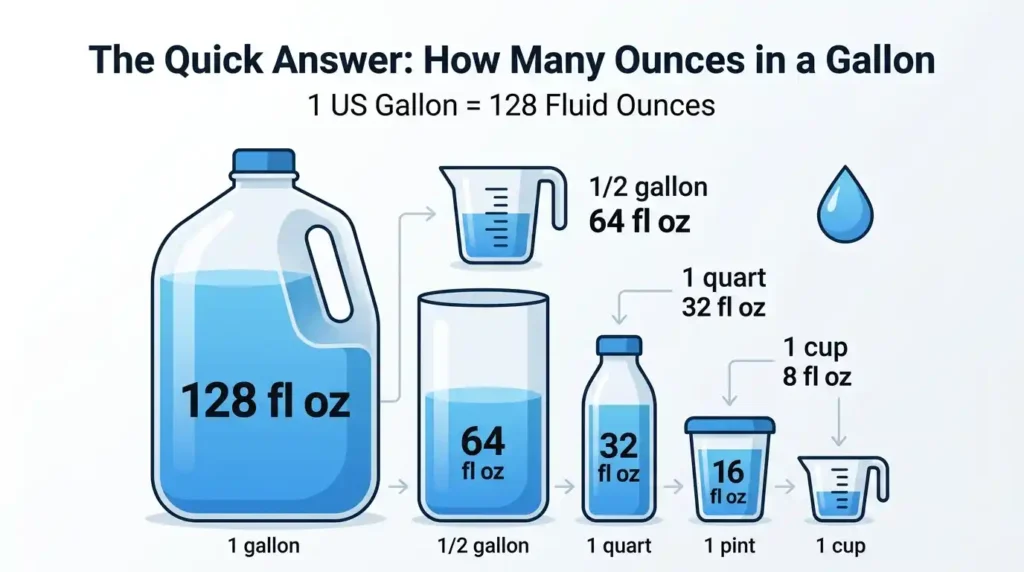
One US gallon contains exactly 128 fluid ounces. That means a half gallon is 64 fl oz, a quart is 32 fl oz, a pint is 16 fl oz, and a standard cup is 8 fl oz. These are fixed, defined values under the US customary units system not approximations.
What Exactly Is a Fluid Ounce?
A fluid ounce is a unit of volume not weight. It measures how much space a liquid takes up. One fluid ounce equals approximately 29.57 milliliters in the US system.
This matters because grocery labels, recipe books, and hydration apps all use fluid ounces when talking about liquids. It’s purely about capacity.
Is a Fluid Ounce the Same as a Weight Ounce?
No and this trips people up constantly. A fluid ounce (fl oz) measures volume. A weight ounce (oz) measures mass.
128 fl oz of water happens to weigh close to 128 weight oz because water is very dense but pour 128 fl oz of olive oil or honey and the weight will be completely different. The two units are not interchangeable.
Wait Which Gallon? The US vs. UK Gallon Confusion, Solved
A US gallon is not the same as a UK gallon. The US gallon equals 128 fluid ounces. The UK Imperial gallon equals 160 fluid ounces that’s 25% more liquid in the same word.
If you’re following a UK recipe, reading a British product label, or googling from outside the US, you may be getting the wrong number without realizing it.
Why Does the US Have a Different Gallon?
The split comes down to history. In 1706, Queen Anne of England standardized the wine gallon at 231 cubic inches which became the foundation for the US gallon after American independence. The US kept that standard.
Britain later went a different direction. The UK Weights and Measures Act of 1824 established the larger Imperial gallon (277.4 cubic inches) for the British Empire. The US, by then independent, didn’t follow.
The result: two countries, two gallons, centuries of confusion.
How Does the Metric System Compare?
For anyone outside the US, here’s a quick anchor:
| Unit | US Customary | Metric Equivalent |
| 1 US gallon | 128 fl oz | 3.785 liters |
| 1 UK Imperial gallon | 160 fl oz | 4.546 liters |
| 1 liter | ~33.8 fl oz | 1,000 ml |
The metric system is simpler for most of the world but if you’re in the US, the 128 fl oz standard is what applies everywhere from fuel stations to milk jugs.
The Full Breakdown From Gallons Down to Ounces (and Everything In Between)
Here is every major US liquid measurement and how it relates to the gallon:
| Unit | Fluid Ounces | Gallons |
| 1 gallon | 128 fl oz | 1 |
| 1 half gallon | 64 fl oz | 0.5 |
| 1 quart | 32 fl oz | 0.25 |
| 1 pint | 16 fl oz | 0.125 |
| 1 cup | 8 fl oz | 0.0625 |
| 1 fluid ounce | 1 fl oz | 0.0078 |
Every value above is exact within the US customary system. There’s no rounding these are defined ratios.
How Many Water Bottles Make a Gallon?
This is one of the most searched hydration questions right now, especially with the “drink a gallon a day” fitness trend everywhere on TikTok and YouTube. Here’s the math by bottle size:
| Bottle Size | Bottles to Make 1 Gallon |
| 8 oz (small) | 16 bottles |
| 16 oz (standard) | 8 bottles |
| 16.9 oz (standard US store bottle) | ~7.57 bottles (~8 full bottles) |
| 32 oz (large) | 4 bottles |
| 64 oz (half gallon) | 2 bottles |
The 16.9 oz size (500 ml) is the most common bottled water size sold in the US. You’d need just under 8 of them to hit a full gallon most people round up to 8 for simplicity.
How Many Cups, Pints, and Quarts in a Gallon?
If you prefer thinking in other units rather than ounces:
- 1 gallon = 16 cups
- 1 gallon = 8 pints
- 1 gallon = 4 quarts
- 1 gallon = 2 half gallons
These are the building blocks for every US liquid recipe, every hydration calculation, and every conversion you’ll ever need.
How Many Ounces in a Gallon of Water Should You Actually Drink?
Most healthy adults need roughly 64–100 fluid ounces of water per day from all sources, though the exact amount depends on body weight, activity level, and climate. That’s anywhere from a half gallon to just under a full gallon daily.
Is 64 Ounces of Water Enough Per Day?
For many adults, yes 64 oz (half a gallon, or 8 standard cups) meets the minimum daily hydration target. The old “8 glasses of 8 oz per day” rule comes directly from this number.
However, the National Academies of Sciences, Engineering, and Medicine set a higher general target: about 125 oz (3.7 liters) per day for men and 91 oz (2.7 liters) per day for women from all food and drink combined. Around 20% of daily water intake typically comes from food, especially fruits and vegetables.
Bottom line: 64 oz is a solid floor, not a ceiling.
Is Drinking a Gallon of Water a Day Actually Safe?
For most healthy adults, yes drinking a full gallon (128 fl oz) per day is safe and can support energy, digestion, and skin health.
The “gallon a day challenge” has been popular in fitness communities for years, and for active people in warm climates, it’s a reasonable goal. That said, forcing fluid intake far beyond your thirst in a short time can lead to hyponatremia (low sodium) a rare but real risk.
If you’re active, sweating heavily, or in a hot climate: a gallon a day is reasonable and often beneficial.
If you’re sedentary and in a cool environment: your needs may be lower. Let thirst guide you and use 64–80 oz as a practical minimum.
Which Organs Benefit Most From Staying Hydrated?
Water is not just for thirst it runs critical functions across your entire body:
- Kidneys: Filter about 200 liters of blood daily and need adequate water to flush waste through urine. Dehydration is the leading cause of kidney stones.
- Brain: About 75% water. Even mild dehydration (1–2% fluid loss) measurably impairs focus, memory, and reaction time.
- Skin: Hydration supports elasticity, cell turnover, and the skin barrier. Chronic low water intake is linked to dryness and accelerated aging.
- Heart: Adequate blood volume (maintained by water) reduces the heart’s workload and supports stable blood pressure.
- Digestive system: Water keeps food moving through the gut. Low intake is the most common cause of constipation.
Bottled vs. Tap Does the Container Change What You’re Drinking?
The container doesn’t change the ounce count 16 oz is 16 oz whether it’s bottled or from your tap. But it does change what you might be ingesting alongside the water itself, and that’s where the debate gets real.
What Do Cardiologists Actually Say About Bottled Water?
The viral “cardiologists say avoid bottled water” claim comes primarily from concerns about microplastics and BPA (bisphenol A) leaching from plastic bottles into the water especially when bottles are stored in heat, like in a hot car or warehouse.
Studies published in peer-reviewed journals have found microplastic particles in most commercial bottled water brands. Research on BPA has linked it to disruptions in hormone regulation, cardiovascular stress, and elevated blood pressure which is why cardiologists specifically have raised concerns.
This doesn’t mean bottled water is dangerous in one-off uses. The concern is about regular, daily reliance on single-use plastic bottles as your primary hydration source.
Is Tap Water as Safe as Bottled Water?
In the United States, tap water is regulated by the EPA under the Safe Drinking Water Act, one of the most rigorous water quality frameworks in the world. Bottled water is regulated by the FDA and by some standards, to a less stringent testing schedule.
In most US cities and developed countries, tap water meets or exceeds bottled water in safety, mineral content, and testing frequency.
Practical takeaways:
- A reusable bottle filled with filtered tap water is safer, cheaper, and better for the environment than single-use plastic bottles.
- If you’re concerned about local tap water quality, a certified home filter (carbon block or reverse osmosis) addresses most contaminants at a fraction of the cost of bottled water.
- If you do use bottled water, store it in a cool, dark place and never reuse single-use plastic bottles heat and repeated use accelerate plastic degradation.
Conclusion
Knowing exactly how many ounces in a gallon 128 for a US gallon, 160 for a UK Imperial gallon is one of those foundational facts that unlocks a chain of practical, everyday answers. Whether you’re measuring ingredients, tracking how many ounces in a gallon of water you’ve drunk today, doing the math on water bottles, or just settling a debate with a friend, the answer is always the same: one gallon, 128 fluid ounces, measured the same way every time.
