

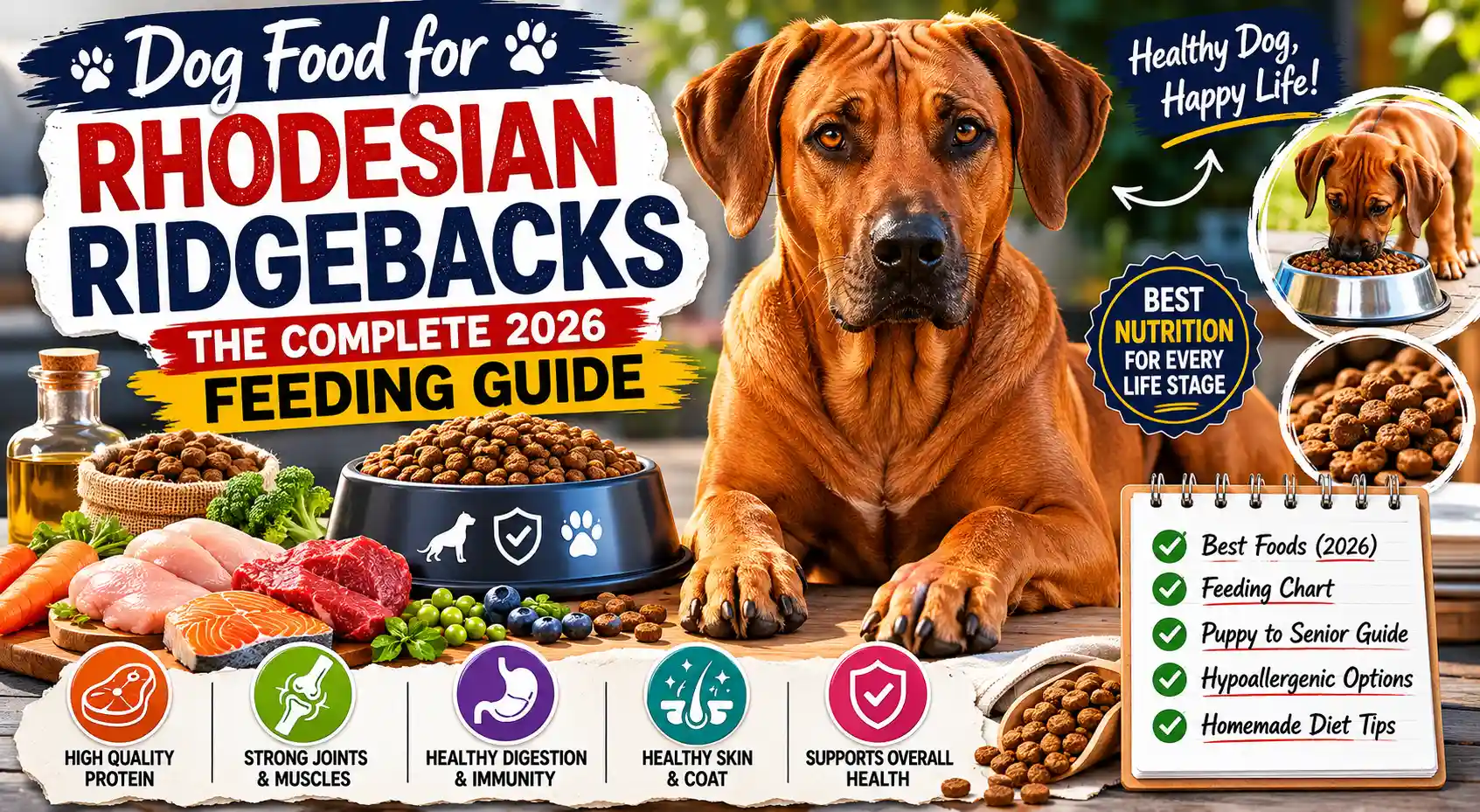
Rhodesian Ridgebacks are not your average large breed dog and they shouldn’t eat like one either. Built for endurance, heat, and athletic performance, this South African breed has specific nutritional demands that generic “large breed” formulas often fail to meet. Whether you’re raising a new puppy or managing an adult Ridgeback’s diet, getting the nutrition right is one of the most impactful things you can do for their long-term health.
This guide covers everything: the best dog food for Rhodesian Ridgebacks in 2026, how to read labels, feeding charts by life stage, hypoallergenic options, homemade meals, and the honest truth about some popular brands.
What Makes Rhodesian Ridgebacks Nutritionally Unique?
Before choosing a food, you need to understand what makes this breed tick biologically.
They’re lean muscle machines. Ridgebacks carry minimal fat and high muscle mass relative to their size (typically 70–85 lbs for males, 60–70 lbs for females). They need high-quality animal protein not plant-based fillers to maintain that muscle composition.
They have deep chests, which raises bloat risk. Gastric Dilatation-Volvulus (GDV), or bloat, is a life-threatening emergency that affects large, deep-chested breeds disproportionately. Diet timing, kibble size, and meal frequency all influence this risk.
Their energy needs shift dramatically with activity level. A Ridgeback who runs 5 miles a day has completely different caloric needs than one who gets two 20-minute walks. A “one-size” feeding amount doesn’t work for this breed.
They can be prone to skin sensitivity. Many Ridgebacks develop environmental or food-related allergies, often showing up as itchy skin, recurring ear infections, or coat dullness which makes ingredient quality and sourcing more important than with many other breeds.
How to Read a Dog Food Label (The Ridgeback-Specific Version)
Most dog owners skim labels. For Ridgeback owners, a few key checkpoints make a real difference:
- First ingredient should be a named animal protein “chicken,” “deboned salmon,” “beef,” not “meat meal” or “poultry by-product meal” as the primary protein source.
- Protein percentage for adults: Look for 28–35% crude protein on a dry matter basis.
- Fat percentage: 14–20% is the right range for active adults. Too low and they lose muscle; too high and sedentary dogs gain fat quickly.
- Avoid corn, wheat, and soy as primary carbohydrates these are common allergen triggers and offer lower nutritional density than alternatives like sweet potato, brown rice, or lentils.
- Calcium-to-phosphorus ratio matters for puppies: More on this in the puppy section below.
Best Dry Dog Food for Rhodesian Ridgebacks
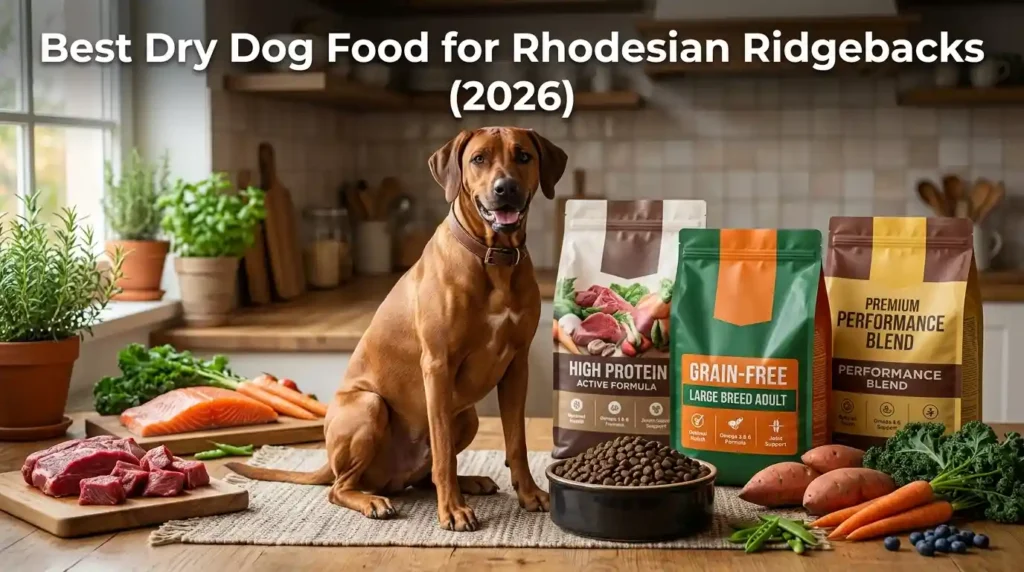
Dry kibble remains the most practical choice for most Ridgeback owners it’s easy to portion control, shelf-stable, and most quality formulas are nutritionally complete.
1. Orijen Large Breed (Top Overall Pick)
Orijen continues to lead in 2026 for ingredient quality. Their large breed formula uses 85% animal ingredients (chicken, turkey, fish, eggs) with freeze-dried liver coating for palatability. The protein percentage lands around 38% slightly above the recommended range for sedentary dogs, so portion control matters. For highly active Ridgebacks, it’s ideal.
Best for: Active adult Ridgebacks, owners who prioritize ingredient sourcing.
2. Purina Pro Plan Large Breed Adult (Best Science-Backed Formula)
Pro Plan’s large breed chicken and rice formula remains one of the most rigorously tested dog foods available. It’s backed by feeding trials (not just nutrient analysis), and its AAFCO statement reflects actual feeding study data. The protein quality is excellent, the calcium-phosphorus ratio is well-calibrated, and it’s widely available.
Best for: Owners who want peer-reviewed formulation backing, moderate budgets.
3. Royal Canin Large Breed Adult
Royal Canin engineers food for specific body conditions, not marketing. Their large breed adult formula is designed to support joint health, muscle maintenance, and digestive efficiency in large-breed dogs. It’s not the most glamorous ingredient list, but the nutritional precision is hard to argue with.
Best for: Ridgebacks with sensitive digestion, owners working with a veterinarian’s recommendation.
4. Fromm Dog Food Large Breed Adult Gold
Fromm dog food deserves a genuine spot on this list, not just a mention. This family-owned Wisconsin company has operated without a recall since 1904, which in the dog food industry is practically unheard of. Their Large Breed Adult Gold uses duck, chicken, lamb, and egg as protein sources, with a moderate protein level around 26% appropriate for less active adults. Fromm rotates proteins seasonally, which may help prevent protein-specific sensitivities.
Best for: Ridgebacks with mild food sensitivities, owners who value brand integrity and safety record.
Best Dog Food for Rhodesian Ridgeback Puppies
Puppy nutrition for large breeds is one area where mistakes have lasting consequences. Ridgeback puppies grow fast they can reach near-adult size within 12–14 months but their skeletal development continues until around 18–24 months. Overfeeding or feeding the wrong calcium-to-phosphorus ratio during this window can contribute to developmental orthopedic disease (DOD), hip dysplasia exacerbation, and joint problems.
What to look for in the best food for Rhodesian Ridgeback puppy:
- AAFCO statement for “growth of large breed dogs” not just “puppies” generically. This distinction matters because large breed puppy formulas restrict calcium to 1.2–1.8% (dry matter basis), whereas standard puppy foods can go much higher.
- Avoid “puppy” formulas designed for small breeds. Higher caloric density and calcium levels appropriate for a Chihuahua puppy can cause problems in a fast-growing Ridgeback.
- Moderate fat: 12–16% is appropriate for large breed puppies. High fat accelerates growth rate, which stresses developing joints.
Top Picks for Ridgeback Puppies:
Purina Pro Plan Large Breed Puppy The gold standard for large breed puppy feeding. Backed by feeding trials, appropriately formulated calcium-to-phosphorus ratio, and widely recommended by veterinary nutritionists.
Hill’s Science Diet Large Breed Puppy Another veterinary-endorsed option with controlled nutrient levels and excellent digestibility. Good choice if your vet has recommended it specifically.
Royal Canin Large Breed Puppy Breed-appropriate kibble size and a formulation specifically modeled for large breed developmental needs. Also contains EPA and DHA from fish oil for brain and eye development.
Rhodesian Ridgeback Feeding Chart
Use this as a starting framework, then adjust based on your dog’s body condition score (you should be able to feel ribs without pressing hard, but not see them visibly).
| Life Stage | Weight Range | Daily Calories | Meals Per Day |
| Puppy (8–16 wks) | 10–25 lbs | 800–1,200 kcal | 3–4 |
| Puppy (4–6 months) | 25–50 lbs | 1,200–1,800 kcal | 3 |
| Puppy (6–12 months) | 50–70 lbs | 1,600–2,200 kcal | 2–3 |
| Adult (active) | 65–85 lbs | 1,600–2,200 kcal | 2 |
| Adult (less active) | 65–85 lbs | 1,200–1,600 kcal | 2 |
| Senior (7+ years) | 60–80 lbs | 1,100–1,500 kcal | 2 |
Bloat prevention note: Always split daily intake into at least two meals. Avoid vigorous exercise for 60–90 minutes before and after feeding. Elevated food bowls are no longer recommended by most veterinary nutritionists research suggests they may increase bloat risk rather than reduce it.
Wet Dog Food for Rhodesian Ridgebacks
Wet food isn’t typically a primary diet for large breeds the cost to calorie ratio is impractical for a dog needing 1,600+ calories daily. However, it has genuine uses:
- Mixing with kibble to improve palatability for picky Ridgebacks
- Post-surgery or illness recovery when appetite is low
- Senior dogs who develop dental pain or reduced appetite
- Adding hydration for dogs who don’t drink enough water
If you’re using wet dog food for Rhodesian Ridgebacks as a meal topper, stick to options with named proteins (not “meat by-products”) and no added sugar. Brands like Merrick, Wellness, and Purina Pro Plan all offer high-quality wet formulas that complement dry kibble well.
Mixing ratio: A common approach is 80% high-quality kibble with a 20% wet food topper by caloric contribution this keeps cost manageable while improving palatability and hydration.
Rhodesian Ridgeback Hypoallergenic Diet Options
Allergies in Rhodesian Ridgebacks most commonly manifest as skin issues recurrent hot spots, paw licking, ear infections, or a dull, flaky coat. True food allergies (vs. environmental allergies) typically involve a reaction to a specific protein the dog has been repeatedly exposed to, most often chicken, beef, or dairy.
If you suspect a Rhodesian Ridgeback hypoallergenic diet is needed, the right approach is:
Step 1: Rule out environmental causes first. Seasonal itching that worsens in spring/summer is usually environmental, not food-related. Work with your vet before switching food.
Step 2: If food allergy is suspected, do a proper elimination diet. This means 8–12 weeks on a novel protein or hydrolyzed protein diet nothing else. No treats, no table scraps, no flavored medications.
Novel protein options to consider:
- Duck and sweet potato (Merrick Limited Ingredient, Natural Balance)
- Kangaroo or venison (Zignature, Acana Singles)
- Salmon and pea (Taste of the Wild Pacific Stream)
Hydrolyzed protein prescription diets:
- Hill’s Prescription Diet z/d
- Purina Pro Plan HA (Hydrolyzed)
- Royal Canin Hydrolyzed Protein
These prescription formulas break proteins into small enough fragments that the immune system doesn’t recognize and react to them. They’re the most reliable for true food allergy diagnosis.
Important: Grain-free doesn’t automatically mean hypoallergenic. Grains are relatively rare allergens in dogs. Protein source is almost always the culprit.
Homemade Dog Food for Rhodesian Ridgebacks
The appeal of home-cooked meals for your Ridgeback is understandable you control every ingredient. The risk is that without careful formulation, homemade diets are almost always nutritionally incomplete, particularly in calcium, zinc, vitamin D, and iodine.
If you want to feed homemade dog food for Rhodesian Ridgebacks, here’s how to do it without creating nutritional deficiencies:
Work With a Board-Certified Veterinary Nutritionist
This is non-negotiable for a long-term homemade diet. A specialist (DACVN-certified) will create a recipe tailored to your dog’s weight, age, health status, and activity level. Services like BalanceIt.com allow certified nutritionists to formulate recipes online.
Basic Nutritional Framework (Per Day for a 75 lb Active Adult)
A balanced homemade meal for a Ridgeback needs to include:
- Protein source (50–60% of diet): Lean ground beef, chicken thighs, turkey, salmon, or eggs. Raw or cooked both can work if done safely.
- Carbohydrate/fiber source (20–30%): Sweet potato, brown rice, quinoa, or oats. These also provide energy and digestive support.
- Vegetables (10–15%): Carrots, zucchini, green beans, spinach, broccoli. Avoid onion, garlic, grapes, raisins.
- Supplementation (essential): A recipe-specific supplement like BalanceIt or Rx Essentials, plus fish oil for omega-3s. Without this, deficiencies develop over months.
- Calcium source: If no raw bones, you need calcium carbonate or bone meal at specific quantities based on the recipe.
A Simple Starter Recipe (Consult Your Vet Before Long-Term Use)
- 300g lean ground turkey (cooked)
- 150g cooked sweet potato
- 100g steamed green beans
- 1 teaspoon fish oil
- Vet-prescribed supplement powder per label instructions
This is roughly 650–700 calories scale up to your dog’s daily needs.
Red flag to avoid: Recipes found on random pet blogs or Pinterest with no nutritionist involvement are typically incomplete. A 2019 UC Davis study found that over 95% of homemade dog food recipes sourced online failed to meet AAFCO nutritional guidelines for at least one essential nutrient.
Foods to Never Feed Your Rhodesian Ridgeback
Regardless of diet type, keep these out of reach completely:
- Grapes and raisins can cause acute kidney failure, even in small amounts
- Xylitol (found in sugar-free gum, peanut butter, baked goods) causes dangerous blood sugar drops and liver failure
- Onions and garlic damage red blood cells and cause anemia
- Macadamia nuts cause neurological symptoms
- Cooked bones splinter and can cause intestinal perforation (raw bones from appropriate sources are a separate discussion)
- Chocolate theobromine toxicity; dark chocolate is especially dangerous
Transitioning to a New Food
Ridgebacks can have sensitive stomachs, and an abrupt food switch often causes digestive upset. Use a 10-day transition:
- Days 1–3: 75% old food, 25% new food
- Days 4–6: 50/50
- Days 7–9: 25% old food, 75% new food
- Day 10+: 100% new food
If loose stools persist beyond Day 10, give it another week before assuming the food doesn’t agree with your dog some adjustment takes longer.
The Bottom Line
Finding the right dog food for Rhodesian Ridgebacks isn’t about chasing trends or picking the most expensive bag. It’s about matching the food to your specific dog’s life stage, activity level, and health status and then actually monitoring whether it’s working (coat quality, energy, stool consistency, body weight).
The best starting point for most Ridgeback owners is a high-quality large breed dry food from a brand with robust quality control (Purina Pro Plan, Fromm, Orijen, Royal Canin), fed in split meals twice daily, with regular vet check-ins to catch any developing issues early. From there, adjust based on what your individual dog shows you.
If you’re ever unsure especially around puppies, food allergies, or homemade diets the investment in a single consultation with a veterinary nutritionist pays for itself many times over.
