

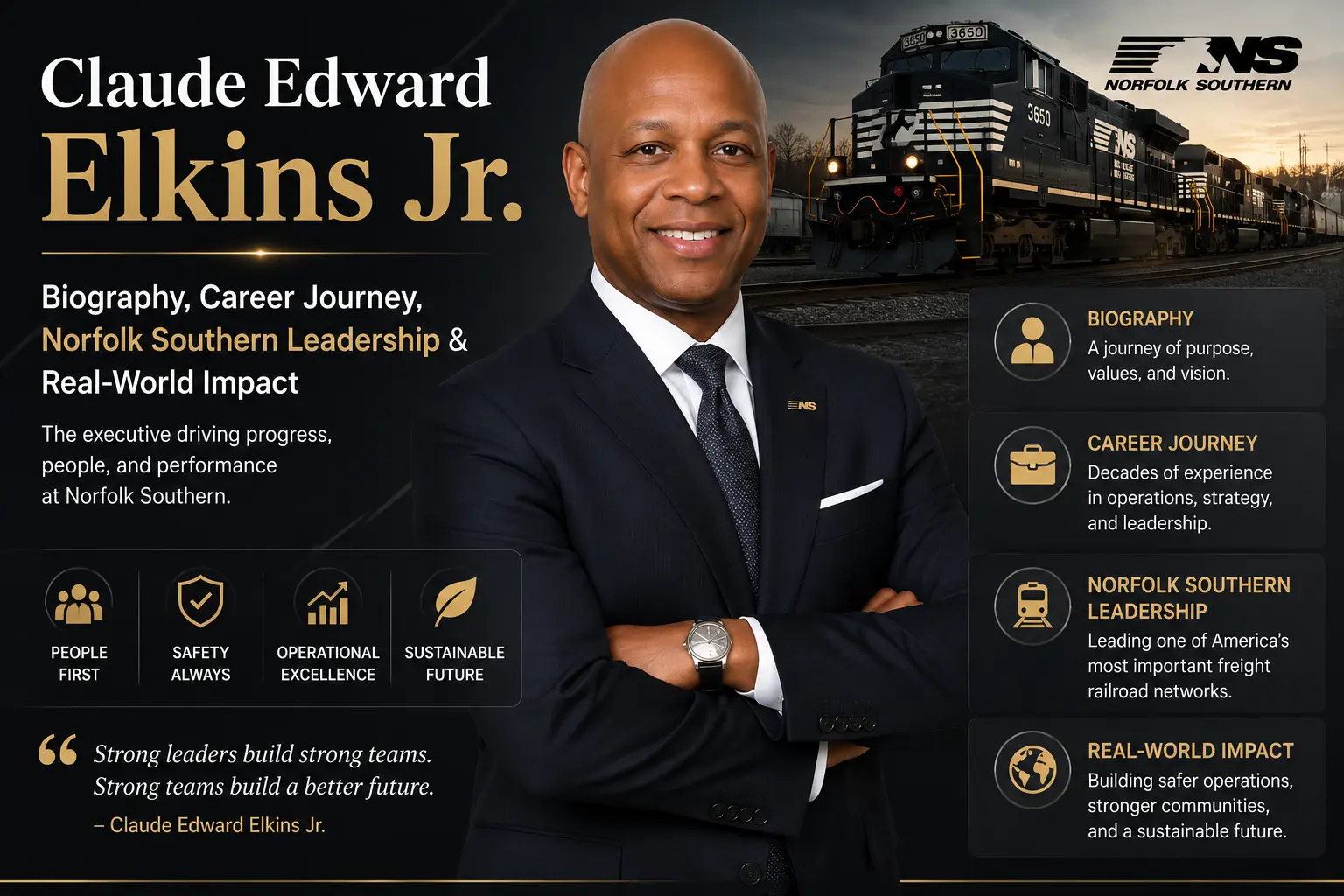
In the modern American transportation industry, few leadership stories are as compelling as that of Claude Edward Elkins Jr, a railroad executive whose rise from entry-level rail operations to the executive suite of a Fortune 500 company represents decades of discipline, learning, and operational mastery.
He is widely known in the rail and logistics sector for his role at Norfolk Southern Corporation, one of the largest freight railroad networks in the United States.
His journey reflects a rare leadership trajectory—one built not in boardrooms, but on the rail lines, in operational yards, and through decades of hands-on industry experience.
Early Life and Background
Publicly available professional profiles indicate that Claude Edward Elkins Jr was born in Southwest Virginia, United States, a region historically tied to railroads, manufacturing, and heavy industry.
He is also reported to have served in the United States Marine Corps, an experience that is often cited as foundational to his leadership style, emphasizing discipline, accountability, and structured decision-making.
According to multiple corporate and biographical sources, he later pursued higher education, earning academic credentials including:
- A Bachelor’s degree from the University of Virginia’s College at Wise
- An MBA from Old Dominion University
- Executive education programs from institutions such as Harvard Business School and UVA Darden
This combination of military discipline and academic training shaped his early leadership development.
Starting Career in the Rail Industry
The defining aspect of Claude Edward Elkins Jr is his entry into the railroad industry at the operational level.
He began his career in 1988 at Norfolk Southern as a road brakeman, a physically demanding role responsible for train assembly, safety coordination, and track operations.
From there, he progressed through multiple frontline roles including:
- Conductor
- Locomotive engineer
- Yard operations roles
This ground-level experience is frequently highlighted in industry profiles because it is uncommon for modern executives to rise from such operational beginnings.
It gave him firsthand understanding of:
- freight safety systems
- workforce challenges
- rail logistics efficiency
- real-time operational risk management
Transition Into Commercial and Strategic Leadership
After years in operational rail roles, Claude Edward Elkins Jr transitioned into commercial strategy and marketing functions within Norfolk Southern.
This shift marked the beginning of his rise into corporate leadership, where he worked in areas such as:
- intermodal marketing
- industrial products strategy
- chemicals and automotive freight services
- customer logistics and pricing operations
According to rail industry reports, this dual experience—operations + commercial strategy—became a key differentiator in his leadership profile (Western Business)
It allowed him to bridge the gap between:
- field operations teams
- corporate decision-makers
- customer-facing logistics systems
Rise to Executive Leadership at Norfolk Southern
The most significant milestone in his career came when Claude Edward Elkins Jr was appointed Executive Vice President and Chief Commercial Officer (CCO) at Norfolk Southern.
In this role, he oversees major revenue-generating and strategic business units including:
- intermodal transport systems
- automotive logistics
- industrial freight services
- real estate and industrial development
- customer logistics and field sales
Norfolk Southern itself is a major U.S. freight rail operator serving the eastern United States, moving millions of carloads annually across critical supply chain networks.
His leadership role places him at the center of decisions that impact:
- U.S. manufacturing supply chains
- automotive distribution networks
- agricultural exports
- intermodal container logistics
Military Influence and Leadership Style
A key part of Claude Edward Elkins Jr’s professional identity is his reported U.S. Marine Corps service, which is often referenced in leadership discussions about his career.
Military training typically instills:
- discipline under pressure
- structured decision-making
- leadership accountability
- teamwork in high-stakes environments
These traits align closely with the demands of railroad operations, where safety, timing, and precision are critical.
Industry commentary often describes his leadership style as:
- operationally grounded
- disciplined and structured
- focused on execution and efficiency
- highly experience-driven rather than theoretical
Impact on Norfolk Southern Operations
Within Norfolk Southern, Claude Edward Elkins Jr plays a central role in shaping commercial strategy and customer logistics.
His responsibilities directly influence how the company:
- structures freight pricing models
- develops long-term industrial partnerships
- expands intermodal freight capacity
- integrates digital logistics systems
Railroads in the United States form the backbone of industrial logistics, and leadership decisions at this level affect national supply chain performance.
His operational background allows him to understand constraints that purely financial executives might overlook, such as:
- track capacity limitations
- train scheduling efficiency
- labor coordination
- safety compliance requirements
Industry Reputation and Leadership Recognition
Across rail industry commentary and corporate profiles, Claude Edward Elkins Jr is frequently recognized for his unusual career trajectory.
Unlike many executives who enter leadership through finance or consulting paths, his progression is rooted in:
- field operations
- technical rail knowledge
- long-term organizational experience
This gives him credibility among both:
- frontline employees
- senior corporate stakeholders
Industry analysts often highlight his ability to connect operational realities with strategic business decisions as a key factor in his success.
Net Worth and Financial Profile
Public financial details for Claude Edward Elkins Jr are not fully disclosed.
However, as a senior executive at a Fortune 500 company, his compensation typically includes:
- executive salary
- performance bonuses
- stock-based compensation
Estimates based on similar executive roles suggest total compensation can include substantial equity-based incentives, though exact figures vary and are not publicly confirmed.
Why His Career Matters
The career of Claude Edward Elkins Jr reflects broader trends in American industry leadership:
- Operational experience matters
Leaders with field experience often make more grounded strategic decisions. - Industry knowledge is powerful
Deep understanding of rail logistics provides competitive advantage. - Long-term progression is still relevant
His rise took decades, not rapid corporate acceleration. - Hybrid leadership models are growing
Combining operations + strategy is increasingly valued in logistics industries.
Read More Guide on: Meredith Schwarz: Biography, Career & Private Life Story
Conclusion
The story of Claude Edward Elkins Jr is a classic example of long-term professional growth within one of America’s most essential industries.
From a railroad brakeman in 1988 to Executive Vice President and Chief Commercial Officer at Norfolk Southern, his journey demonstrates how operational expertise, discipline, and continuous learning can lead to senior leadership roles in complex global industries.
His career continues to influence freight logistics strategy across the United States, shaping how goods move through one of the world’s largest rail networks.
