

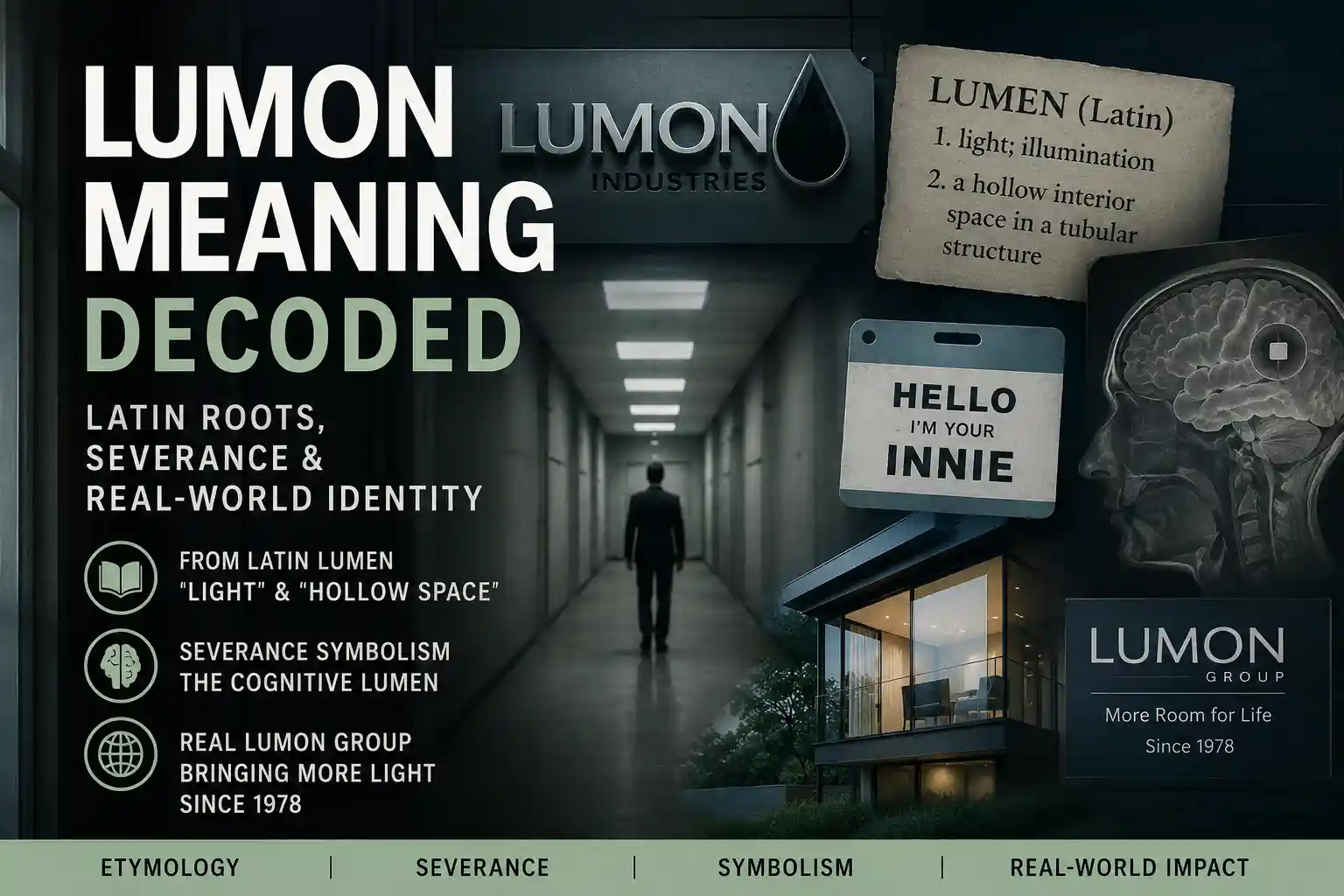
Lumon the name of the most psychologically disturbing fictional corporation in recent television derives from a Latin word meaning light. That is not accidental irony. What deepens the strangeness further is that a real company called Lumon Group has existed for nearly fifty years, dedicated to the genuinely illuminating work of designing glass spaces that bring more light into people’s homes. Understanding the full lumon meaning requires moving across three registers at once: ancient etymology, dystopian fiction, and real-world engineering.
This article resolves every layer the Latin root, the anatomical dimension competitors have missed entirely, the Severance symbolism, and the Finnish company that predates the show by decades.
Lumon Is Not a Dictionary Word But Its Latin DNA Explains Everything
Lumon does not exist as a standard entry in Merriam-Webster, Oxford, or any major English dictionary. It is a proper noun, a constructed brand identity, built from the Latin lumen a word carrying two distinct technical meanings that are, when placed against the narrative of Severance, deeply and precisely ironic. Understanding the full lumon meaning requires examining both of these definitions together. The first meaning is light, as in luminous flux. The second is an interior hollow cavity inside a tubular anatomical structure. Both definitions are active in understanding this name.
The Latin Root Lumen: Light, Openings, and the Proto-Indo-European Family
The word lumen descends from the Proto-Indo-European root *leuk-, meaning “to become bright.” This ancient root generated cognates across the entire Indo-European language family:
- Greek: leukos “bright, shining, white”
- Sanskrit: rocate “shines”
- Old English: leoht “light, daylight”
- Latin: lucere “to shine”; lux “light”; lucidus “clear”
In classical Latin, lumen meant light, but also specifically an opening through which light passes a window, an aperture, any gap that allows illumination to enter. The American Heritage Dictionary traces it directly to the *leuk- root through the reconstructed Proto-Latin form *louk-s-men.
The word entered physics formally in 1894, when French physicist André-Eugène Blondel adopted it in French as the name for the SI unit of luminous flux the measurable quantity of light perceived by the human eye per unit of time. One lumen represents the luminous flux emitted within a solid angle of one steradian from a point source of one candela. Blondel’s coinage became internationally standardised, and “lumen” entered scientific English permanently.
The Anatomical Lumen Nobody Mentions A Hollow Space Inside a Living Body
In anatomy and biology, a lumen (plural: lumina) is the interior hollow space of any tubular organ. This definition predates the physics usage by over two decades it entered medical literature in 1873.
Structures defined by their luminal architecture include:
- Blood vessels arteries, veins, and capillaries, through which blood flows inside the lumen
- The gastrointestinal tract the GI lumen is the continuous channel from mouth to intestine through which digested material passes
- The bronchial airways bronchial lumina conduct air through the respiratory system
- Renal tubules and urinary collecting ducts the luminal spaces of the nephron
This is the definition that every article about Lumon and Severance has entirely ignored and it is the most anatomically precise metaphor in the show. The severance procedure involves a microchip surgically implanted inside the skull. The procedure creates a cognitive hollow space: a sealed interior channel within the brain’s architecture in which one version of the employee is contained, unable to see outside, unable to exit. That is, structurally, a lumen. The show named its corporation after the very biological concept that best describes what the corporation does to human beings.
Why Lumon Feels Like a Real Word When It Isn’t
Pharmaceutical branding has spent decades exploiting the phonemic properties of Latinate suffixes to create brand names that sound authoritative without being dictionary words: Ambien, Nexium, Lucentis, Humira. The pattern uses familiar Latin roots to suggest clinical legitimacy while the unique suffix prevents trademark conflicts.
Lumon fits this template exactly:
- The lum- stem activates associations with light, clarity, and medical precision
- The -on suffix closes the word with the same terminal phoneme used in major pharma brands (Prozac, Lexapro, Wellbutrin use similar closure mechanics)
- The result is a word that passes the linguistic plausibility test instantly, which is precisely why it works as a corporate name for a company that runs, in every respect, on deception
Kier Eagan’s Empire of Synthetic Light: How Lumon Industries Got Its Name
Lumon Industries, as depicted in Apple TV+’s Severance, is a biotechnology corporation that surgically separates employees’ memories between their working and personal lives. The company publicly presents itself as enlightening, progressive, and liberatory. In practice, it operates through surveillance, psychological manipulation, and the systematic erasure of individual identity. The name encodes this contradiction at the root level.
Severance was created by Dan Erickson and premiered on Apple TV+ in February 2022. Season 2 ran from January to March 2025, executive produced and directed in part by Ben Stiller. The show’s exterior Lumon headquarters the oppressive, modernist corporate campus was filmed at the landmark Bell Labs building in Holmdel, New Jersey, designed by Eero Saarinen. The building’s own history as an AT&T research campus operating under monopolistic corporate control adds an additional layer of real-world resonance to the show’s fictional premise.
Dan Erickson’s Deliberate Irony The Corporation of Light That Runs on Darkness
Erickson has confirmed in interviews that Lumon’s design philosophy was always about total environmental saturation the company’s reach was meant to extend beyond its building walls into the surrounding town of “Kier, PE,” so that even in the outside world, employees remain inside Lumon’s architecture of control. “Even if you’re not in Lumon like in the building you may still be in Lumon in a way,” Erickson told BuzzFeed.
The light/darkness inversion is the structural engine of the series:
| What the Name Claims | What the Corporation Does |
| Lumen = light, illumination | Destroys employees’ access to self-knowledge |
| Clarity, transparency, openness | Total information blackout for severed workers |
| Medical precision and care | Surgical violation of cognitive sovereignty |
| Corporate luminosity | White hallways, fluorescent sterility, zero windows |
This is why Lumon-coded became a viral workplace hashtag the show’s audience recognised their own employers in the gap between the brand promise and the operational reality.
Lumon Sounds Like “Looming” Phonetic Analysis of a Sinister Name
A significant interpretive thread in fan and critical communities is that Lumon was chosen partly because it phonetically resembles “looming” the present participle used for something menacing, threatening, approaching at an unreadable scale. The phonetic convergence is real:
- Both words carry the initial loo- / loom- phoneme cluster
- The -on suffix shortens “looming” into a brand-safe monosyllabic close
- The result sounds like a compressed threat: a word that dangles the shadow of “looming” without completing it
This reading is critically plausible and structurally consistent with Erickson’s known approach to layered world-building. It has not been confirmed as a stated intention in any published interview a distinction that matters for intellectual credibility. It belongs to the category of productive critical interpretation rather than canonical fact.
The Tansy Michaud Logo Pharmaceutical Pastiche and the Droplet That Divides Everything
The Lumon Industries logo was created by graphic designer Tansy Michaud. Her design draws directly from the visual language of 1970s pharmaceutical companies clean serif wordmarks, restrained colour palettes, and a secondary symbol that operates as a corporate sigil.
That symbol is a liquid droplet.
Three primary interpretations circulate in the critical conversation:
- The microchip theory: The droplet represents the severance chip itself an implantable liquid-form device or capsule, echoing real-world pharmaceutical delivery systems
- The blood theory: The droplet is a single drop of blood, referencing the surgical nature of the procedure and the violence beneath the corporate calm
- The cellular division theory: The droplet’s shape mirrors a cell or organ in cross-section the very image of a lumen, a hollow interior space, sliced open
Michaud’s pharmaceutical inspiration is the most structurally significant detail: the logo is designed to make the company feel trustworthy, clinical, and legitimate. That is its function within the fiction. The beauty of the design is that it achieves that effect completely while being legible, to an informed eye, as a symbol of invasion.
Inside Lumon Industries The Mechanics of Severance and the Anatomy of Control
Lumon Industries’ core product is a neurological procedure called “severance.” The procedure bifurcates an employee’s consciousness through a surgically implanted chip, creating two separate and mutually ignorant selves: the innie, who exists only during work hours inside Lumon, and the outie, who lives in the world outside and retains no memory of work. The two selves share one body but inhabit entirely separate experiential realities.
The lumon meaning at its deepest structural level maps directly onto this mechanism: the anatomical lumen a hollow sealed channel inside a living body is precisely what the severance chip creates inside the employee’s cognitive architecture.
The Severance Chip How a Neural Implant Creates a Cognitive Lumen
In biological terms, a lumen is a space enclosed within a living structure through which something flows or is contained. The severance procedure creates an equivalent structure in the brain: a sealed cognitive compartment through which one version of the person flows during work hours and another during personal time, with an impermeable boundary between them.
Key mechanics of the fictional procedure:
- The chip activates at the threshold of the Lumon elevator a transitional point that triggers the consciousness switch
- The innie has no awareness of external life, no memories, no relationships outside the office
- The outie has no awareness of what occurs at work, effectively losing 40+ hours of lived experience per week
- The result is two full people, each experiencing themselves as complete, each existing in total ignorance of the other’s reality
This is not metaphorical severance. It is the clinical construction of a lumen inside consciousness a sealed internal space.
Macrodata Refinement and the Manufactured Self
The Macrodata Refinement department where protagonist Mark Scout and his colleagues work occupies the centre of Severance‘s narrative mystery. MDR employees sort numerical data into visual categories on outdated computer terminals, guided by nothing more than emotional responses to clusters of numbers. The actual purpose of this data sorting has not been fully canonically confirmed.
What is structurally clear: Lumon keeps its severed employees completely ignorant of the significance of their work. This is not incidental it is the operational philosophy of a company named after a concept that includes hollow, sealed spaces.
The MDR team is contained inside Lumon’s lumen. They perform functions they cannot understand. They produce outputs they will never see. The corporation’s value extraction is pure and total precisely because the workers remain inside the dark.
Kier Eagan’s Victorian Gospel How a Founding Myth Becomes a Control Mechanism
Kier Eagan is the fictional 19th-century founder of Lumon Industries, revered by current employees with the intensity of religious devotion. His writings are quoted in the offices like scripture. His portraits line the Perpetuity Wing. The corporate hierarchy traces its authority directly to his lineage current CEO Jame Eagan is a direct descendant.
Erickson modelled the Kier mythology on the mechanics of real company towns places like Pullman, Illinois, where workers in the 19th century lived, ate, and socialised within a corporate ecosystem owned and governed by their employer. The innovation in Severance is that Lumon has moved the company town inside the employee’s own mind.
The Real Lumon A Finnish Chicken Coop, 1978, and a Philosophy of Genuine Light
Here is the structural counterpoint that makes the full picture complete: there is a real company called Lumon Group, and it has existed since 1978. It is entirely unrelated to Severance. It represents, in every operational respect, the exact opposite of what the fictional corporation stands for.
Outokumpu, 1978 The Actual Origin of the Lumon Name
The company that became Lumon Group began operations in 1978 under the name Pohjois-Karjalan Lasipalvelu Ky, in an old chicken coop in Outokumpu, North Karelia, Finland. The founders repaired windows for private houses. The business was difficult in its early years, barely covering operating costs.
In 1981, the company relocated south to Kymenlaakso and rebranded as Ikkunanikkarit Ky “Window Carpenters” in Finnish establishing itself as the region’s most capable renovator of residential buildings. The business grew steadily through the 1980s.
Then in 1990, the company invented something that did not previously exist: the frameless balcony glazing system.
A timeline of the company’s key milestones:
| Year | Milestone |
| 1978 | Founded as Pohjois-Karjalan Lasipalvelu Ky, Outokumpu, Finland |
| 1981 | Relocated to Kymenlaakso; rebranded as Ikkunanikkarit Ky |
| 1990 | Invented frameless balcony glazing; first installation still in use today |
| 1992 | Began export operations in response to the early 1990s recession |
| Mid-1990s | Expanded into Central European markets |
| 2003 | Launched first terrace glazing system in Finland |
| 2012 | Acquired Finnish blind manufacturer Visor |
| 2024 | Revenue: EUR 149 million; operations in 20+ countries, 1,000+ employees |
| March 2026 | Launched a CO₂ calculator for construction professionals |
“More Room for Life” How the Real Lumon Builds the Opposite of Severance
The real Lumon Group’s brand philosophy is captured in four words: “More Room for Life.”
Their core product frameless glass balcony and terrace enclosures physically opens boundaries. Where walls formerly separated interior warmth from exterior environment, Lumon’s systems create glass-enclosed transitional spaces that remain thermally functional year-round. The product literally expands perceptual space while maintaining shelter.
The lumon meaning at Lumon Group operates as a direct inversion of the fictional corporation’s premise:
| Attribute | Lumon Industries (Fictional) | Lumon Group (Real) |
| Industry | Biotech / Memory Manipulation | Frameless Balcony Glazing |
| Founded | 19th century (fictional timeline) | 1978, Outokumpu, Finland |
| Philosophy | Extreme work-life separation | Connecting indoors and outdoors |
| Visual Aesthetic | White corridors, zero natural light | Glass facades, maximum light ingress |
| Employee Relationship | Cognitive imprisonment | “More Room for Life” |
| 2024 Revenue | Classified (fictional) | EUR 149 million (verified) |
The company has directly addressed its notorious fictional namesake on its official website, noting that the two entities are distinct and that, unlike Lumon Industries’ ethos of severance, the real Lumon’s mission is to create spaces where people can “be their most authentic self.”
Lumon Meaning Across Language, Culture, and the Questions That Keep Ranking
Beyond the Latin and the television series, the word Lumon carries additional layers of meaning across languages and contemporary cultural discourse that the search data shows are actively sought.
What Lumon Meaning in Tagalog and Philippine Dialects
A statistically significant volume of lumon meaning searches originates from Filipino users, and this cluster is almost entirely unaddressed in current content.
In Philippine languages:
- Lumon is not a standard entry in Tagalog (Filipino national language) dictionaries
- In some Bisaya/Cebuano usage contexts, lumon appears as a colloquial or dialectal term referring to the lemon fruit or citrus-adjacent plants derived from the same Spanish limón that produced “lemon” in English
- The phonetic similarity between lumon and the Tagalog/Bisaya citrus terms is a cross-linguistic coincidence, not a shared etymological origin
Filipino searchers arriving on lumon meaning pages are generally either:
- Seeking to understand the Severance cultural reference, or
- Verifying whether a dialectal citrus-related term they have encountered is formally documented
Neither the Latin root nor the fictional corporation is directly relevant to the Philippine language dimension but both coexist in the search results, creating the need for this disambiguation.
Lululemon vs. Lumon Two Brands, One Confusing Search Result
“What is the meaning of Lululemon?” appears in the People Also Ask data for lumon meaning queries, so the disambiguation deserves direct resolution.
Lululemon Athletica takes its name from a different construction entirely. The company’s founder, Chip Wilson, deliberately included multiple L-sounds in the name because it was difficult for Japanese speakers to pronounce, and he believed this difficulty would signal a product’s North American origin and premium positioning to Japanese consumers. The word has no Latin, Greek, or European-root etymological connection to lumen or Lumon. It is a branding construction, not a linguistic derivation.
Lumon-Coded When a Fictional Word Becomes a Living Cultural Diagnosis
Since Severance Season 1 premiered in 2022 and Season 2 aired in 2025, Lumon-coded has entered the active vocabulary of workplace culture discourse. The phrase is used, primarily on social media and in professional forums, to describe:
- Offices designed to eliminate employees’ sense of time
- Management philosophies that treat workers as functions rather than people
- Return-to-office policies framed as benefits rather than control mechanisms
- Corporate wellness programs that exist to increase productivity rather than wellbeing
Dan Erickson confirmed in multiple interviews that the show receives a constant stream of audience messages from workers who identify their own employers in Lumon’s operational logic. The fictional corporation’s name has become a genuine analytical lens through which contemporary workers interpret real institutional behaviour.
[FAQ SECTION]
What does lumon meaning actually refer to is it a real English word?
Lumon is not a standard English dictionary word. It is a proper noun derived from the Latin lumen, meaning both “light” and, in anatomy, the hollow interior of a tubular organ. It names the fictional biotechnology corporation in Apple TV+’s Severance and a real Finnish glazing company founded in 1978. Neither usage creates a common noun entry.
What does Lumon Industries actually do in Severance, and does the anatomy of the word reflect that?
Lumon Industries performs a surgical procedure that bifurcates employee consciousness into two ignorant selves an innie (work-only) and outie (personal life only). The anatomical definition of lumen a sealed hollow interior channel inside a living body precisely mirrors this: the procedure creates a cognitive lumen, an enclosed internal space in which one self is permanently contained, unable to perceive outside.
Is the real Lumon Group in any way connected to the Severance TV show?
No. Lumon Group is an independent Finnish company founded in 1978 44 years before Severance aired. It specialises in frameless balcony and terrace glazing systems and operates in over 20 countries. The company has directly addressed the naming coincidence on its official website, noting that its mission of openness and connection is the philosophical inverse of Lumon Industries’ premise.
What does the Lumon Industries logo represent, and who designed it?
The logo was designed by graphic designer Tansy Michaud, drawing from 1970s pharmaceutical company aesthetics. The central droplet symbol carries three primary interpretations: the severance microchip itself, a drop of blood referencing the surgical procedure, or a cross-sectional view of a cellular lumen. All three readings are consistent with the show’s thematic architecture.
Does lumon mean anything in languages other than English or Latin?
In some Bisaya/Cebuano dialects of the Philippines, a term resembling lumon refers to citrus fruit in colloquial usage, derived from the Spanish limón. This is a phonetic coincidence rather than a shared etymology. The word carries no equivalent common-noun status in Tagalog, Greek, or other major languages outside of the Latin scientific tradition.
Why does the word Lumon feel psychologically unsettling before you even know what it means?
The word exploits pharmaceutical branding phonetics the lum- opening activates subconscious associations with clinical authority, while the hard -on closure creates a terminal sound associated with institutional naming conventions (Prozac, Ambien, Lexapro). Additionally, its phonemic proximity to “looming” a word for approaching menace creates an unresolved tonal dissonance that the brain registers as uncanny without being able to articulate why.
Conclusion
The full lumon meaning cannot be resolved in a single sentence, because it was constructed deliberately or by productive coincidence to operate on multiple semantic registers simultaneously. The name itself traces back to a Latin root meaning both radiant light and a hollow interior darkness. Within the narrative, it represents a corporation that promises illumination while manufacturing cognitive voids. In the real world, it refers to a Finnish company that genuinely opens walls to let more light in. That the same four syllables can carry all of these meanings at once clarity and captivity, opening and enclosure, ancient etymology and contemporary cultural diagnosis is precisely why the lumon meaning has become one of the most searched compound terms in prestige television’s history.
