

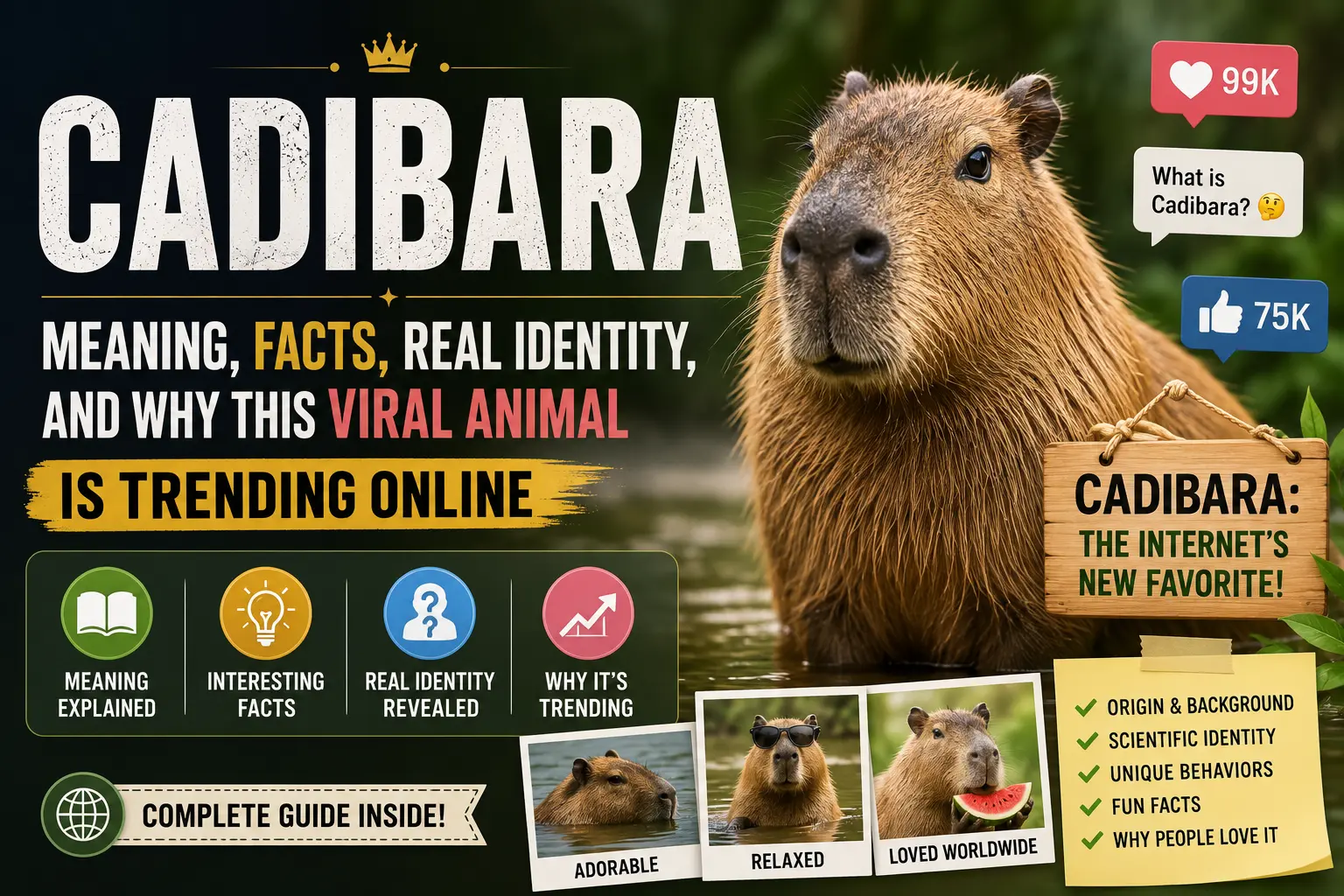
In recent years, the term cadibara has spread rapidly across social media platforms, search engines, and meme culture. Many users encounter the word in viral animal videos, captions, or trending posts and assume it refers to a rare or newly discovered species.
However, scientific and zoological sources confirm that cadibara is not a separate animal species. Instead, it is a phonetic spelling variation of the capybara (Hydrochoerus hydrochaeris), the world’s largest living rodent native to South America.
Understanding this distinction is important because it helps separate internet language trends from biological reality.
What Is Cadibara? Understanding the Viral Term
The word cadibara is widely used online as an alternative spelling of “capybara.” It originated from how the word is pronounced and how it is commonly heard in informal speech and viral content.
In most cases, when people search for cadibara, they are actually referring to the real animal capybara, a semi-aquatic herbivore found across South America.
The popularity of the term has grown due to:
- TikTok animal videos
- Instagram memes
- YouTube Shorts content
- Search engine autocorrect behavior
In reality, cadibara does not represent a separate biological classification, but it has become a recognized internet keyword due to repeated usage online.
Why the Name Cadibara Became Popular Online
The rise of cadibara is a classic example of how internet culture reshapes language.
Several factors contributed to its popularity:
1. Phonetic spelling influence
People often write words the way they sound. “Capybara” can be misheard and rewritten as “cadibara.”
2. Meme culture
Capybaras are widely known as calm, friendly animals, making them perfect meme subjects. This helped alternative spellings spread quickly.
3. Algorithm reinforcement
Once enough users search “cadibara,” search engines begin suggesting it as a valid query, reinforcing its usage.
4. Viral video captions
Many creators intentionally use alternate spellings for humor or uniqueness, further spreading the term.
Over time, cadibara became a searchable internet identity rather than a scientific term.
The Real Animal Behind Cadibara: Capybara
To understand cadibara, we must look at its real-world counterpart: the capybara.
The capybara is a semi-aquatic mammal native to South America and belongs to the rodent family Caviidae. It is closely related to guinea pigs and cavies, but significantly larger.
Key biological facts:
- Scientific name: Hydrochoerus hydrochaeris
- Habitat: Wetlands, rivers, marshes, and flooded grasslands
- Distribution: Brazil, Colombia, Venezuela, Argentina, Peru, and surrounding regions
- Diet: Herbivorous (grass, aquatic plants, fruits)
- Behavior: Highly social and peaceful animals
Capybaras are widely recognized as the largest living rodents on Earth.
Physical Characteristics and Adaptations
Capybaras (commonly searched as cadibara) have unique physical traits that make them highly adapted to aquatic environments.
Body structure:
- Barrel-shaped, heavy-bodied mammal
- Short head with eyes, ears, and nostrils positioned high
- Partially webbed feet for swimming
Size:
- Adults typically weigh 35–66 kg
- Length ranges from 1.0 to 1.3 meters
Adaptations:
- Can remain submerged in water for long periods
- Excellent swimmers and divers
- Dense teeth designed for constant grazing
These traits make them perfectly suited for life near rivers and wetlands.
Habitat and Natural Distribution
Capybaras (or cadibara in online usage) are native to South America and are commonly found in regions with abundant freshwater.
Their habitats include:
- Amazon Basin
- Pantanal wetlands (Brazil)
- Orinoco River basin
- Grasslands and swamp regions
Water is essential to their survival because it provides:
- Protection from predators
- Temperature regulation
- Access to aquatic vegetation
Capybaras are rarely found far from water sources, as their entire survival strategy depends on aquatic environments.
Social Behavior and Group Life
One of the most fascinating traits of capybaras is their highly social behavior.
They live in groups ranging from:
- 10 to 20 individuals on average
- Up to 100 during dry seasons
Their social structure includes:
- Dominant males
- Multiple females
- Young offspring
Group living helps them:
- Detect predators early
- Share protective strategies
- Maintain social bonding
This peaceful social structure is one reason why cadibara videos became viral online, as viewers are drawn to their calm and cooperative behavior.
Diet and Feeding Habits
Capybaras are strict herbivores. Their diet includes:
- Grasses
- Aquatic plants
- Tree bark (occasionally)
- Fruits during dry seasons
They often graze in early morning and evening hours, avoiding heat and predators.
A unique biological feature is coprophagy, where they consume their own feces to extract additional nutrients from plant material. This is a normal digestive adaptation in herbivorous rodents.
Ecological Importance
Capybaras play a major role in their ecosystems.
Environmental contributions:
- Control vegetation growth in wetlands
- Serve as prey for jaguars, anacondas, and caimans
- Help maintain ecological balance in river systems
They are considered a key species in South American wetland ecosystems.
Without them, vegetation and predator-prey balance in these ecosystems could be disrupted.
Why Cadibara Became an Internet Trend
The rise of cadibara is strongly connected to digital culture.
Main reasons include:
- Viral TikTok and YouTube animal clips
- “Relaxed animal” meme culture
- Misheard pronunciation spreading online
- SEO-driven content duplication
Capybaras became symbolic of:
- calmness
- relaxation
- emotional balance
- “vibe culture” online
Because of this cultural symbolism, even misspellings like cadibara gained traction.
Misconceptions About Cadibara
Many users mistakenly believe:
- It is a separate species
- It is a new animal discovery
- It is a fictional creature
In reality:
- It is simply a spelling variation
- It refers to capybara
- It has no scientific classification
This confusion highlights how internet trends can reshape biological terminology in public perception.
Read More Guide’s: Lewis Center Ohio Champion Trees: Ohio’s Largest & Oldest Trees
Conclusion
The term cadibara is a perfect example of how language evolves in the digital age. What began as a simple phonetic misspelling has become a widely recognized search term connected to one of the internet’s most beloved animals—the capybara.
Scientifically, there is no separate species called cadibara. It refers entirely to the capybara, the world’s largest rodent, known for its calm nature, social behavior, and aquatic lifestyle.
As internet culture continues to evolve, terms like this will keep emerging, blending humor, language, and biology into new forms of online identity.
