

After a rough night out, you’ve probably heard someone joke about needing a little “hair of the dog” the next morning. Most people know the phrase has something to do with hangovers, but very few actually understand the real hair of the dog meaning or where the saying came from.
The story behind it goes far beyond Bloody Marys and brunch culture. The full phrase “hair of the dog that bit you” comes from an ancient belief that the thing causing harm could also be the cure. Over centuries, that strange idea evolved into one of the most famous hangover expressions in the English language.
Understanding the hair of the dog meaning reveals more than just a drinking phrase it opens the door to old folk medicine, human psychology, and the surprising science behind why this centuries-old remedy still survives today.
What “Hair of the Dog” Really Means (And Why It Sounds So Weird)
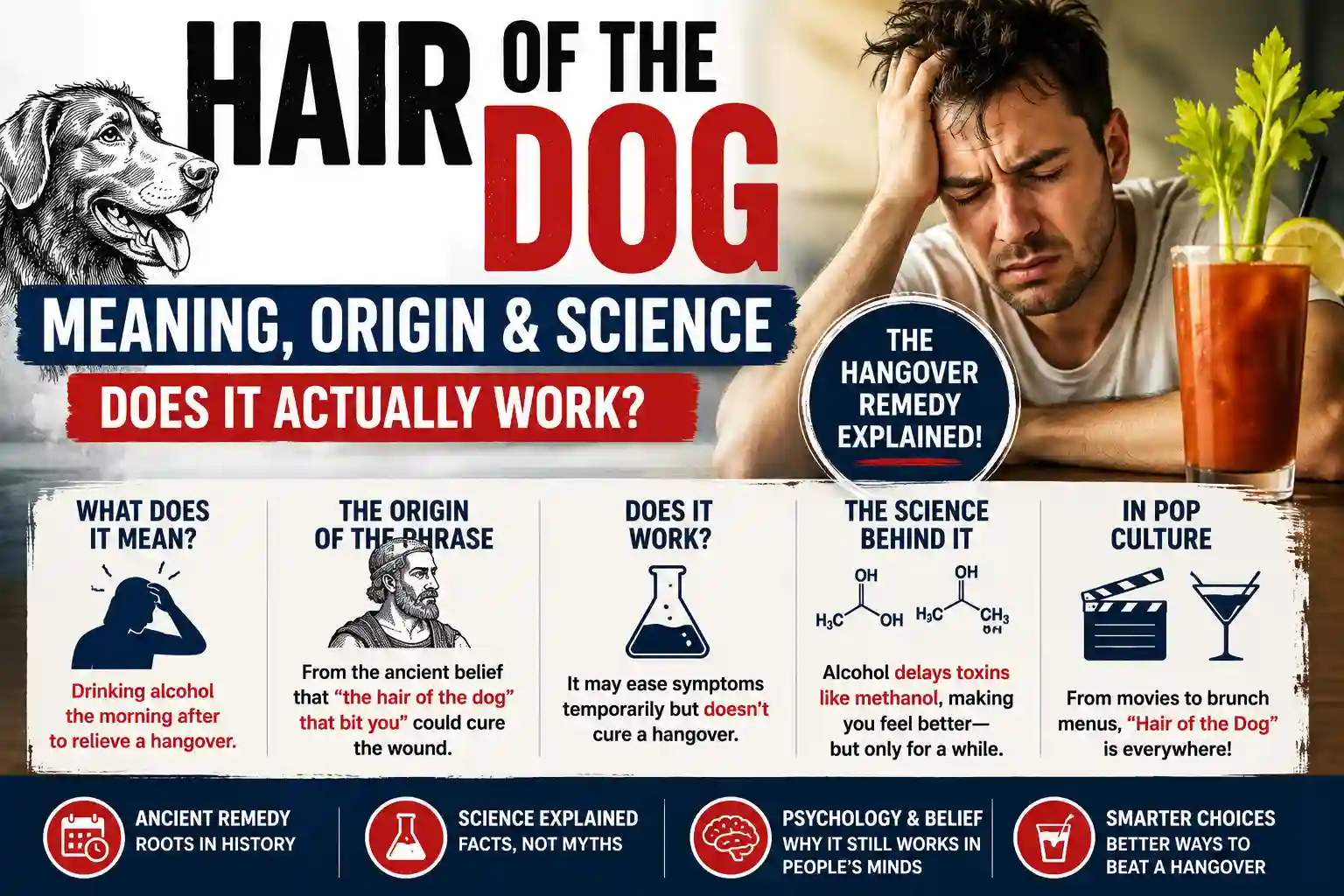
The hair of the dog meaning is simple on the surface: if you drank too much last night, drink a little more this morning to feel better. Most people hear the phrase for years before ever learning the actual hair of the dog meaning or where it came from. It’s used casually all the time at brunches, in movies, at bars on Sunday mornings.
But the phrase is a shortened version of something much older and considerably stranger: “hair of the dog that bit you.”
The Full Phrase: “Hair of the Dog That Bit You”
The complete saying refers to the idea that whatever caused your problem can also cure it. If a dog bites you, the remedy is to take a hair from that same dog and place it on the wound. If alcohol made you sick, drink more alcohol to recover.
It sounds absurd because it is. But this logic was taken seriously for centuries.
How People Use It Today Real Examples in a Sentence
In modern English, the hair of the dog meaning is almost always connected to hangovers and recovery drinking.
- “I feel terrible after last night think I need a hair of the dog.”
- “She ordered a Bloody Mary at brunch; said it was hair of the dog.”
- “He swears by hair of the dog every time he overdoes it at a party.”
It can also appear more broadly to mean “more of what caused the problem,” though the hangover usage dominates modern English.
From Dog Bites to Drinking: The Bizarre Origin of “Hair of the Dog”
The origin of “hair of the dog” has nothing to do with hangovers at least not originally. The phrase comes from an ancient folk remedy involving actual dogs, actual bites, and a genuinely alarming approach to medicine.The historical hair of the dog meaning originally had nothing to do with alcohol at all.
The belief, widespread in ancient Rome and carried through medieval Europe, was that if a rabid dog bit you, the correct treatment was to take some hair from that same dog and press it into the wound. This was thought to prevent infection, neutralize the venom, or ward off the madness that a rabid dog bite was believed to cause.
The Ancient Remedy That Started It All
Pliny the Elder, the Roman author and naturalist who died in 79 AD, documented this practice in his encyclopedic work Naturalis Historia. He described applying the hair of the offending dog to bite wounds as a recognized treatment of his time.
This wasn’t fringe thinking it was mainstream ancient medicine.
The philosophical idea underpinning it was what later became known as “like cures like” the same concept that much later gave rise to homeopathy. If something harms you, a small dose of the same thing heals you. It was logical, if completely wrong.
When Did “Hair of the Dog” Start Meaning Hangovers?
The shift from literal dog-bite remedy to figurative hangover cure happened gradually through the 16th and 17th centuries, when the phrase migrated from medical texts into drinking culture.
John Heywood, a 16th-century English playwright and collector of proverbs, recorded an early version of the phrase around 1546. By this point, English drinkers had already adopted the expression to describe morning-after drinking.
Ebenezer Cobham Brewer, author of the famous Dictionary of Phrase and Fable (first published in 1870), later documented the phrase’s dual meaning its literal origin and its popular drinking application.
The Oxford English Dictionary traces the figurative hangover usage to at least the early 1500s. By the 1600s, it was firmly embedded in English drinking culture, where it has remained ever since.
Does Hair of the Dog Actually Work? Here’s What Science Says
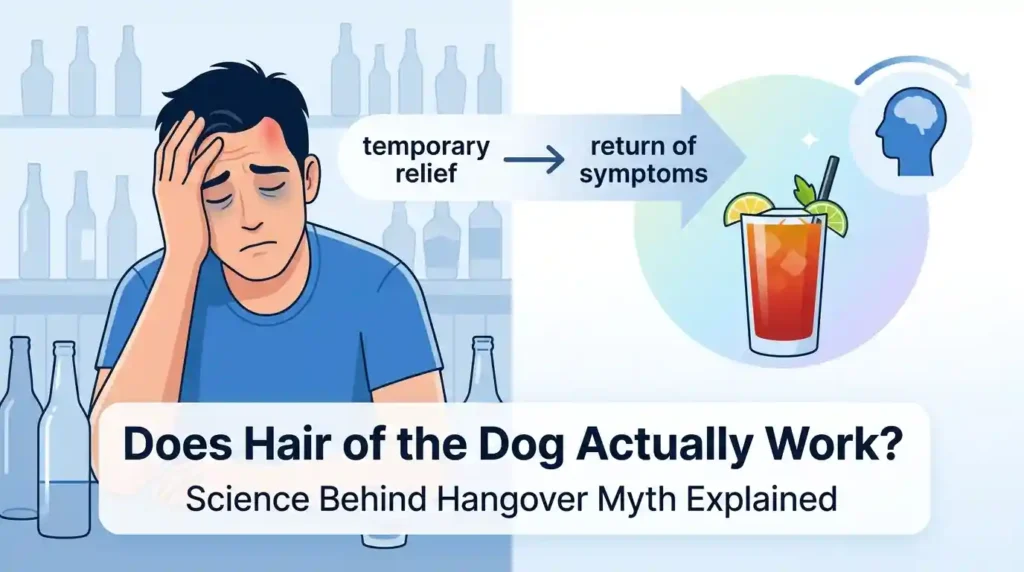
Here’s the honest answer: hair of the dog does not cure a hangover but it does temporarily reduce the symptoms. That distinction matters a lot. There is real science behind why a morning drink might make you feel better briefly, and it comes down to chemistry, not magic. Part of why the hair of the dog meaning survived for centuries is because the remedy can appear to work temporarily.
Why Your Hangover Temporarily Feels Better
When you drink alcohol, your body processes it in two stages. First, the liver converts ethanol (regular drinking alcohol) into acetaldehyde a toxic compound that contributes significantly to hangover symptoms like nausea, headache, and that general feeling of misery.
But here’s the twist: most alcoholic drinks also contain trace amounts of methanol a byproduct of fermentation found especially in darker drinks like red wine, whiskey, and bourbon. Methanol is metabolized into formaldehyde, which is even more toxic than acetaldehyde.
When you drink more ethanol the morning after, your liver prioritizes processing the ethanol putting the methanol breakdown on hold. While the methanol sits waiting, you feel temporarily better because formaldehyde production pauses.
In other words: you’re not curing the hangover. You’re just delaying the worst part of it.
The Problem: You’re Just Moving the Pain Forward
As soon as your body finishes processing the new ethanol, it goes back to work on the methanol. The hangover returns often worse than before, because now you’ve added more alcohol for your body to process on top of your already-depleted state.
This cycle can become a serious issue. For people who drink heavily and regularly, hair of the dog starts to resemble alcohol dependency behavior more than a home remedy. Several medical organizations, including the NHS, do not recommend this practice.
The bottom line: it’s a delay, not a cure.
The “Like Cures Like” Philosophy Behind the Phrase
The hair of the dog saying didn’t exist in isolation it grew from a much older system of thinking that shaped thousands of years of medicine before modern science took over.
The idea that a substance causing harm can also heal when administered in small doses appears across ancient Greek, Roman, and Middle Eastern medical traditions. It’s the same logic that Samuel Hahnemann codified into homeopathy in the late 1700s and early 1800s.
Pliny the Elder and the Ancient World’s Take on Cures
Pliny the Elder’s Naturalis Historia, written around 77 AD, is a treasure chest of remedies built on this principle. Dog hair on bite wounds is one example among hundreds. Snake venom to treat snake bite. Bee stings to treat arthritis.
None of these were considered extreme in their time they were the cutting edge.
The remarkable thing about “hair of the dog” is that unlike most ancient remedies, it has a partial scientific explanation for why it works at all even if the explanation reveals that it’s ultimately counterproductive.
Why People Still Believe in It The Psychology of Folk Remedies
Folk remedies persist not just because of tradition, but because they sometimes feel like they work. If you have a morning drink and your headache fades within an hour, your brain logs that as cause and effect even if the underlying chemistry tells a more complicated story.
This is part of why the phrase survived centuries of medical progress. The remedy feels effective in the short window before the delayed hangover returns. And because that delayed hangover is so commonly misread as “I needed more water” or “I just needed to eat something,” the morning drink gets the credit it doesn’t deserve.
Hair of the Dog in Pop Culture From Bars to Brunch
Despite being medically questionable, “hair of the dog” is culturally everywhere. It has become shorthand for a particular kind of morning-after ritual that appears across media, food culture, and nightlife worldwide.
Famous Uses of the Phrase in Books, Film, and TV
The phrase appears throughout English-language film and television, almost always delivered with a wink. It’s a fixture in brunch scenes, in hangover comedies, and in period dramas set in eras when alcohol was considered a legitimate cure-all.
In bar culture, “hair of the dog” menus are a real thing especially Bloody Marys, mimosas, and shandies, all marketed as morning-after drinks.
Hair of the Dog is also the name of a New York City bar that built its entire brand around the concept, serving creative cocktails specifically designed for the post-party crowd.
Why This Old Saying Is Still Very Much Alive Today
The phrase has survived because the experience it describes is universal. Hangovers have existed as long as alcohol has, which means the desire for a quick fix is equally ancient.
In the age of brunch culture, social media food content, and the normalization of “Sunday Funday,” hair of the dog fits perfectly as a casual, self-aware way to talk about drinking. It sounds less like a problem and more like a tradition.
That framing is part of its staying power.
A Phrase That’s Older Than Modern Medicine And Still Going Strong
“Hair of the dog” has traveled one of the stranger journeys in the English language from a Roman naturalist’s description of a dog-bite cure, through the taverns of 16th-century England, all the way to Sunday brunch menus in 2026. The modern hair of the dog meaning still carries traces of its ancient medical roots. The hair of the dog meaning today is familiar to millions who have no idea they’re quoting a 2,000-year-old medical practice. There’s genuine science explaining why it temporarily works, and genuine science explaining why it ultimately doesn’t which makes it one of the few ancient folk remedies that’s both partially correct and almost entirely useless as a cure. Whether you reach for a Bloody Mary, a glass of water, or just pull the duvet back over your head, at least now you know exactly what someone means when they suggest a hair of the dog.
