

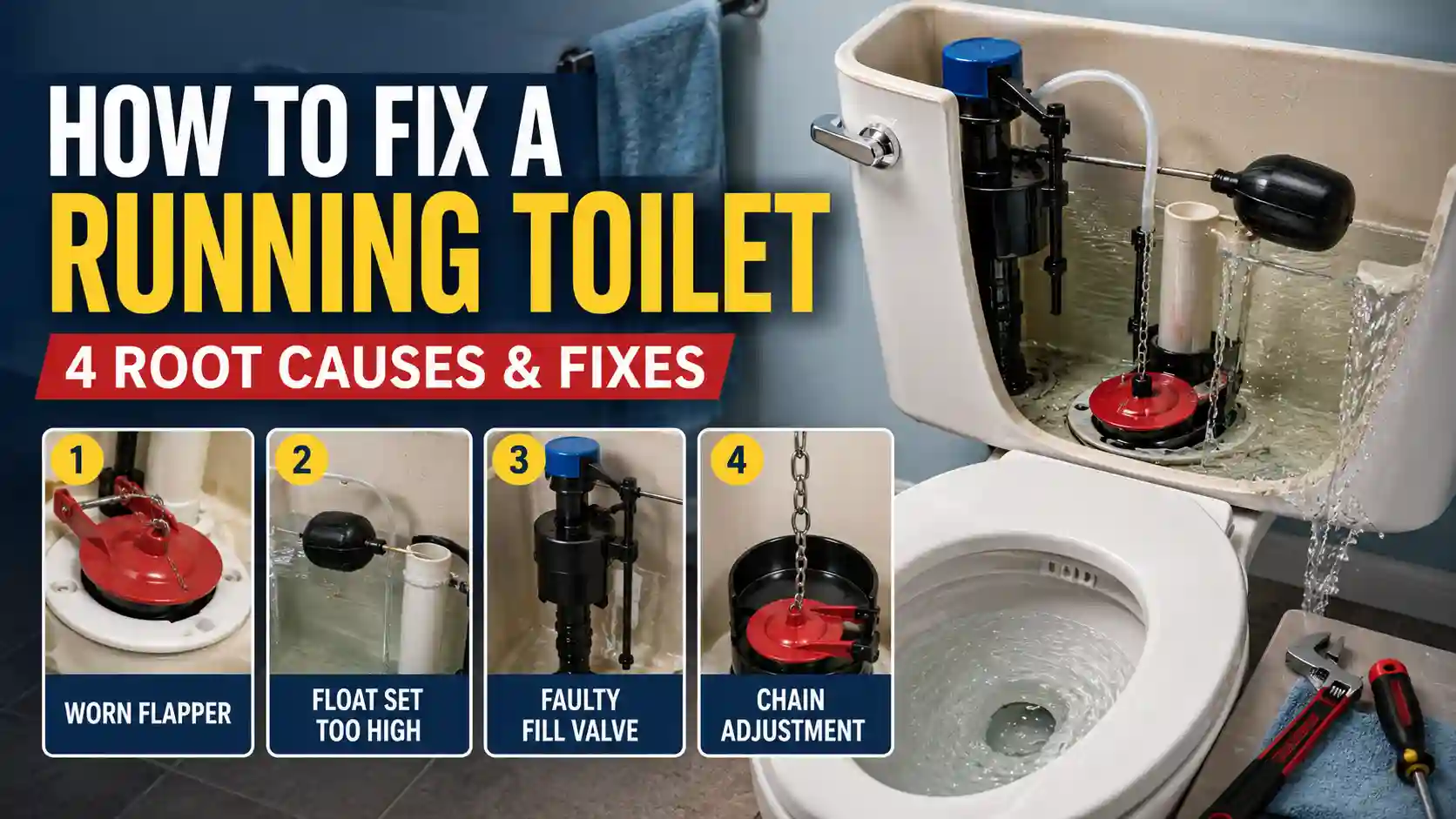
Before you touch anything inside the tank, add ten drops of food coloring to the tank water, set a 15-minute timer, and check the bowl if color seeps in without a flush, your flapper seal has failed. Knowing how to fix a running toilet starts with that single diagnostic step, because the correct repair depends entirely on identifying the exact component responsible.
A toilet that won’t stop running is caused by one of four mechanical conditions. Every one of them can be resolved in under 30 minutes using tools you almost certainly already own. Use the diagnostic table below to locate your specific failure, then jump directly to the corresponding repair section.
How to Fix a Running Toilet: The Four-Cause Diagnosis Framework
A running toilet is caused by exactly one of four mechanical failures: a degraded rubber flapper that no longer seals the flush valve seat; a float set too high, causing water to drain continuously into the overflow tube; a worn fill valve diaphragm that cannot fully shut off the water supply; or a flush chain with incorrect tension that prevents the flapper from closing completely. Each cause produces a distinct sound pattern and symptom signature.
| Symptom | Most Likely Cause | Urgency |
| Constant low hiss, water running non-stop | Faulty flapper or high float | High |
| Toilet refills every 20–60 min with no flush (ghost flush) | Slow flapper leak | Medium-High |
| Water running only immediately after flush, then stopping | Chain too long, getting trapped under flapper | Medium |
| Hissing sound, water level at or above overflow tube | Float set too high or fill valve failure | High |
| Running that continues even after jiggling the handle | Chain too short, holding flapper open | Medium |
The Food Coloring Test: Identifying a Flapper Leak in 15 Minutes Without Opening the Tank
Place 8–10 drops of any food coloring into the toilet tank not the bowl. Wait exactly 15 minutes without flushing. If color appears in the bowl water, the flapper is not creating a complete seal and is leaking tank water into the bowl continuously.
This test is the most efficient first diagnostic step available because it requires zero disassembly and helps determine how to fix a running toilet without replacing unnecessary parts. A negative result (no color transfer) shifts the diagnosis toward float height or fill valve malfunction both of which are addressed by visually inspecting the water level in the tank.
Mapping the Sound to the Component: What a Constant Hiss vs. Intermittent Ghost Flush Actually Means
Constant running means the tank cannot hold its water level either the flapper is actively leaking, or water is continuously overflowing into the overflow tube because the float is set too high.
Ghost flushing that sudden, automated refill sound that occurs when nobody is near the bathroom is the audio signature of a slow flapper leak. The mechanism: a hairline seal failure allows tank water to seep slowly into the bowl. When the water level drops enough, the float descends below the refill threshold, triggering the fill valve to automatically top the tank back up. The cycle repeats every 20 to 60 minutes, indefinitely.
Inside the Tank: How Running Toilet Mechanisms Evolved From Ballcocks to Modern Fill Valves
Modern toilet tank components trace directly back to a single design shift in the mid-twentieth century. The traditional ballcock valve a brass or plastic ball float on a horizontal arm that physically lifts a stopper was the dominant fill valve design from the 1880s onward. Fluidmaster, founded in 1957, introduced the first modern anti-siphon diaphragm fill valve, replacing the mechanical arm with a pressure-sensitive internal diaphragm that closes when water pressure from below reaches a set threshold.
The Fluidmaster 400A became the most widely installed fill valve in North American residential plumbing and remains so today. Its successor, the Fluidmaster 540 AquaSaver, adds a flow-control mechanism to reduce refill water volume. The shift from ballcock to diaphragm design eliminated the primary failure mode of the older system a corroding ball float that would waterlog and sink but introduced a new one: mineral deposit accumulation on the diaphragm seal.
Ballcock to Diaphragm: Why the Fill Valve Design Changed and What It Fixed
The ballcock design failed in three predictable ways: the ball float corroded and took on water, losing buoyancy; the brass valve seat wore unevenly, causing incomplete shutoff; and the horizontal lever arm created water hammer pressure spikes that damaged supply lines over time.
The diaphragm fill valve solved all three. The float is a hollow plastic cylinder that slides vertically on the valve shaft it cannot waterlog, it does not corrode, and its vertical action eliminates pressure shock. Under the International Plumbing Code, all new toilet installations in the United States must use anti-siphon fill valves, which the diaphragm design satisfies by construction.
Rubber Degradation Timeline: Why Toilet Flappers Fail After 4–8 Years
Toilet flappers are manufactured from chlorinated rubber or silicone two materials that begin oxidizing on contact with chlorinated municipal water. The degradation rate depends on three variables: chlorine concentration in the local water supply, water temperature (warmer water accelerates oxidation), and the frequency of flushing cycles.
Under average U.S. municipal water conditions, a standard rubber flapper reaches functional failure meaning it can no longer maintain a watertight seal against the flush valve seat within 4 to 8 years. In areas with aggressive chlorination or high mineral content, the timeline compresses to 2 to 4 years. Hard water deposits (calcium carbonate and magnesium scale) accumulate on the flush valve seat surface, preventing the flapper from seating flush regardless of the rubber’s condition.
How to Fix a Running Toilet Caused by a Faulty Flapper: The Most Common Repair
Flapper failure accounts for approximately 80–85% of all running toilet cases. Replacing or reseating the flapper requires no plumbing tools beyond a sponge, a bucket, and the replacement part itself. Total repair time is 15–20 minutes. The first step is never purchasing a new flapper the first step is inspecting and cleaning the flush valve seat.
Tools required: Adjustable pliers (optional), sponge, small bucket, white vinegar or CLR, fine emery cloth (optional), replacement flapper.
Inspecting and Cleaning the Flapper Seat Before Replacing Any Part
- Close the isolation valve (angle stop) the oval-handled valve behind the toilet at floor level by turning it fully clockwise. This shuts off water to the tank.
- Flush the toilet to empty the tank, then sponge out the remaining inch of water at the bottom.
- Unhook the flapper’s side ears from the overflow tube posts and disconnect the chain from the flush lever arm.
- Run your finger around the flush valve seat the circular ceramic or plastic ring at the tank floor that the flapper rests against. Feel for mineral ridges, roughness, or visible calcium deposits.
- If deposits are present: soak a cloth in undiluted white vinegar or CLR and hold it against the seat for 10 minutes, then scrub lightly with a fine emery cloth.
- Reinstall the existing flapper, reopen the isolation valve, and refill the tank. Repeat the food coloring test after 15 minutes.
If color still appears in the bowl after cleaning the seat and reinstalling the original flapper, the rubber itself has degraded and replacement is required.
Choosing the Right Replacement Flapper: 2-Inch vs. 3-Inch and OEM vs. Universal Compatibility
Flapper size is not universal. Purchasing the wrong size is the single most common DIY repair error on this fix.
| Flapper Size | Compatible Toilet Types | Common Brands |
| 2-inch standard | Most toilets manufactured before 2000; standard gravity-flush models | Korky 2″ Universal, Fluidmaster 502 |
| 3-inch large | Kohler Class Five, American Standard Champion 4, most post-2005 high-efficiency models | Korky 528GT, Fluidmaster 5403 |
| OEM-specific | TOTO toilets (most models); some Mansfield models | TOTO THU338S, manufacturer-direct only |
To determine your size without measuring: look at the flush valve opening at the bottom of the tank. If it is roughly the diameter of a baseball, it is 2 inches. If it is closer to the diameter of a softball, it is 3 inches. The tank manufacturer and model number are typically stamped on the inside rear wall of the tank cross-reference this with the Korky or Fluidmaster compatibility finder before purchasing.
Installation steps:
- Hook the flapper’s side ears over the overflow tube posts.
- Attach the chain to the flush lever arm, leaving approximately 1/2 inch of slack enough that the flapper can close fully, not so much that it can slide beneath the flapper and prevent a seal.
- Open the isolation valve and refill the tank. Perform the food coloring test as final confirmation.
Fill Valve Failure and Float Miscalibration: When the Tank Cannot Shut Off
If the food coloring test is negative but the toilet continues to run, the problem is upstream of the flapper either the float is set too high (causing water to cascade into the overflow tube) or the fill valve diaphragm has degraded and cannot fully close. Both conditions result in a continuously running toilet, and both are diagnosed by observing the water level in the filled tank. Understanding this distinction is essential when learning how to fix a running toilet, because replacing the flapper will not solve a problem caused by the fill valve or float assembly.
Open the tank lid and locate the overflow tube the vertical plastic pipe standing at the center-rear of the tank. Water should sit 1 to 1.5 inches below the tube’s top rim. If water is running into the tube or sitting at its lip, the float is set too high or the fill valve is not closing.
The One-Inch Rule: How to Set Float Height Precisely and Stop Silent Overfill
The float height calibration standard: the water line in a filled, static tank must sit between 1 and 1.5 inches below the top of the overflow tube. This measurement is the functional threshold above it, the tank drains silently into the overflow tube 24 hours a day regardless of flapper condition.
For cylinder float (modern diaphragm valve, e.g., Fluidmaster 400A):
- Locate the adjustment clip or screw on the fill valve shaft it sits approximately midway up the shaft.
- Turn the adjustment screw counterclockwise (or slide the clip downward) to lower the water shutoff point.
- Adjust in small increments; each half-turn of the screw typically shifts the water level by approximately 1/4 inch.
- Refill the tank and measure. Repeat until the water line holds at the 1-inch mark.
For ball float (older ballcock design):
- Bend the float arm gently downward to lower the shutoff level, or adjust the set screw at the valve body if present.
- The float itself should not be submerged more than halfway when the tank is at correct level a deeply submerged float indicates the ball has taken on water and must be replaced.
When to Clean vs. Replace Your Fill Valve: A Decision Framework for Hard and Soft Water Homes
| Condition | Recommended Action | Estimated Cost |
| Valve less than 5 years old, soft water area | Clean diaphragm with white vinegar soak (15 min) | $0 |
| Valve less than 5 years old, hard water area | Rebuild kit or diaphragm replacement | $5–$8 |
| Valve over 8 years old, any water type | Full fill valve replacement | $10–$18 (Fluidmaster 400A) |
| Valve base cracked or visibly corroded | Full fill valve replacement plumber advised if corrosion extends to supply line | $10–$18 + labor |
Think of the fill valve like the charging cable on your phone it takes constant use, and past a certain number of cycles, cleaning the connector is a temporary fix, not a permanent one. On a valve older than 8 years in a hard water region, full replacement with a Fluidmaster 400A or Fluidmaster 540 AquaSaver delivers a permanent solution faster than a cleaning cycle.
Running Toilet Water Waste, Cost Impact, and Why Same-Day Repair Pays for Itself
According to the EPA’s WaterSense program, 10 percent of American homes have water leaks wasting 90 or more gallons per day, and a continuously running toilet ranks among the three most common sources. Knowing how to fix a running toilet quickly can prevent hundreds of dollars in avoidable water costs. A slow flapper leak wastes between 200 and 1,000 gallons per day; a severe flapper failure or float overflow can waste up to 26,500 gallons per month.
At the U.S. average water rate of approximately $0.006 per gallon, a toilet leaking 500 gallons per day generates an additional $90 per month on a household water bill or over $1,000 per year. The flapper that caused it costs $6.
How Much Water a Running Toilet Actually Wastes: EPA Data, Daily Gallons, and Annual Cost
| Leak Severity | Daily Waste (Gallons) | Monthly Waste | Est. Annual Cost (at avg. U.S. rate) |
| Slow silent seep (hairline flapper) | 30–200 | 900–6,000 | $20–$130 |
| Moderate flapper leak | 200–1,000 | 6,000–30,000 | $130–$657 |
| Severe flapper failure | 1,000–3,500 | 30,000–105,000 | $657–$2,300 |
| Full float overflow (into tube) | Up to 26,500/day | Variable | Up to $5,800+ |
These figures represent EPA-sourced estimates and are consistent with AWWA (American Water Works Association) household leak data published in its residential water use studies.
Button Flush and Dual-Flush Toilet Running Repairs: Different Mechanism, Different Fix
Button-flush and dual-flush toilets a design pioneered by Caroma in Australia in 1980 and now standard in European and modern North American renovations do not use a traditional rubber flapper. They use a tower seal: a tall cylindrical flush valve with a rubber gasket at the base. When this gasket degrades, the toilet runs in exactly the same manner as a traditional flapper failure, but the repair is entirely different.
Do not install a standard flapper in a dual-flush cistern. The geometry and seating surface are incompatible, and the repair will fail immediately.
For a running dual-flush toilet:
- Identify the tower flush valve at the center of the tank.
- Turn off the isolation valve and drain the tank.
- Twist the tower counterclockwise and lift it free.
- Replace the circular rubber seal at the tower base with an OEM or compatible replacement gasket.
- Reinstall, refill, and test.
Tower seal kits cost $8–$15 and are available from the toilet manufacturer or major hardware retailers.
Conclusion
A running toilet is not a plumbing emergency it is a precision mechanical failure in a system with exactly four possible points of origin. Understanding how to fix a running toilet is, at its core, a process of elimination: the food coloring test rules the flapper in or out, the overflow tube water level rules the float in or out, and a cycling fill valve that won’t shut off points to the diaphragm.
Every component involved costs less than $20 at any hardware retailer. Every repair in this guide requires no specialized tools, no pipe-cutting, and no technical background beyond the ability to follow a numbered list. The only prerequisite is closing the angle stop valve before you begin.
Replace your flapper proactively every five years. The part costs $6–$12 and requires 15 minutes of work. It is the single most effective preventive maintenance action available for the most common way to fix a running toilet before it starts running again.
