

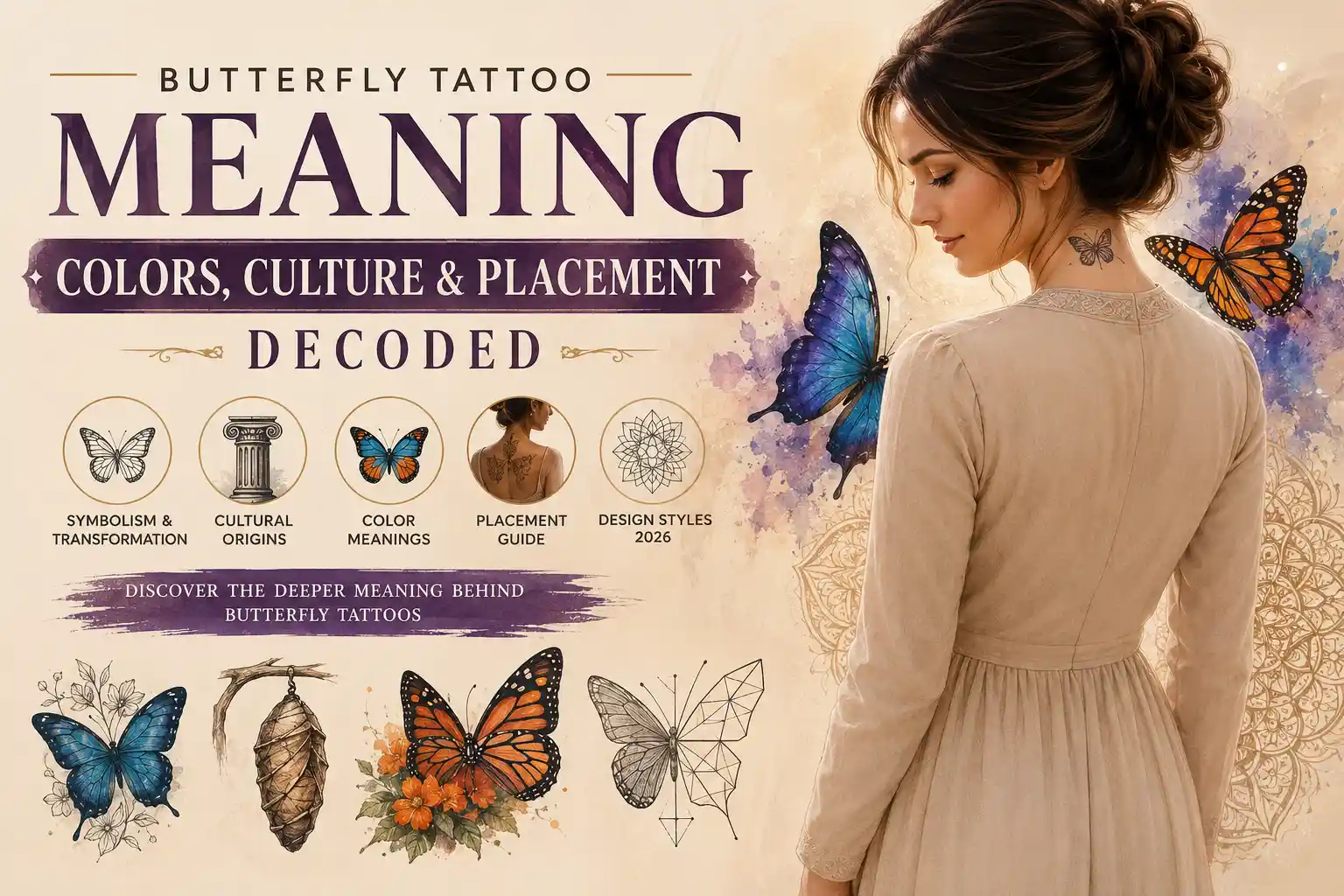
The ancient Greeks used a single word psyche for both “butterfly” and “soul,” embedding inside one language the radical idea that transformation and spiritual identity are, at their root, the same phenomenon.
Most people searching meaning for butterfly tattoo already know what they feel. They are not looking for a dictionary entry they are searching for a cultural mirror that confirms the depth of an experience they cannot yet fully articulate. What follows is not a list of adjectives. It is a complete architecture: the biological metaphor, five distinct cultural origin traditions, a full color-encoding system, a placement psychology guide, and the design vocabulary that in 2026 lets you communicate your intention to a tattoo artist with absolute precision.
The Chrysalis Principle: What a Butterfly Tattoo Really Means at Its Core
A butterfly tattoo, at its most foundational level, is a permanent declaration of personal metamorphosis the transformation from a constrained, earlier self into a freer, reconstructed identity. The symbol carries this weight because it is not metaphor borrowed from mythology alone. It is grounded in observable biological fact: a creature undergoes a literal cellular deconstruction inside the chrysalis and emerges as a structurally different organism.
From Larva to Wing: The Biological Reality That Makes the Butterfly a Universal Symbol
The metamorphosis process holometabolism is one of biology’s most radical events. Inside the chrysalis, larval tissue dissolves almost entirely. What reassembles is a completely new anatomical form, built from imaginal discs present since larval stage but dormant until the transformation begins.
This is precisely why the symbol resonates for people who have survived:
- The end of a long-term relationship
- A cancer diagnosis and treatment cycle
- Eating disorder recovery
- A career collapse followed by reinvention
- Grief after the death of a loved one
The experience of “dissolving” before reconstitution is not poetic exaggeration it is a biologically accurate description of how profound personal change actually works.
Transformation, Freedom, and Psychological Rebirth: The Three Symbolic Layers
The butterfly’s symbolism operates on three distinct, stackable layers that reinforce each other:
- Metamorphosis the passage from one identity state to a more evolved one
- Freedom the shift from the ground-bound, constrained larval form to flight-capable autonomy
- Psychological rebirth the explicit acknowledgment that a previous self was relinquished, not merely modified
These three layers mean that a butterfly tattoo functions simultaneously as biography, aspiration, and grief acknowledgment. It documents a before and an after. That is its fundamental authority as a symbolic choice it holds contradiction without resolving it.
How Ancient Civilizations Encoded the Butterfly: A Cross-Cultural Origin Timeline
Butterfly symbolism does not originate in Western tattoo culture. It predates tattooing by millennia and carries distinct, non-overlapping meanings across five major civilizations that inform how contemporary tattoos are read and chosen. Understanding the meaning for butterfly tattoo through these historical traditions reveals why the symbol continues to resonate across cultures and generations.
The Greek Soul Connection: Psyche, Eros, and the Etymology of the Spirit
The Greek myth of Psyche establishes the oldest and most structurally complete butterfly-as-soul framework in Western tradition. Psyche whose name literally translates as both “butterfly” and “soul” undergoes a series of divine trials imposed by Eros’s mother, Aphrodite, before achieving immortality and union with Eros. Her iconographic representation in Hellenistic art consistently depicts butterfly wings emerging from her shoulders. This is not decorative flourish. It is a precise theological statement: the soul’s capacity for transformation is what grants it divinity.
The etymological link persists in modern usage. The word “psyche” in contemporary psychology referring to the totality of the conscious and unconscious mind carries this ancient encoding. When someone places a butterfly tattoo on their body, they are, with or without knowing it, invoking a tradition that is at minimum 2,500 years old.
Kachō-fūgetsu and Zhuangzi’s Dream: Eastern Philosophical Frameworks
Two Eastern intellectual traditions independently arrived at the butterfly as a symbol of identity fluidity and impermanence.
Japanese: The aesthetic philosophy of Kachō-fūgetsu (“flower, bird, wind, moon”) codes the butterfly as an embodiment of mono no aware the bittersweet awareness of transience. In Heian-period Japanese poetry (794–1185 CE), butterfly imagery specifically signifies feminine beauty and the grace of change accepted rather than resisted. This tradition directly informs why butterfly tattoos in Japanese fine-art tattooing (irezumi) are frequently placed on women as symbols of elegant transformation rather than violent rupture.
Taoist: The philosopher Zhuangzi (c. 369–286 BCE) wrote the first known philosophical text using the butterfly as a metaphor for identity fluidity. In his butterfly dream parable, he describes being unable to determine whether he was a man dreaming of being a butterfly or a butterfly dreaming of being a man. The explicit conclusion is that identity is not fixed it is a temporary arrangement between states of being. This is the intellectual origin of every “I don’t know who I am anymore, but I’m becoming someone” tattoo ever placed.
Monarch, Messenger, and Mourning: Native American, Aztec, and Victorian Traditions
| Tradition | Butterfly Species/Type | Symbolic Meaning | Contemporary Tattoo Application |
| Nahua/Aztec | Monarch (Danaus plexippus) | Souls of deceased warriors and ancestors returning | Spiritual connection to ancestry; grief honoring |
| Día de los Muertos (Mexican) | Monarch migration to Michoacán | Beloved dead visiting the living in late October–November | Memorial tattoos; Monarch-as-loved-one symbolism |
| Native American (various nations) | General butterfly | Spiritual messenger between worlds; carrier of prayers | Spiritual intermediary; prayer and protection |
| Victorian (1837–1901) | Black-winged specimens | Death acknowledgment; mourning iconography | Black butterfly grief tattoos |
The Aztec tradition is particularly precise: the Monarch butterfly’s annual 3,000-mile migration to the oyamel forests of Michoacán, Mexico, coincides exactly with Día de los Muertos (late October/early November). Nahua belief held that this was not coincidence but confirmation the Monarch carried the souls of deceased warriors returning to visit the living. This is why a Monarch tattoo as a memorial piece has deep pre-Columbian cultural grounding, not merely aesthetic appeal.
The Color Code: How Meaning for Butterfly Tattoo Changes Completely by Hue
Meaning of butterfly tattoo shifts fundamentally based on color. A blue butterfly encodes serenity, rare beauty, and sudden positive alignment traceable to Eastern European folklore. A black butterfly carries memento mori symbolism rooted in Victorian mourning culture and represents deliberate grief acknowledgment or spiritual threshold-crossing. Color is a second, independent symbolic layer that modifies the base transformation meaning.
Blue Butterfly Tattoo: Serenity, Rare Beauty, and Sudden Positive Alignment
The blue butterfly’s luck associations derive from its natural rarity. Genuinely blue Lepidoptera including the Morpho menelaus of South America and the Papilio ulysses of the Pacific are among the most visually striking insects in nature, their iridescence produced not by pigment but by the nanostructure of their wing scales.
In Eastern European and Slavic folk traditions, seeing a blue butterfly was treated as an omen of sudden positive change a shift in fortune that arrives without warning. This maps onto contemporary usage: a blue butterfly tattoo communicates:
- Serenity after extended turbulence
- The arrival of unexpected good fortune
- Rare beauty claimed and acknowledged
- An alignment with something larger than personal will
Black Butterfly Tattoo: Memento Mori and the Courage of Grief Acknowledgment
The black butterfly is the most misunderstood tattoo color in any search result online, because most content avoids its death associations to prevent “negative” ranking signals. This guide addresses it directly.
In Victorian mourning culture (1837–1901), black butterfly brooches and lockets were worn during periods of formal bereavement. The symbolism was deliberate: the butterfly’s transformation capacity, applied to a blackened, death-marked form, communicated that grief was not the end of the self it was a chrysalis state. Darkness was acknowledged, not escaped.
A black butterfly tattoo in 2026 most commonly encodes:
- Memento mori (“remember that you will die”) a conscious acknowledgment of mortality as a life-organizing truth
- Processing the loss of a loved one in a way that honors rather than aestheticizes the grief
- Spiritual transition acknowledging that the self who existed before a specific event is gone, and that this departure is real
This is not a “dark” tattoo in the casual sense. It is one of the most emotionally honest symbols available.
Monarch, White, and Yellow: The Symbolic Range of Additional Butterfly Colors
| Color | Core Symbolism | Common Context |
| Monarch (orange/black) | Ancestral connection; resilience across distance; spiritual messenger | Memorial tattoos; heritage; endurance |
| White butterfly | Purity, new beginnings, spiritual presence of the recently deceased | Post-loss tattoos; spiritual protection |
| Yellow butterfly | Joy, creativity, lightness of being, childlike wonder reclaimed | Recovery from depression; emerging optimism |
| Red butterfly | Passion, life force, transformation through intensity | Post-breakup identity reconstruction |
| Purple butterfly | Spiritual depth, intuition, connection to the subconscious | Healing from complex trauma |
The Body as Canvas: How Placement Unlocks the Hidden Psychology of Meaning for Butterfly Tattoo
Placement is a second-layer encoding system operating independently from both design and color. Where on the body a butterfly is positioned communicates a specific psychological intent the degree of visibility functions as a statement about how public or private the transformation being honored actually is. The meaning for butterfly tattoo is often shaped by where it is placed, with visibility and personal significance influencing how the transformation is expressed.
Wrist and Forearm: Daily Resilience Anchors
A butterfly tattoo on the wrist or inner forearm serves a functional psychological purpose: it is a daily-visible reminder, positioned within the natural sightline during ordinary tasks. This placement is disproportionately chosen by people recovering from anxiety, self-harm, or eating disorders.
The wrist’s psychological significance in this context is not incidental it is the site where self-harm most commonly occurs, and reclaiming that skin with transformation imagery is a deliberate act of identity reconstruction. Research in body modification psychology identifies this type of placement as site-specific reclamation using the exact location of former pain as the canvas for new meaning.
Collarbone, Shoulder, and Chest: Grace, Openness, and Visible Vulnerability
The collarbone and chest placements signal a willingness to be seen in one’s transformation. These are zones of natural emotional exposure the chest is the site of the heart, the collarbone the architectural threshold between the face and the body. Placing a butterfly here communicates:
- Grace in change the transformation is worn openly, not concealed
- An invitation for the viewer to acknowledge the journey
- Alignment with Kachō-fūgetsu values of accepted transience
Behind the Ear, Neck, and Ankle: Private Transformation Keepers
| Placement | Visibility | Psychological Intent |
| Behind the ear | Low (hair-dependent) | Private, secret transformation; known only to the self |
| Nape of neck | Medium | Boundary marker; seen by those permitted behind you |
| Inner ankle | Low | Grounded transformation; linked to the journey literally walked |
| Ribcage | Very low | Most intimate placement; transformation held close to breath and heartbeat |
| Hip | Low-medium | Sensual identity claim; transformation connected to embodiment |
Design Language in 2026: How Style Architecture Modifies What a Butterfly Tattoo Communicates
Fine-line micro-realism, geometric vector fusion, and single-continuous-line are not merely aesthetic trends. Each represents a distinct philosophical position about how transformation is experienced, communicated, and held on the body.
Fine-Line Micro-Realism: Anatomical Precision as Authentic Vulnerability
Fine-line micro-realism produces butterfly tattoos that use micro-shading and negative spacing to mimic the precise anatomical structure of actual wing venation the branching network of veins that gives butterfly wings their structural integrity.
The symbolic implication of this technique is significant: choosing photorealistic detail communicates that the transformation being honored is specific and real, not generic or aspirational. It refuses comfortable vagueness. The fine-line aesthetic is dominant in 2026 precisely because it aligns with a broader cultural shift toward radical honesty in self-expression.
Geometric Fusion: Structured Growth and Harmonic Order
Geometric butterfly tattoos split the design architecture between the organic wing form and precise mathematical vectors crisp triangles, tessellated patterns, botanical line-work. One wing follows natural butterfly anatomy; the other follows geometric abstraction.
The symbolic reading of this fusion is the tension between chaos and order, natural emergence and structural intention. For someone who has rebuilt their life according to deliberate principles after a period of dissolution, the geometric butterfly encodes that the reconstruction was not accidental it was designed.
Single Continuous Line and Watercolor Wash
The single-stroke contour technique in which the entire butterfly outline is rendered as one unbroken, occasionally wandering line communicates the uninterrupted continuity of a life journey, even through disruption. The line may waver or thin, but it does not stop.
Watercolor wash technique, by contrast, uses soft color bleed and intentional imprecision to communicate that transformation does not have clean edges it bleeds into adjacent territories, leaves traces, and cannot be fully contained.
Conclusion
The butterfly tattoo is not a trend that arrived in the 2020s. It is a living archive that has been accruing cultural meaning for more than 2,500 years across at least five independent civilizations each of which arrived independently at the same core conclusion: that this insect’s life cycle is the most accurate visible metaphor for the experience of surviving profound change.
When you understand the full architecture the biological precision of holometabolism, the Greek soul-etymology, the Aztec Monarch migration, the Victorian grief encoding, the Japanese mono no aware tradition the meaning for butterfly tattoo you carry becomes something richer than self-expression. It becomes cultural inheritance.
Every butterfly tattoo documents a chrysalis that was survived. Every meaning for butterfly tattoo is, at its core, evidence of transformation that was real enough to be made permanent.
