


Imagine your friend texting you that someone was “so out of pocket.” The next hour, you open a medical bill listing an “out-of-pocket maximum,” only to later receive an email from your manager stating she will be “out of pocket” this Thursday. Same phrase, three completely different meanings and zero overlap between them. Same phrase, three completely different meanings and zero overlap between them. Understanding the exact out of pocket meaning depends entirely on the context and who you are talking to.
This guide breaks down all three with real examples, cultural backstory, and the 2026 insurance numbers you actually need.
TL;DR Quick Summary
| Context | Meaning | Who Uses It |
| Slang | Rude, inappropriate, or going too far | Gen Z, millennials, social media |
| Finance / Insurance | Paying from your own personal funds | Medical billing, business, legal |
| Corporate / Workplace | Temporarily unavailable or unreachable | Older millennials, Gen X, office email |
Decoding the Out of Pocket Meaning: Three Contexts Explained
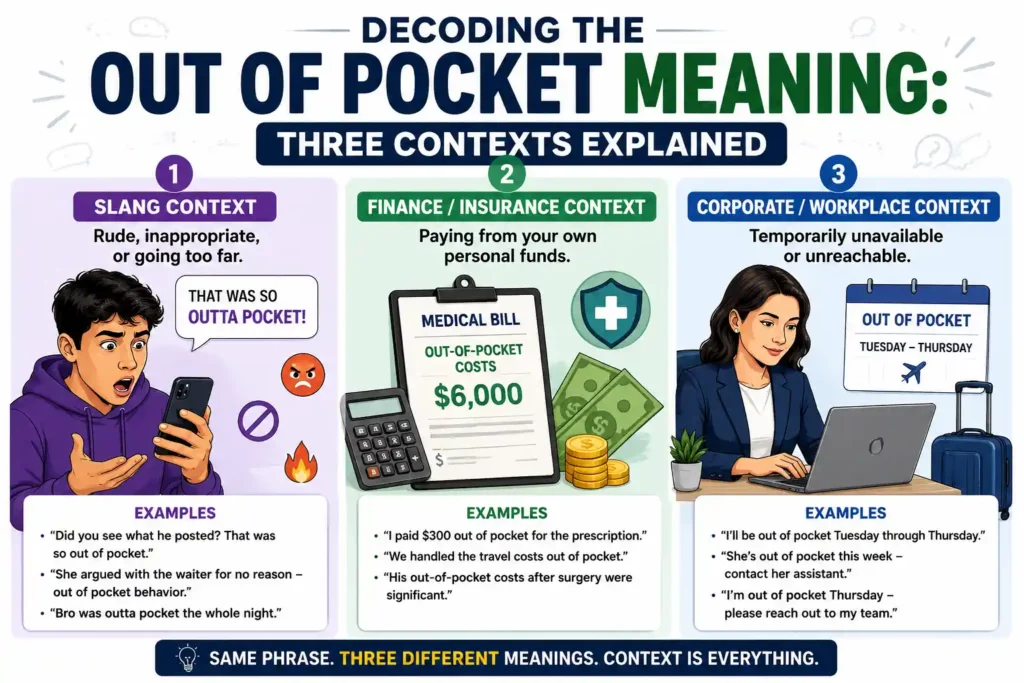
“Out of pocket” is genuinely one of the most context-dependent phrases in American English and the context shifts completely depending on who’s speaking.
Here’s the fast version: in slang, it means inappropriate. In finance, it means paying from your own funds. In the office, it means unreachable. The words alone tell you nothing. You need the setting to unlock the true out of pocket meaning behind the conversation.
1. The Slang Meaning: Rude, Wild, or Inappropriate
When someone says “that comment was out of pocket,” they mean it crossed a line inappropriate, offensive, or just flat-out wrong.
This is the dominant out of pocket meaning for anyone under 35. If your friend texts “bro, he was so out of pocket for that,” money is not involved. Someone said or did something they had no business saying or doing. Think of it as a sharper version of “uncalled for” or “out of line” with an implication that the person knew they were crossing it.
Real examples:
- “Did you see what he posted? That was so out of pocket.” → It went too far.
- “She argued with the waiter for no reason out of pocket behavior.” → Wild and unnecessary.
- “Bro was outta pocket the whole night, I had to leave.” → Acting unacceptable all evening.
- “That’s outta pocket, no cap.” → Genuinely inappropriate; no exaggeration.
2. The Financial Meaning: Paying From Your Own Funds
In finance, insurance, and business, the traditional out of pocket meaning means you’re covering an expense personally not being reimbursed, and not being covered by insurance.
This is the original meaning, and it still owns professional, medical, and legal contexts.
Real examples:
- “I paid $300 out of pocket for the prescription.” → Insurance didn’t cover it.
- “We handled the travel costs out of pocket.” → No company reimbursement.
- “His out-of-pocket costs after surgery were significant.” → What he personally owed after insurance paid its share.
3. The Corporate Meaning: Unavailable or Unreachable
In workplace communication especially from managers or older colleagues the professional out of pocket meaning translates to being temporarily offline, traveling, or not responding.
- “I’ll be out of pocket Tuesday through Thursday.” → Traveling; don’t expect quick replies.
- “She’s out of pocket this week contact her assistant.” → Not reachable right now.
This is largely a millennial and Gen X workplace phrase. Younger colleagues rarely use it this way, which is exactly why it causes generational confusion in office emails. A Gen Z employee reading “I’ll be out of pocket Thursday” might genuinely wonder what their manager did wrong.
Outta Pocket vs. Out of Pocket vs. Out-of-Pocket: The Spelling Clue
Spelling is actually a useful signal to identify which out of pocket meaning is being used:
- “Outta pocket” almost always the slang meaning. You’ll see this in tweets, TikTok comments, and group chats.
- “Out of pocket” could be any of the three; context is required.
- “Out-of-pocket” (hyphenated) nearly always financial or insurance. The hyphen is a formal writing convention used in insurance policies, legal documents, and medical billing.
Out of Pocket Meaning in Insurance: Deductibles, Maximums & Your Bill
In health insurance, “out of pocket” refers to what you personally pay for covered services the portion not paid by your insurer. This includes your deductible, copays, and coinsurance.
What Does “Out-of-Pocket Maximum” Actually Mean?
Say your plan has a $6,000 out-of-pocket maximum. Here’s how it plays out across a plan year:
- You pay first. You cover costs up to your deductible before insurance contributes anything.
- You split costs. After the deductible, you and your insurer share costs through coinsurance or copays.
- You hit the ceiling. Once your total personal payments reach $6,000 for the year, your insurance covers 100% of remaining covered expenses.
That $6,000 is not a monthly cost or a per-visit fee. It’s your annual ceiling.
2026 ACA Out-of-Pocket Maximum Limits
Under the Affordable Care Act (ACA), out-of-pocket maximums are federally capped and updated each year. For 2026, the official limits are:
- Individual plan: $10,050
- Family plan: $20,100
These figures apply to ACA-compliant marketplace plans. Grandfathered plans and some employer plans may have different rules.
Out-of-Pocket Maximum vs. Deductible: The Key Difference
These two trip up almost everyone. Here’s how they can be differentiated under the standard financial out of pocket meaning:
| Term | What It Is | Example |
| Deductible | Amount you pay before insurance helps at all | First $1,500 of covered costs each year |
| Copay | Fixed fee per visit or prescription | $30 per doctor’s visit |
| Coinsurance | Percentage split after deductible is met | You pay 20%, insurer pays 80% |
| Out-of-Pocket Maximum | Your annual ceiling for personal payments | After $6,000 total, insurance covers everything |
The key relationship: your deductible is part of reaching your out-of-pocket maximum, not a separate thing. Every dollar you pay toward your deductible counts toward that ceiling.
Where Did “Out of Pocket” Come From?
The phrase has been running on two separate tracks for over a century, with a third meaning arriving from a completely different direction in the early 2000s.
The Financial Root (1800s–Present)
The financial meaning is the oldest. “Out-of-pocket expenses” appears in British and American legal and accounting texts from at least the mid-1800s, simply meaning costs paid from one’s personal funds rather than claimed from an employer or fund. By the time the ACA passed in 2010, “out-of-pocket maximum” was already standard U.S. health policy language.
How Hip-Hop and AAVE Gave It a New Meaning
The slang meaning rude, inappropriate, going too far originated in African American Vernacular English (AAVE) and spread through hip-hop culture in the late 1990s and early 2000s.
In AAVE, “out of pocket” described someone who had stepped outside acceptable social limits. The phrase carried real weight: not just wrong, but outside the boundary of what’s allowed. Hip-hop artists and Black social media communities used it widely through the 2000s. By the early 2010s accelerated by Twitter, Vine, and eventually TikTok it entered mainstream American slang across all demographics.
This is a well-documented pattern: AAVE expressions enter the broader American lexicon through music, entertainment, and social media, often without the original cultural context being credited. “No cap,” “salty,” “lowkey,” and “bet” traveled the same route.
Does “Out of Pocket” Mean Rude?
In slang, yes. If someone says “that was out of pocket,” they mean the behavior or comment crossed a clear social line.
This only applies in slang contexts. In financial or corporate settings, the phrase has nothing to do with rudeness if someone says “this expense was out of pocket,” they’re definitely talking about money, not manners.
Gen Z vs. Millennial Usage: Who Means What
Gen Z uses “out of pocket” almost exclusively for the slang meaning calling out inappropriate behavior without being overly formal about it. It’s more pointed than “that was rude”; it implies the person knew exactly where the line was.
Millennials sit in the middle. They understand the slang meaning and grew up using the corporate “unavailable” meaning in workplace emails. That dual fluency is exactly why millennials are the most likely generation to hear the phrase and second-guess which out of pocket meaning is intended.
Gen X and older tend toward the financial and corporate uses. The slang meaning may register as familiar from context, but it’s rarely how they’d use it themselves.
Quick Reference: “Out of Pocket” in a Sentence
Slang (inappropriate behavior):
- “The way he addressed her in that meeting? Completely out of pocket.”
- “She was outta pocket the whole trip.”
Financial (personal payment):
- “After hitting the out-of-pocket maximum, all remaining costs were covered.”
- “Out-of-pocket expenses for the conference totaled $1,200.”
Corporate (unavailable):
- “I’ll be out of pocket Monday reach my assistant for urgent matters.”
- “If you need a decision before Friday, note that I’m out of pocket Thursday.”
What You Now Know
Three meanings. Completely unrelated to each other. Context is the only way to tell them apart and now you have three reliable signals: who’s speaking, what the setting is, and how it’s spelled.
“Outta pocket” in a group chat and “out-of-pocket maximum” on a medical bill are using the same four words to say two entirely different things. Unlocking the true out of pocket meaning depends entirely on these subtle cues. The financial meaning traces back centuries. The slang carries real cultural history from AAVE and hip-hop. The corporate version lives on in office emails, quietly baffling anyone who learned the phrase from TikTok.
